
Amanat Acquisition Corp. Commences SPAC Journey with $75 Million IPO Capital
Newly public special purpose acquisition company holds IPO proceeds in trust, preparing for a business combination.
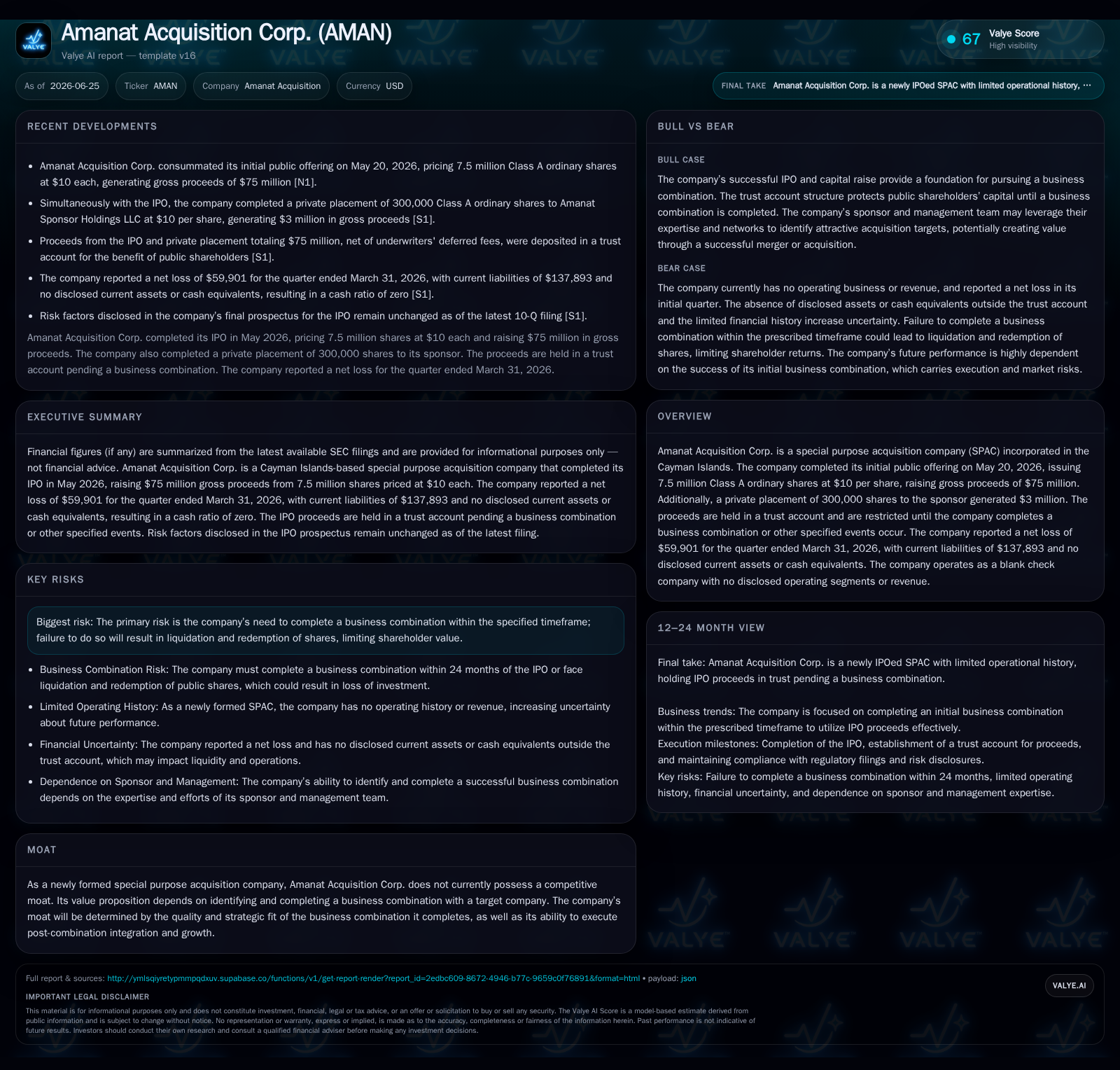
Amanat Acquisition Corp., a Cayman Islands-incorporated SPAC, completed its initial public offering on May 20, 2026, raising gross proceeds of $75 million plus a $3 million private placement from its sponsor. The capital raised is held in a U.S.-based trust account pending the completion of a business combination or liquidation event within a two-year timeframe. The company reported no revenue and a net loss of approximately $60,000 in its first quarter ending March 31, 2026, reflecting typical pre-combination operating expenses. Amanat’s primary value driver is identifying and consummating an attractive acquisition target, with the operational and financial outlook hinging on successful deal execution within mandated deadlines.
Recent Operating Update
Amanat Acquisition Corp. entered the public markets via an initial public offering (IPO) on May 20, 2026, issuing 7.5 million Class A ordinary shares at $10 per share and generating gross proceeds of $75 million [S3][N1]. Concurrently, the sponsor subscribed to a private placement of 300,000 shares for $3 million. These combined proceeds were deposited into a U.S.-based trust account administered by Continental Stock Transfer & Trust Company exclusively for public shareholders’ benefit [S3][S12]. The funds are restricted and will only be released upon completion of an approved business combination or liquidation.
For the quarter ended March 31, 2026—prior to the IPO—the company reported a net loss of approximately $59,901 reflecting typical administrative expenses associated with SPAC formation and pre-acquisition activity [F1][S2]. The balance sheet showed current liabilities near $137,893 and total debt around $102,033 at that date [F1], representing startup obligations before receipt of IPO proceeds.
Business Model: Facilitating De-SPAC Transactions
As a blank check company structured as a SPAC, Amanat’s core business model revolves around raising capital through an IPO to acquire or merge with a private operating company. Revenue generation is dormant until this "de-SPAC" transaction occurs, after which the combined entity operates as a public company.
Investors provide capital upfront by purchasing shares—effectively betting on the sponsor's ability to identify and close an attractive acquisition within the limited timeframe (typically up to two years). These funds are held securely in trust accounts to protect investors' capital until deployment. Sponsors also contribute via private placements and bear underwriting fees that reduce net proceeds but support deal sourcing and administrative costs.
The economics depend heavily on successful deal execution: sponsors typically receive promote shares post-merger as incentives while investors face dilution risks from warrants issued alongside common shares during the IPO.
Industry Context and Competitive Landscape
SPACs like Amanat operate as financial intermediaries bridging private companies seeking liquidity with public markets. Competition centers not on products but on sponsor reputation, deal pipeline quality, and execution capabilities. Amanat competes within an ecosystem that includes established players such as Pershing Square Tontine Holdings (PSTH) and Churchill Capital Corp series, alongside traditional IPO underwriters offering alternate routes for private firms going public.
Success hinges on accessing attractive acquisition targets in competitive sectors while navigating regulatory environments that have increasingly scrutinized SPAC disclosures and governance practices.
Growth Drivers
The main growth catalyst is timely completion of a business combination within the regulatory deadline—usually no more than two years from the IPO date—to avoid mandatory liquidation and return of funds to shareholders without premium [S11]. Achieving this milestone transitions Amanat from a shell entity into an operating public company with potential revenue streams.
Robust sponsor networks and deal pipelines are critical enablers. Broader market trends supporting SPAC growth include heightened private company demand for faster public listing alternatives, investor appetite for innovative equity vehicles, regulatory clarity reducing uncertainty, and PIPE financing mechanisms supplementing deal capital.
Sector valuation trends may also influence target selection dynamics; however, Amanat has not disclosed specific industry focuses at this stage.
Risks and Watchpoints
Failure to consummate an acquisition within mandated timeframes triggers liquidation risk—returning IPO trust funds minus expenses—and extinguishes upside potential for both sponsors and public investors [S11]. Redemption rights embedded in common shares introduce variability in available capital post-deal since large redemptions can impair transaction viability.
Dilution risk arises from warrants issued concurrently with common shares at IPO. Regulatory scrutiny remains elevated following SEC efforts to increase transparency regarding conflicts of interest and valuation methodologies.
Post-merger integration challenges will ultimately affect performance once operations commence under new ownership; these risks loom despite Amanat currently lacking revenues or segments.
Sponsor alignment with shareholder interests is crucial given timing pressures that may impact deal quality versus speed trade-offs.
What to Monitor Next
- Announcements or filings related to definitive agreements for business combinations will signal progress toward de-SPAC milestones.
- Public shareholder redemption rates upon proxy solicitation will reveal investor sentiment toward proposed deals.
- Underwriters’ over-allotment option exercises could modestly alter share float and reflect market confidence.
- PIPE financing commitments accompanying future acquisitions will indicate institutional support beyond retail participation.
- Regulatory developments affecting SPAC operations or amendments to Amanat’s charter might influence strategic flexibility.
- Post-combination financial disclosures will provide insight into emerging operational profitability trends.
Financial Profile Discussion
Reflecting typical early-phase SPAC characteristics, Amanat reported no revenues with nominal net losses—approximately $59,901—for the quarter ended March 31, 2026 attributable to formation costs prior to its May IPO [F1][S2]. Current liabilities stood at roughly $138,000 with total debt near $102,000 as of that date [F1], representing startup obligations rather than substantive leverage.
Following the IPO and private placement closing on May 20, 2026, approximately $78 million was secured in restricted trust accounts dedicated to funding future acquisitions or returning capital if liquidation occurs [S3][N1]. This structure safeguards investor funds but limits discretionary liquidity before completing a business combination.
Underwriting fees—including deferred fees totaling about $2.25 million—are consistent with market norms for SPAC offerings managed by recognized underwriters such as Leerink Partners LLC [S8]
Overall financial strength depends principally on successful deal execution within statutory deadlines; failure results in return of invested capital less expenses rather than ongoing operational cash flow sustainability.
This analysis incorporates data available through June 25, 2026 based solely on publicly disclosed filings without speculative assumptions about prospective acquisitions or post-merger performance.
Disclaimer: This is research-only, informational analysis and not investment advice. It may include AI-generated interpretation and general industry context. Always verify important details using primary sources.

Comments