
SUI Group Holdings' Strategic Digital Asset Management Faces Liquidity and Credit Challenges
Recent quarters highlight operational risks, credit exposures, and the evolving digital asset custody landscape shaping SUI Group's growth trajectory.
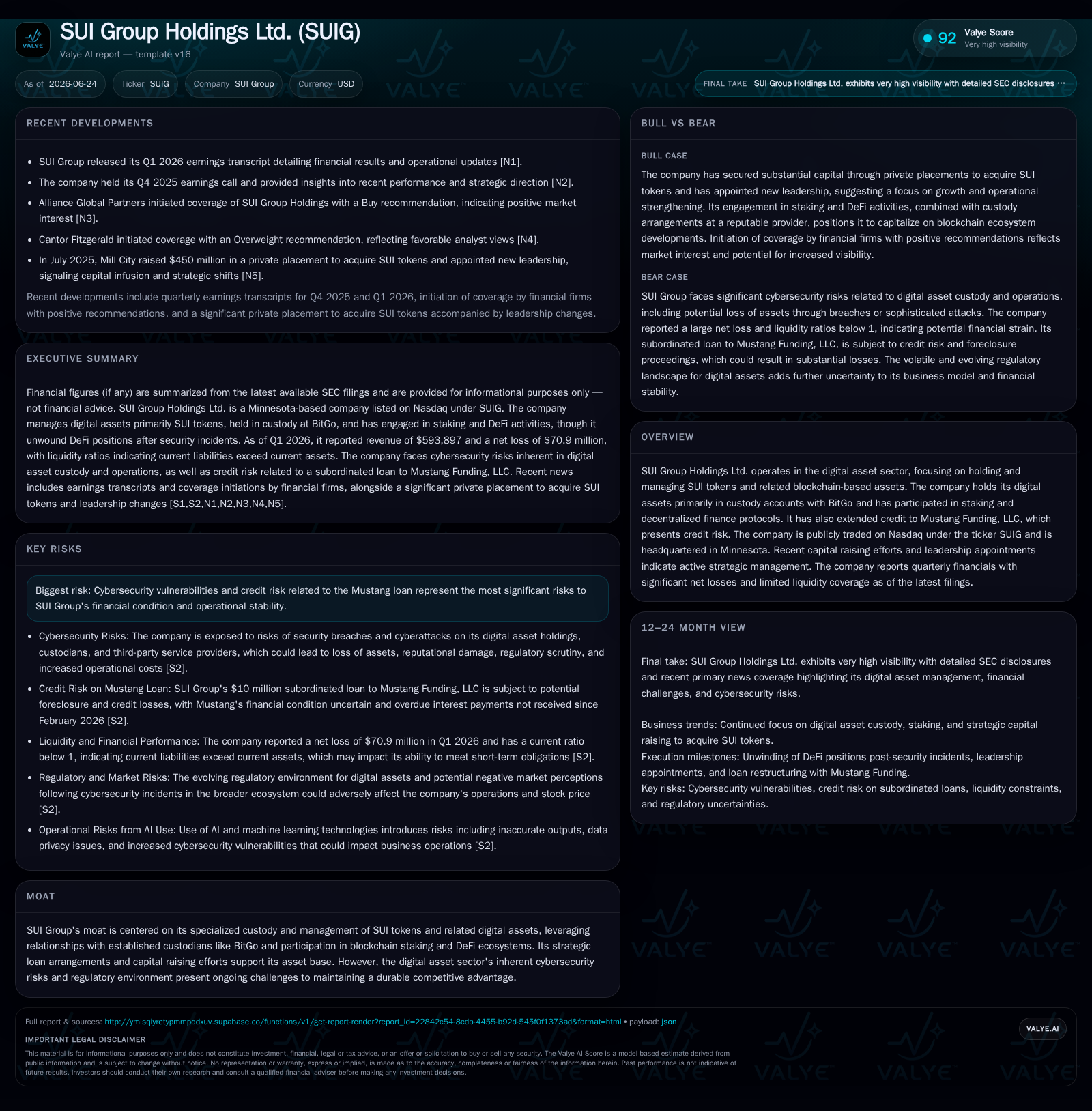
SUI Group Holdings Ltd. continues to focus on managing and leveraging its large treasury of SUI tokens through staking, decentralized finance protocols, and selective lending arrangements. Recently filed quarterly data shows persistent net losses compounded by liquidity constraints and credit risk concentrated in its Mustang Funding loan exposure. The company’s strategic partnerships, including a material loan to BlueFin Labs tied to a Suilend platform acquisition, signal active attempts at expanding asset utilization amid complex industry-wide cybersecurity risks and regulatory uncertainty. Custody relationships with BitGo underpin security efforts but cannot fully offset elevated operational risk typical in digital asset management. Key performance indicators such as digital assets under custody, staking returns, credit portfolio quality, and liquidity coverage remain critical focal points in assessing SUI Group’s capacity to transition from structural losses toward scalable growth.
Latest Operating Update: Elevated Risks Amid Strategic Asset Deployment
In its most recent quarterly filing dated May 8, 2026 [S2], SUI Group Holdings reported continued net operating losses reflecting ongoing challenges in scaling revenue streams relative to expense levels. The company reaffirmed that its substantial holdings of SUI tokens are custodied with BitGo, a recognized secure custodian employing cold storage and multi-signature authorization practices. However, the 10-Q underscored persistent cybersecurity risks inherent in digital asset custody — highlighting industry incidents illustrating vulnerabilities even in so-called cold wallets and off-chain DeFi infrastructures. The filing revealed that unauthorized exploits have recently occurred in liquid restaking and Solana-based protocols affecting millions in value through sophisticated off-chain attacks on verification mechanisms [S2]. This positions SUI Group within a broader ecosystem narrative where cybersecurity remains a paramount concern beyond just token custody.
The latest event filings also disclose an important financing arrangement with BlueFin Labs Inc., entered into June 19, 2026 [S17]. This amended loan agreement consolidates prior loans totaling 2 million SUI tokens with an additional commitment for 4 million more tokens. The purpose centers on financing BlueFin’s acquisition of assets from Concurrent C linked to the Suilend platform — a blockchain lending service tied strategically to the Company’s business model. Compensation terms include an 11% revenue share paid in SUI tokens until repayment or termination by September 30, 2028. This novel structure combines balance sheet leverage with operational synergy hopes but introduces execution risk contingent on BlueFin's revenue generation stability [S17].
Further contextualizing credit exposure risk is the ongoing relationship with Mustang Funding LLC via a $5 million loan maturing September 2023 (amended terms also referenced) [S29]. While initially unsecured, governance provisions allow SUI Group to pursue collateral upon default. A subordinated payment agreement places Mustang’s senior secured lenders ahead of SUI Group in creditor priority. As Mustang continues negotiating potential merger transactions, the company’s prospects depend significantly on Mustang’s success or the ability to enforce collateral rights effectively [S29]. Such exposure highlights counterparty credit risk as a critical watchpoint absent traditional secured lending protections.
Business Model: Digital Asset Treasury Management With Lending Overlay
SUI Group operates primarily as a holder and manager of blockchain-based digital assets focused on the native SUI token ecosystem. Revenue arises chiefly from staking rewards generated by locking tokens within proof-of-stake networks and lending interest earned from credit extended against its token holdings. Staking participation involves committing tokens into network consensus operations via DeFi protocols that yield periodic compensation proportional to staked volumes and network economics.
In addition to organic yield generation, revenue streams include leasing tokens through structured loans like those to BlueFin Labs or Mustang Funding. These arrangements attempt to monetize dormant digital treasury assets by generating interest-like payments denominated in secured cryptocurrencies rather than fiat. Such strategic deployments aim to improve capital efficiency but bring credit risk intrinsic to borrower solvency.
Custody functions are outsourced mainly to BitGo — an established player known for cold storage vaults guarded by multi-signature authentication methods designed to mitigate private key loss or theft risks. While this approach addresses one layer of cybersecurity concern, recent industry breaches demonstrate exposures stemming from off-chain protocols or human error in cross-chain message validation processes.
Operating expenses predominantly comprise security infrastructure upkeep; compliance-related costs loomed large given regulatory ambiguities; personnel expenses; and technology investments for token management platforms integral to maintaining real-time asset visibility and stakeholder reporting.
Industry Context: Digital Asset Custody Amid Evolving Cybersecurity Threats
The digital asset management sector bridges blockchain-native protocols with investor-grade security practices focused on safeguarding cryptographic assets while optimizing yield opportunities including staking and decentralized lending. Firms like Coinbase Custody and Anchorage Digital exemplify regulated custodial services with institutional focus — providing secure offline storage bolstered by insurance solutions that partly offset residual risks borne by asset holders.
Despite advances in technological safeguards such as multi-sig wallets and cold vault isolation, recent incidents underscore evolving attack vectors targeting ancillary infrastructure layers outside blockchain consensus codes—particularly governance frameworks controlling DeFi pools or cross-chain communication networks intersecting multiple blockchains [S2].
Financial institutions' growing traction towards crypto adoption fuels demand for reliable custody but also elevates scrutiny from regulators worried about anti-money laundering compliance and customer protection frameworks yet insufficiently standardized at present.
Primary KPIs shaping competitive positioning include total assets under custody (AUC), realized staking yields adjusted for protocol risk profiles, robustness of loan portfolios measured by delinquency or default rates, operational uptime reflecting continuous wallet availability, frequency/severity of cybersecurity incidents impacting client trust levels, liquidity coverage ratios indicating short-term cash sufficiency relative to liabilities, and net asset value fluctuations driven by volatile token price dynamics.
Growth Drivers: Institutional Demand Meets Expanding DeFi Engagement
Several structural tailwinds support long-term opportunity for enterprises managing native blockchain assets like SUI:
- Increasing institutional investor interest driving inflows into managed crypto treasuries.
- Expansion of novel decentralized finance applications enabling new forms of staking income beyond simple locked assets.
- Development of stablecoin infrastructures (e.g., suiUSDe launch) facilitating synthetic dollar liquidity critical for transaction volume growth [S20].
- Regulatory clarity potentially unlocking broader market participation while prompting standardized best practices beneficial for custodianship reliability.
- Strategic partnerships such as Karatage Opportunities’ involvement offering capital infusion alongside sector expertise guiding corporate governance [S3].
- Continuous innovation enhancing cross-chain interoperability which broadens scope for diversified yield strategies across multiple token ecosystems.
Realization of these drivers depends heavily on successful execution against cybersecurity defenses; diligent counterparty monitoring particularly over lending counterparties; platform resiliency; and ability to convert digital treasury assets efficiently into income-generating vehicles without exacerbating risk exposures.
Risks and Constraints: Credit Exposure and Cybersecurity Challenge Stability
Key vulnerabilities endangering business continuity include:
- The risk of cyberattacks compromising private keys or underlying custodial systems despite sophisticated controls given the high-value targets represented by sizable token holdings [S2].
- Concentrated credit risk linked notably to Mustang Funding LLC loan arrangements lacking initial collateralization but subject to subordination agreements complicating recovery if defaults materialize [S29].
- Dependence on third-party custodians like BitGo which centralizes custody operation risks despite enhanced security standards.
- Regulatory uncertainties around classification of digital assets, compliance mandates for lending activities involving crypto collateral or revenue-sharing structures.
- Market volatility causing sharp swings in net asset values reducing valuation buffers against operating losses observed historically [F1].
- Execution complexity involved in deploying synthetic stablecoin products such as suiUSDe requiring robust smart contract security audits plus adoption traction monitoring [S20].
- Potential dilution effects from frequent capital raising needed due to ongoing negative profitability metrics that weigh on investor confidence.
What To Watch Next
Key developments indicative of progress or distress will include:
- Quarterly updates on staking yields realized versus expectations; increases or decreases in total token count maintained or deployed across DeFi use cases [S2].
- Performance indicators from the BlueFin Labs loan agreement including revenue payments received denominated in SUI tokens until maturity in late 2028 [S17].
- Health and recovery status around the Mustang Funding loan default risk profile especially any exercising of collateral rights or renegotiation outcomes [S29].
- Changes in liquidity coverage reflecting ability to meet near-term obligations given current ratio historically below one suggesting caution [F1].
- Frequency reports around cybersecurity incidents affecting either custody providers or associated DeFi protocols impacting treasury assets.
- Adoption metrics for suiUSDe stablecoin deployment signaling ecosystem expansion opportunities beyond native token staking rewards [S20].
- Board composition shifts or new strategic advisor appointments augmenting governance capabilities supporting capital markets confidence [S3].
Financial Profile Discussion
As of March 31, 2026 quarter-end [F1], SUI Group reported current assets totaling approximately $10 million compared with current liabilities near $13 million yielding a below-par current ratio around 0.77—highlighting short-term liquidity tightness that constrains operating flexibility. Cash reserves stood modestly above $1.4 million as of June 2025 reporting dates indicating limited immediate cash runway absent capital infusions.
Capital raising activities supported by investors such as Karatage hedge fund stakeholders provide vital financial lifelines aiming at sustaining operations during this scaling/reinvestment phase though sustainability hinges ultimately on improving both operational performance metrics (staking yields/net new assets) alongside prudent credit risk controls governing lending arrangements.
This analysis is based solely on publicly available filings without pricing data or forecasts. The digital asset custody sector balances promising growth prospects linked closely with technological innovation against fundamental risks inherent in cyber threats, regulatory flux, credit exposure concentration, and volatile market environments affecting asset valuations.
Investors reviewing companies like SUI Group should prioritize monitoring key operational metrics alongside governance enhancements reflective of adaptive risk management capable of sustaining long-term viability amidst rapidly evolving blockchain landscapes.
Disclaimer: This is research-only, informational analysis and not investment advice. It may include AI-generated interpretation and general industry context. Always verify important details using primary sources.

Comments