
Air T’s Strategic Expansion Through Rex and Arena Acquisitions Tests Integration and Compliance Strengths
Air T Inc’s recent acquisitions broaden its aviation asset management and regional airline operations but introduce integration, regulatory, and financial complexities requiring careful execution.
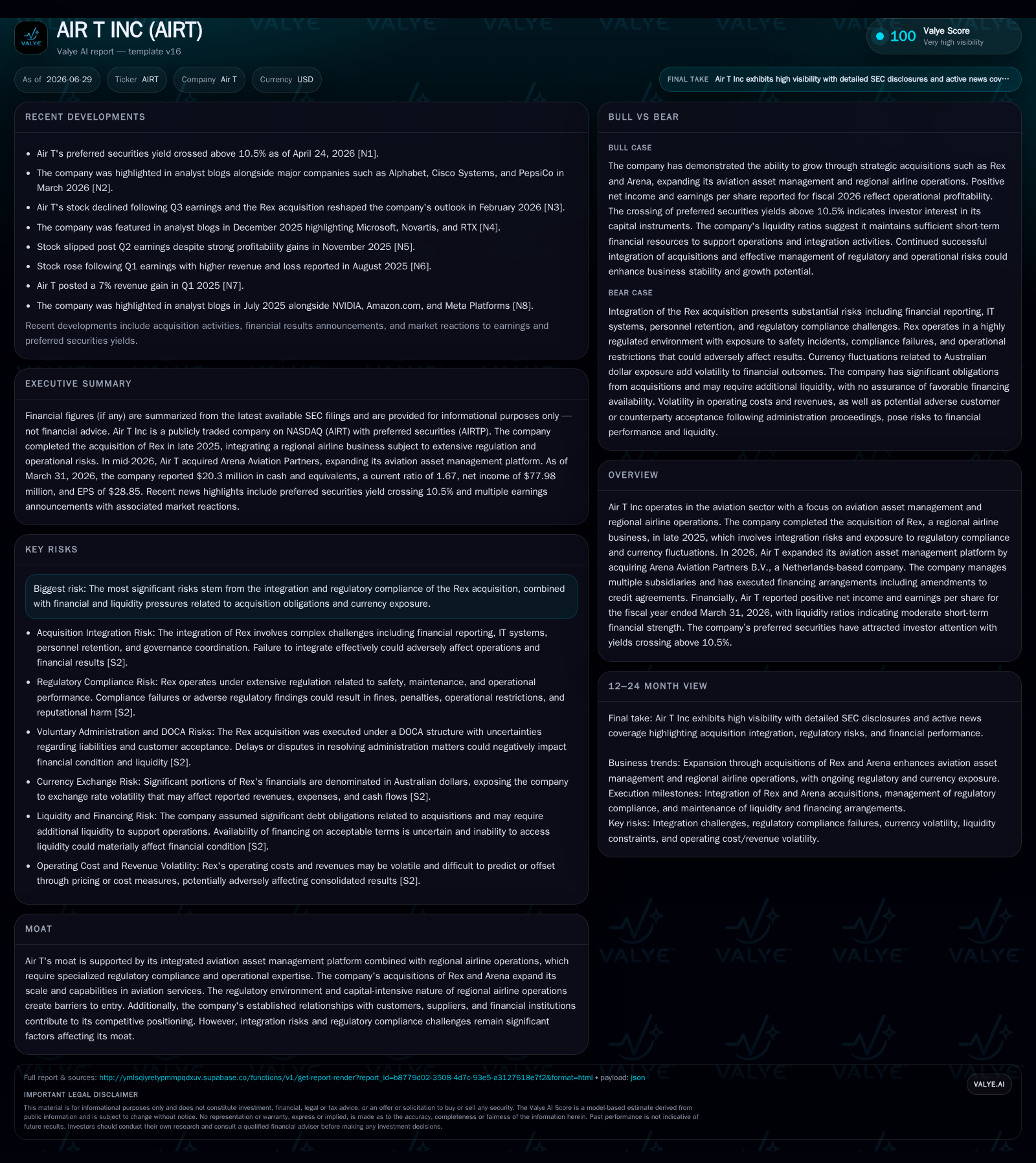
In its latest quarterly filing, Air T Inc highlighted ongoing integration challenges following its late 2025 acquisition of Rex, a regional airline, alongside progress in expanding its aviation asset management platform through the March 2026 acquisition of Arena Aviation Partners B.V. These strategic moves position Air T at the intersection of regional airline services and aircraft asset management but necessitate robust regulatory compliance and operational coordination. Financially, the company reported positive net income for fiscal 2026 despite operating losses, supported by moderate liquidity and significant debt. The issuance of preferred securities reflects capital market dynamics tied to the company’s acquisition-driven growth strategy and complex capital structure.
Recent Operating Update: Managing Integration Complexity Amid Expansion
Air T’s latest quarterly report dated February 13, 2026 [S2] underscores significant integration challenges following its acquisition of Rex during the quarter ended December 31, 2025. The company is focused on aligning financial reporting systems, harmonizing accounting policies, integrating IT infrastructure across multiple jurisdictions, retaining critical personnel amid transition uncertainty, and establishing cohesive governance and risk management frameworks. These efforts are resource-intensive and could temporarily suppress operational efficiency or cash flow if execution timelines extend or complexity increases.
Concurrently, in March 2026 Air T completed the acquisition of Arena Aviation Partners B.V., a European aviation asset management platform incorporated in the Netherlands [S4], [S22]. This transaction broadens Air T’s service offerings beyond direct airline operations into aircraft leasing and asset management with a strategic foothold in Europe. The purchase price exceeded $35 million plus contingent payments linked to servicing agreement collections post-closing. Successfully integrating Arena within Crestone Air Partners LLC—the platform vehicle—requires cross-border operational coordination and precise capital structuring evidenced by the issuance of preferred units supporting the acquisition financing.
Business Model: Dual Focus on Regional Airline Operations and Aviation Asset Management
Air T combines revenue streams from operating regional airline services—principally through subsidiaries such as Rex—with fees generated by an expanding aviation asset management platform including Crestone Air Partners LLC and now Arena Aviation [S1], [S22]. This hybrid model generates passenger ticket sales revenue while supplementing it with recurring income from aircraft leasing contracts, maintenance oversight fees, and other asset servicing agreements.
Regional airline operations depend heavily on key performance indicators like passenger load factor, available seat miles (ASM), operational efficiency metrics such as on-time performance, maintenance cost control, and yield management within a capital-intensive fleet environment. The asset management segment provides more stable fee-based revenues that help mitigate cyclicality typical in airline operations.
However, complexity rises due to stringent regulatory environments governing safety standards, crew training requirements, consumer protections, and operational licensing—particularly for Rex’s Australian routes [S2]. Additionally, managing currency exposure and legal compliance across European jurisdictions post-Arena acquisition adds layers of operational risk.
Industry Context & Competitive Positioning
In the aviation services sector intersecting regional airlines and aircraft asset management platforms, Air T occupies a distinctive niche requiring integrated operational expertise across disparate functions. Capital intensity coupled with rigorous regulatory oversight creates high barriers to entry but also heightens execution risk.
Peers such as SkyWest Airlines or Mesa Air Group focus primarily on regional flight operations without significant asset leasing portfolios; conversely, aircraft lessors like Air Lease Corporation concentrate solely on leasing without operating airlines directly. Air T’s combined approach demands effective synthesis of airline operational discipline with sophisticated asset management capabilities—a potential competitive advantage if integration succeeds.
Scale expansion via the Rex acquisition should increase available seat miles under control while adding complexity in crew management and regulatory compliance that must be tightly managed to avoid reputational damage or operational disruptions.
Growth Drivers
Growth catalysts include leveraging Rex’s network to enhance fleet utilization rates and drive revenue passenger mile growth post-integration [S2]. The Arena acquisition extends geographic reach into Europe with complementary fee-generating servicing contracts expected to mature over time [S4], [S22].
Operational improvement initiatives targeting on-time performance enhancements and reductions in operating cost per ASM can directly improve margins by optimizing fuel usage patterns and maintenance scheduling across both airline services and leased assets.
Capital raised through preferred securities issuance supports these growth initiatives while offering attractive yields (~10.5%+) that appeal to investors seeking higher returns commensurate with elevated risk profiles [S3].
Risks & Watchpoints
Primary risks involve successful post-acquisition integration—merging corporate cultures at Rex introduces potential employee turnover or governance challenges that could disrupt service continuity in a highly schedule-dependent industry [S2]. Regulatory compliance poses ongoing challenges given exposure to multiple jurisdictions’ safety audits; non-compliance could lead to fines or operational restrictions limiting revenue capacity.
Financial leverage has increased due to acquisition funding; this elevates sensitivity to interest rate fluctuations or liquidity stress during periods of uneven cash flows. Operating income declined into negative territory ($11.2 million loss) despite positive net income driven by non-operating gains related to purchase accounting or financing effects [F1], highlighting potential margin pressure ahead.
Currency volatility linked to Arena’s European domicile adds earnings variability when consolidating results into USD reporting.
Finally, lingering customer or counterparty concerns following Rex’s prior voluntary administration proceedings could affect contract renewals or credit terms—any protracted disputes may impair working capital stability [S2].
What to Watch Next
Investors should monitor:
- Progress toward harmonized financial reporting timelines integrating Rex under shared ERP systems;
- Outcomes of regulatory audits assessing Rex’s safety compliance across Australian routes;
- Revenue trends demonstrating monetization success from expanded assets including Arena platforms;
- Debt servicing relative to cash generation signaling leverage sustainability;
- Preferred securities trading spreads versus benchmarks reflecting investor sentiment;
- Potential announcements regarding further strategic transactions or capital raises refining ownership within Crestone Asset Management structures.
These indicators will reveal whether Air T can achieve durable synergies critical for maintaining competitiveness amid sector pressures.
Financial Profile Discussion
Overall liquidity appears adequate for near-term obligations but depends heavily on realizing synergy targets within Rex operations along with maturation of fee income streams from Arena-managed assets contributing toward stable free cash flow generation.
Disclaimer: This analysis relies exclusively on publicly available SEC filings through June 29, 2026 ([S1]-[S29]) and Companyfacts data as of March 31, 2026 ([F1]). It provides informed commentary without investment advice or price targets.
Disclaimer: This is research-only, informational analysis and not investment advice. It may include AI-generated interpretation and general industry context. Always verify important details using primary sources.

Comments