
Mexco Energy's Low-Cost, Non-Operated Growth Strategy Sustains Profitability Amid Market Volatility
Despite commodity price headwinds, Mexco Energy continues to expand reserves and cash flow through selective royalty and working interest acquisitions with strong cost control.
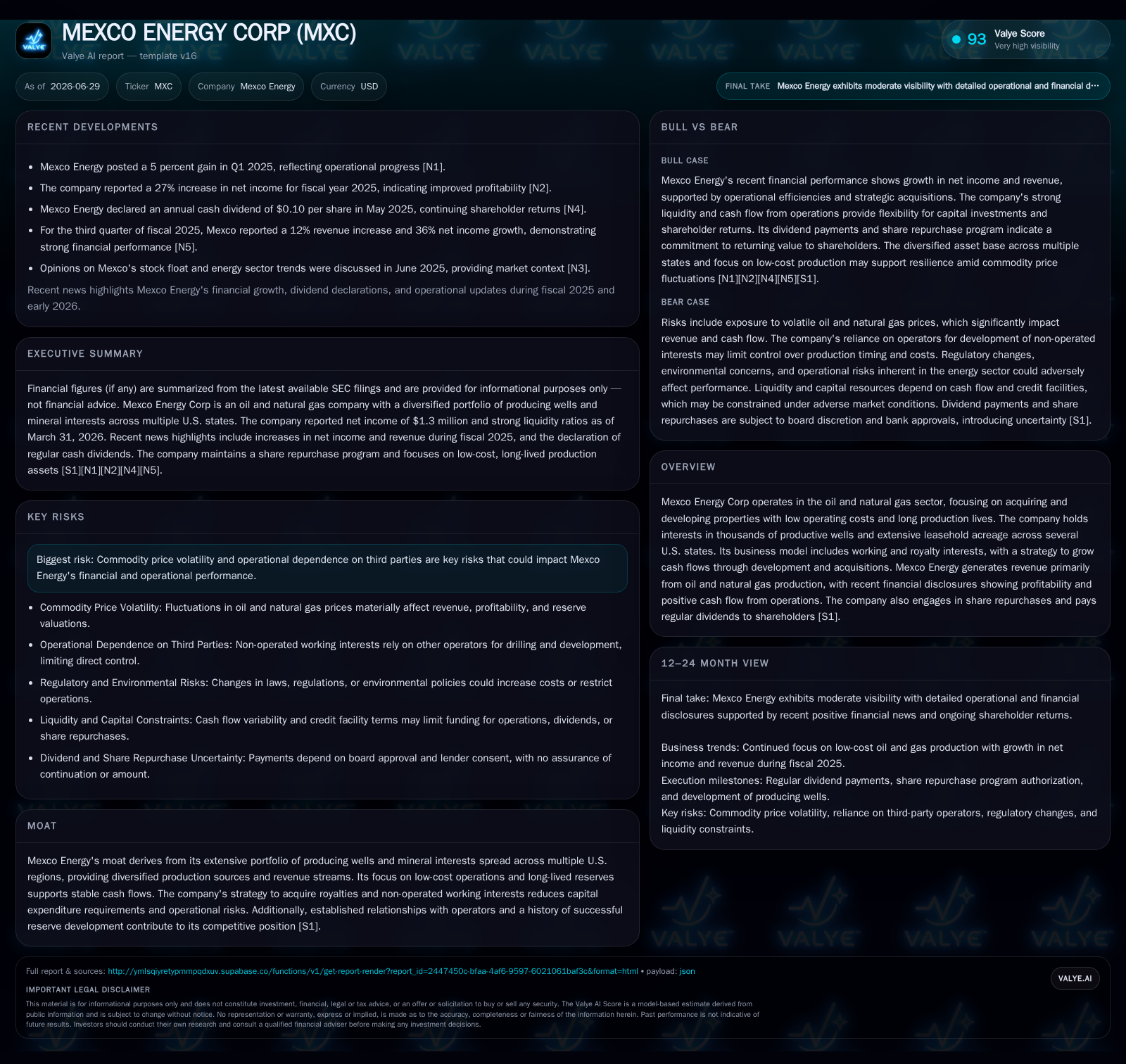
Mexco Energy Corp reported net income of $1.3 million for fiscal 2026, supported by disciplined capital allocation toward low-cost reserves and non-operated interests across multiple U.S. basins. The company added 247 MBOE of proved reserves via extensions and discoveries and acquired 39 MBOE during the year, maintaining a focus on assets with long production lives and low operating expenses. With a robust balance sheet characterized by a current ratio near 10x and no outstanding borrowings on its $1.5 million credit facility, Mexco sustains shareholder returns through dividends and share repurchases. Key risks remain commodity price volatility and dependence on third-party operators, while growth hinges on continued acquisition discipline, reserve replacement metrics, and natural gas price improvements.
Recent Operating Update
Mexco Energy Corp’s latest disclosure filing for fiscal year ended March 31, 2026 highlights sustained profitability of $1.3 million net income despite a challenging commodity price environment marked by oil price declines but offset partially by rising natural gas volumes and prices [S23]. Operating revenues fell 8% year-over-year to approximately $6.55 million as oil revenues declined sharply (-14%) driven by a 12.6% drop in average realized oil prices ($64.25 vs. $73.54 per barrel) alongside a modest volume decrease (82,133 barrels vs 83,564). Conversely, natural gas revenue increased nearly 31% supported by both higher production (+20%) and prices (+9.7%) [S23]. These dynamics underscore Mexco’s exposure to commodity price volatility but also reveal some diversification benefits between hydrocarbon types.
Operationally, the company added meaningful proved reserves totaling nearly 339 thousand barrels of oil equivalent (MBOE) considering extensions/discoveries (247 MBOE), acquisitions (39 MBOE), and upward revisions (53 MBOE), though this was partially offset by reductions in undeveloped reserves primarily due to shifting development schedules in key acreage like Lea County, New Mexico [S22]. The reserve growth largely reflects successful well performance updates and selective acquisition execution consistent with Mexco’s strategy to focus on assets with long productive lives and low operating costs.
The firm’s portfolio spans producing wells and significant leasehold acreage concentrated in West Texas (Permian Basin) and southeastern New Mexico with additional properties across fourteen states—all operated by third parties under a mix of royalty interests (which require minimal capital expenditure) and non-operated working interests that involve some capital participation but reduce operational risk exposure compared to operated assets [S1]. This structural positioning enables relatively stable cash flows through diversified production sources while limiting Mexco’s direct operational burden.
Business Model Analysis
Mexco operates exclusively in the upstream oil and gas sector—generating revenues principally via sales of crude oil and natural gas production attributable to its ownership interests in producing wells and mineral rights. Revenues are net of post-production costs when deducted by operators before distribution [S8]. Capital allocation centers heavily on acquiring royalty interests and non-operated working interests with low operating costs combined with development drilling aimed at converting proved undeveloped reserves into developed producing status—in fiscal year 2026 alone, capital expenditures enabled the development of 25 wells converting about 48 MBOE from proved undeveloped into producing categories at a modest aggregate capital cost (~$119k) indicating efficient deployment per incremental barrel [S22].
The business model’s moat is rooted in Mexco’s broad asset diversification across geographies limiting operator-concentration risk while emphasizing properties with long reserve lives to sustain cash flows over time [S21][S25]. By favoring royalty interest acquisitions—such as those completed in recent periods involving approximately 270 producing wells across Colorado, Louisiana, New Mexico, Texas among others—the company minimizes upfront capital needs yet captures value from underlying hydrocarbons production without requiring direct operational oversight or execution risk typically associated with operated properties
Revenue generation depends materially on commodity price realizations combined with production volumes primarily measured in barrels of oil equivalent per day (BOE/d). Margins improve when operational expenses such as lease operating expenses (LOE) decline—a trend observed fiscal year-to-year given an 11% decrease in production costs attributed partly to reduced LOE on working interest wells as well as lower production taxes commensurate with revenue decreases [S17]. Depletion, depreciation & amortization (DD&A) represents a substantial non-cash charge reflective of reserve base amortization calculated via the full cost method based on proved reserve quantities which saw modest increases from sustained additions in proved developed reserves [S17][S22].
Cash flow mechanics rely principally upon consistent hydrocarbon sales collections; though receipts lag by two to three months requiring revenue accrual estimates based on operator reports that have historically been accurate [S8]. The company supplements internal cash generation with its revolving credit facility—undrawn as of March 2026—with available borrowing capacity of $1.5 million supporting liquidity flexibility for opportunistic capital deployments or dividends [S5][F1].
Industry Structure and Competitive Position
Mexco occupies a classic niche within the independent upstream sector distinguished by predominant ownership of non-operated assets spanning multiple conventional U.S. basins including the Permian (Spraberry/Wolfcamp), Delaware Basin formations, plus smaller positions nationwide [S25][S1]. Its approach contrasts sharply with large independents like Devon Energy or Diamondback Energy who often operate their own wells directly thereby bearing higher capex obligations but capturing full operational economics while leveraging scale advantages.
By avoiding operated wells’ technical complexity and associated capital intensity Mexco reduces both financial risk volatility tied to drilling/completion cost overruns or well performance variations as well as mitigates counterparty concentration risk—though it remains exposed indirectly through operators’ operational decisions impacting production profiles.
Peer companies focused solely on royalty/mineral interests illustrate a highly capital-efficient model with steady cash flow profiles resilient through cycles but limited direct influence over future resource development timing or pace. Operating cost control relative to peers generally favors companies holding higher proportions of royalties since op-ex related to active drilling programs is outsourced.
Industry-wide factors influence Mexco’s economics notably commodity price cycles which exhibit considerable volatility driven by global supply-demand imbalances impacted by OPEC policy shifts, geopolitical tensions (e.g., Russia-Ukraine conflict effects), changing regulations targeting greenhouse gases emissions including methane reductions mandates affecting operational practices by producers/operators especially within environmentally sensitive jurisdictions.[S13]
Growth Drivers
Mexco’s growth revolves around the following levers:
- Reserve Replacement & Extensions: Consistent additions via extensions/discoveries year-over-year complemented with upward revisions from improved reservoir understanding sustain reserve life critical for ongoing cash flows.
- Strategic Acquisitions: Selective purchasing of royalty interests in producing wells especially in prolific basins enhances near-term revenue without commensurate capex demands or operating complexity [S21][S25].
- Development Drilling Participation: Modest working interest exposure involving participation in horizontal wells completion advancing proved undeveloped resources into producing status underpins volume growth potential while controlling CapEx scale [$119k capital for conversion of ~48 MBOE proven undeveloped]—indicative of efficient low-cost investment thresholds.
- Operational Efficiency: Reducing lease operating expenses per BOE through judicious asset management despite reliance on third-party operators supports margin sustainability amid commodity price pressure.
- Commodity Price Environment: Improvements particularly in natural gas prices directly enhance revenue given growing volume contribution; hedging strategies are not employed hence exposure remains open but monitored.[S15]
Risks and Watchpoints
Risks intrinsic to Mexco’s operations include:
- Commodity Price Volatility: Sharp swings influence revenue flows directly affecting borrowing base calculations under credit agreements possibly triggering ceiling test write-downs altering asset valuations even absent physical deterioration reducing access to capital markets for exploration/development funding.
- Operator Dependence: Reliance on third-party operators exposes Mexco to counterparty risk including production curtailments or operational disruptions beyond direct control impacting reserve deliverability predictions.
- Reserve Estimation Uncertainty: Potential downward revisions arising from changing development timelines or technological factors can alter depletion rates or require impairment charges.
- Regulatory/Environmental Pressures: Emerging federal/state methane regulations or carbon pricing proposals may increase operator costs indirectly lowering payouts; geopolitical events also represent sources of unpredictability.[S13]
- Liquidity Constraints: Although currently ample liquidity exists (~$2.78 million cash & equivalents plus undrawn credit line), adverse market turns could constrain capital expenditure financing if generating less internal cash flow.[F1]
Future key milestones that will signal strategy execution success include achieving sustained reserve replacement ratios above one through both acquisition and drilling activity metrics alongside maintaining or improving operating cost per BOE levels relative to historical averages.
What To Watch Next
Important forthcoming data points include:
- Quarterly production volumes tracking oil vs gas splits which affect total realized revenue mix particularly amid divergent pricing trends.
- Capital expenditure levels committed towards development drilling or acquisitions indicating growth momentum clarity.
- Reserve report updates reflecting whether extensions/upward revisions continue offsetting natural declines or timing adjustments.
- Operating expense trends specifically lease operating expense trajectory as a proportion of production volumes revealing operation leverage.
- Cash flow generation supporting dividends/share buybacks providing insight into free cash flow sustainability.
- Borrowing base reassessments under bank agreements potentially influencing credit availability or covenant compliance flexibility.
- Any shifts in dividend policy reflecting changing board stance relative to profitability or financial condition nuances.
Financial Profile Discussion
The company maintains a revolving credit facility arranged originally at $2.5 million borrowing limit with annual borrowing base redeterminations; undrawn as of last reporting period but available up to $1.5 million providing additional liquidity buffer if necessary [S5][F1]
Operating income totaled around $1.27 million confirming profitable operations alongside positive net cash provided by operations totaling nearly $3.78 million supporting investing activities ($2.54 million net capex outflow) balanced against manageable financing outflows including dividends [$204k] highlighting capability to self-fund core growth investments without dependence on new external debt issuance substantially protecting financial resiliency during volatile industry cycles [S10][F1]
Overall liquidity profile coupled with disciplined capex controls aligns well with strategic objectives prioritizing sustainable profit margins anchored on low-cost resource acquisition/development emphasizing steady cash flow contributions whilst cautiously managing leverage amid inherent upstream commodity cyclicality risks.
This analysis is based solely on publicly available SEC filings dated up to June 29, 2026 ([S1]-[S29]) supplemented by validated company facts ([F1]). All interpretations aim for an objective industry-centric perspective without any investment advice.
Disclaimer: This is research-only, informational analysis and not investment advice. It may include AI-generated interpretation and general industry context. Always verify important details using primary sources.

Comments