
Emerson Radio’s Inventory Precision and Licensing Resilience Define 2026 Trajectory
Latest quarterly disclosures reveal Emerson Radio balancing operational execution challenges with steady trademark licensing amid concentrated customer dependencies and supply chain pressures.
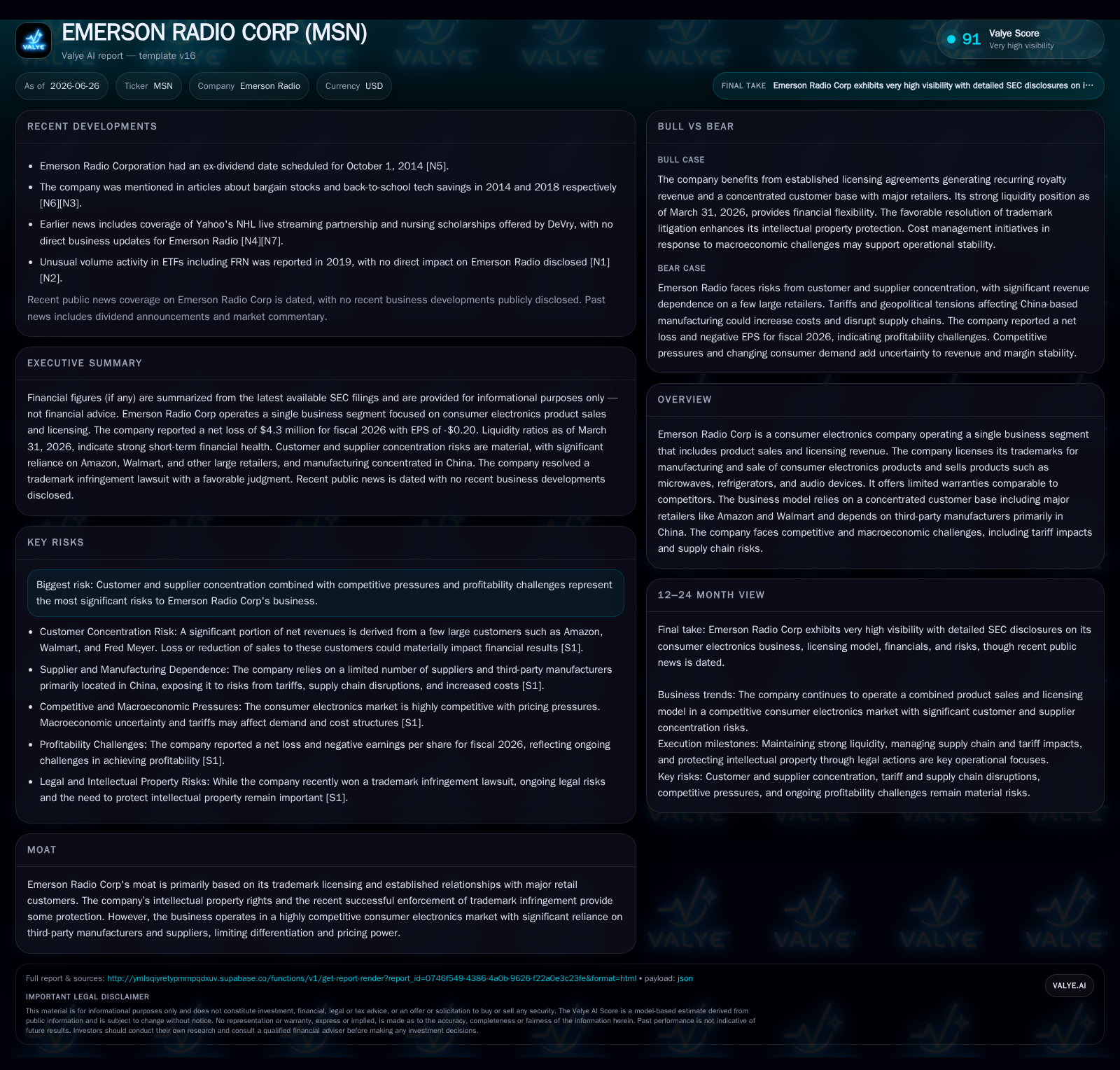
Emerson Radio Corp’s most recent quarterly filing spotlights key operational dynamics shaping its performance in fiscal 2026. The company demonstrates disciplined inventory management paired with cautious consumer demand forecasting, critical given its reliance on a handful of major retail customers such as Amazon and Walmart. While product sales face margin pressure influenced by tariff effects and competitive commoditization, stable trademark licensing revenue offers a less volatile financial cushion. Supply chain risks stemming from supplier concentration and external tariffs remain material concerns that could constrain margin recovery. Going forward, metrics around order fulfillment accuracy, licensee expansion, and customer retention will be vital to gauge the sustainability of Emerson’s business model in a challenging consumer electronics landscape.
Q3 Update: Inventory Discipline Amid Volatile Demand Forecast
Emerson Radio Corp's latest quarterly filing underscores the critical role of accurate consumer demand forecasting coupled with stringent inventory management. The company explicitly recognizes revenue net of promotional discounts, volume rebates, and estimated returns liability based on historical product return experience—metrics essential in managing the frequently unpredictable consumer electronics marketplace [S2]. This careful liability provisioning highlights Emerson's focus on limiting adverse impacts from product returns—a known challenge in home appliance segments where warranty claims can be significant drivers of costs.
Inventory turnover dynamics are accentuated given Emerson’s product mix dominated by microwave ovens and audio devices, categories demanding high availability but also sensitive to rapid obsolescence risks. Efficient inventory management not only tightens working capital cycles but supports gross margin stabilization as surplus stock can trigger higher carrying costs or mark-downs [S15]. This operational rigor is imperative against the backdrop of fluctuating order volumes from major retailers.
Licensing Revenue Resistance Provides Cushion Against Margin Pressure
A distinctive feature of Emerson’s business is its dual revenue streams: product sales and trademark licensing. Licensing revenue showed growth driven by increased guaranteed minimum royalties from licensees—a clear sign of successful enforcement efforts bolstering the company's intellectual property position [S1][S2]. This stream provides more predictable revenue less sensitive to retail sales volatility.
While direct product sales face pressure from competitive commoditization and tariff-induced cost escalations affecting profitability, licensing income serves as a defensive moat grounded in brand equity and trademark control [S1]. Thereby, intellectual property enforcement not only protects brand distinction but also underpins this relatively stable income source amid sector-wide margin compression
Customer Concentration: Double-Edged Sword for Revenue Stability
Emerson's revenue streams exhibit high customer concentration risk. Two dominant retail customers account for approximately half or more of trade receivables at any given time—with Amazon comprising about one-third or more of sales alongside Walmart or Costco in varying intervals [S9][S15][S27]. This dependence enhances negotiation complexity: while these large retailers drive volume scale pivotal for Emerson’s product placement, they wield substantial pricing leverage that constrains margin expansion.
Such reliance heightens vulnerability to abrupt order reductions or shifts in retailer assortment strategies. Robust credit evaluation processes are in place but do not fully mitigate the systemic risk tied to losing or materially shrinking business from any top customer—a pronounced structural challenge common among mid-tier consumer electronics brands reliant on mass-market retail distribution.
Supply Chain Dependencies and Tariff Effects Shaping Cost Structures
The company procures virtually all manufactured products through a small group of third-party factories principally located in China—a source region heavily affected by ongoing US-China trade tensions. Tariff impacts manifest as cost escalation that Emerson can only partially pass through to retailers due to end-market pricing sensitivity [S1]
This concentrated supplier base amplifies supply chain risks including potential disruptions, lead-time variability, and exposure to currency fluctuations—factors that can impair service levels or inflate working capital requirements via higher safety stock.
Efforts toward supply chain risk mitigation are implicit but constrained by limited vertical integration capabilities typical across similar brand-focused licensors employing contract manufacturing models in Asia.
Competitive Positioning: Brand Equity Versus Commoditized Market Dynamics
Emerson operates primarily as a brand licensor with associated product sales in highly commoditized categories featuring aggressive price competition. Despite leveraging established trademarks with historic equity value, the company faces a market landscape where pricing power remains limited.
Trademark licensing provides some differentiation compared to white-label or no-name entrants but does not confer substantial premium positioning given industry saturation. The ongoing intellectual property enforcement actions contribute meaningfully to brand protection; however, these represent defensive rather than offensive strategic assets limiting direct topline growth acceleration [S1]
In sectors like microwaves and audio devices, innovation cycles are rapid yet often incremental—thus Emerson’s competitive edge derives more from retail channel access and cost-effective manufacturing arrangements than technological leadership.
Growth Outlook: Retail Channel Expansion and Licensing Opportunities
Growth levers for Emerson are grounded largely in deepening retail distribution networks—including e-commerce platforms—and scaling licensing arrangements that extend brand reach without proportionate capital expenditure or balance sheet risk.
The company’s capability to secure new licensees or expand existing agreements underpins potential uplifts in royalty income streams [S1][S2]. Meanwhile, increasing online grocery/retail penetration presents an avenue for improved consumer accessibility aligned with shifting shopping preferences
Emerging markets might offer incremental opportunity if addressed through appropriate licensing structures benefiting from rising disposable incomes; however, no direct evidence confirms active expansion initiatives as of the latest reporting.
Risks to Monitor: Supplier Concentration, Warranty Claims, and IP Enforcement Challenges
Supplier geographic concentration predominantly in China exposes Emerson to sustained geopolitical uncertainties including tariffs that elevate input costs unpredictably. Warranty claim rates inherent in appliance categories carry the risk of episodic spikes affecting profitability if product quality issues surface or recall-like events occur.
Though intellectual property enforcement has yielded positive outcomes supporting royalty stability, ongoing litigation uncertainties pose legal expense risks alongside potential collection challenges especially when facing bankruptcies among infringing parties [S6][S10].
Additionally, surges in promotional allowances demanded by dominant retailers could erode realized pricing margins further adding operational complexity.
Financial Profile Discussion
What To Watch Next: Demand Indicators, Customer Retention, and Margin Trends
Key future milestones will center on refined consumer demand forecasting accuracy reflected in improved inventory turnover ratios confirming working capital efficiency gains. Monitoring renewal or expansion trends with major retail partners and licensees will be crucial signals of sustainable revenue base health given customer concentration risks.
Margin trajectory will indicate how effectively Emerson manages tariff pass-throughs alongside promotional discount impacts amidst competitive headwinds. Any shifts toward greater diversification of suppliers or geographic footprint would reduce supply chain vulnerabilities. Legal developments regarding ongoing IP litigations also warrant close attention for their impact on royalty reliability.
In summary, Emerson Radio’s near-term outlook hinges on operational execution precision balanced against structural sector constraints—a classic scenario for mid-size players reliant on trademark licensing fortified within mature commodity-driven end-markets.
Disclaimer: This is research-only, informational analysis and not investment advice. It may include AI-generated interpretation and general industry context. Always verify important details using primary sources.

Comments