
Virtuix’s Omni One Expands VR Boundaries Amid Defense Market Push and Capital Restructuring
Virtuix Holdings is scaling consumer VR treadmill sales while advancing immersive defense simulation amid ongoing financial and competitive challenges.
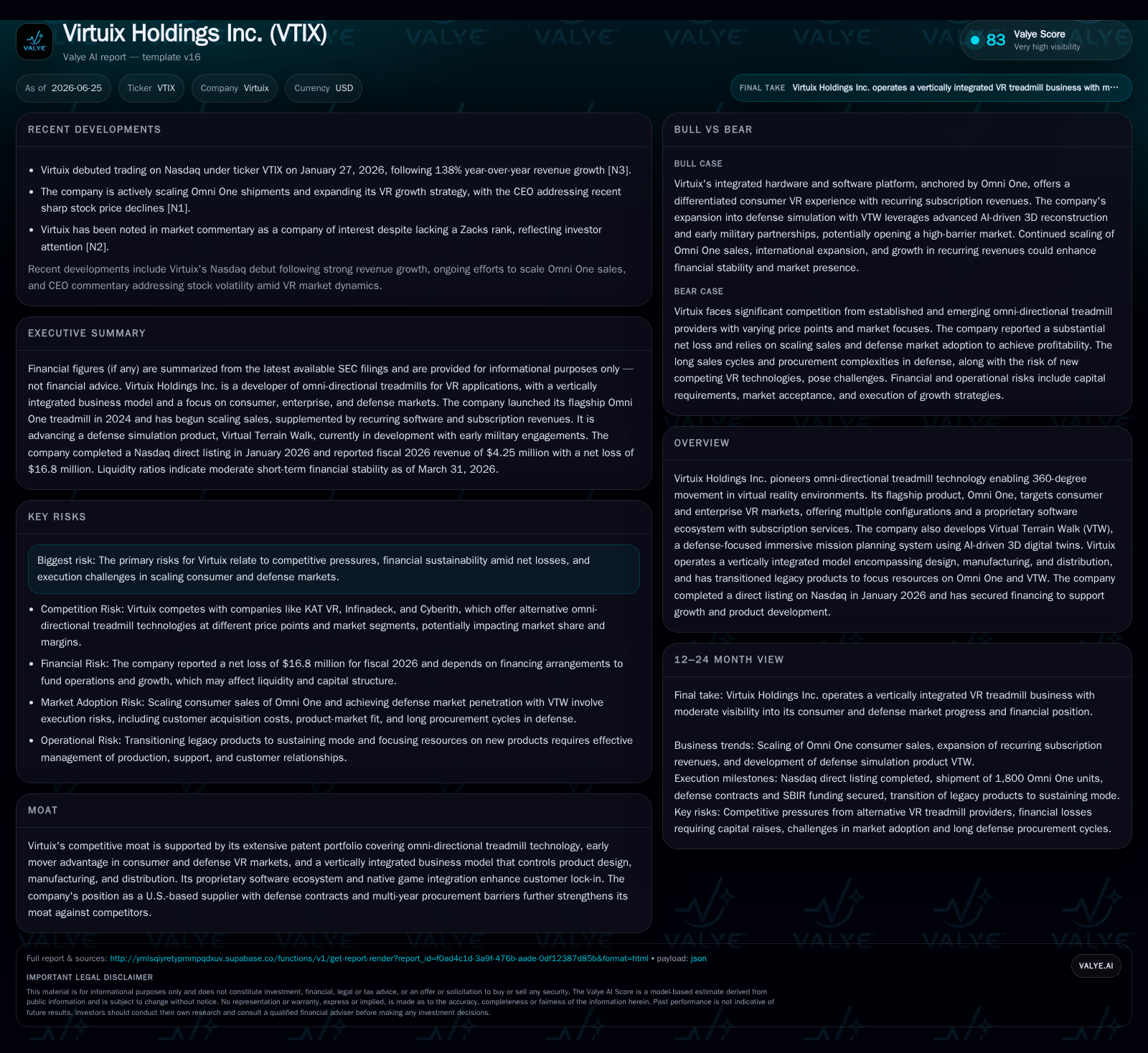
Virtuix Holdings continues to scale shipments of its flagship Omni One omni-directional treadmill, pushing into consumer, enterprise, and defense segments. Its vertically integrated model and extensive patent portfolio provide a credible moat, though the company faces execution risks in penetrating long-cycle defense contracts and sustaining financial health amid net losses. Recent amendments to warrant financing highlight ongoing efforts to optimize capital structure as the firm develops Virtual Terrain Walk (VTW), aiming for growth through a diversified product and software subscription approach.
Recent Operating Update
In its most recent quarterly filing ending March 31, 2026, Virtuix Holdings detailed continued operational progress focused on scaling their flagship Omni One omni-directional treadmill alongside strategic steps to commercialize Virtual Terrain Walk (VTW) for defense applications [S2][S3]. By September 2025, the company had shipped approximately 1,800 Omni One units worldwide resulting in over $4 million in revenues—signaling nascent but tangible traction in consumer and enterprise VR hardware markets [S1]. The firm also announced amendments to warrants related to its debt financings with Streeterville Capital during June 2026 as part of ongoing capital restructuring efforts supporting growth plans [S3]. Importantly, they initiated closure procedures for their Chinese joint venture Heroix VR to redirect and consolidate China market sales under their wholly owned subsidiaries by end of Q3 2026—suggesting channel optimization for improved market penetration [S28].
Business Model Analysis
Virtuix operates a vertically integrated model across hardware design, manufacturing via multiple subsidiaries in Asia (Hong Kong, Zhuhai China, Taiwan), distribution, alongside software development including game content and subscription services. Its flagship product line centers on Omni One—a compact omni-directional treadmill enabling full-body movement inside virtual reality environments with multiple configurations such as complete systems for consumers and enterprises as well as an "Enterprise" variant sold through distributors [S1][S9]. The company targets roughly 40% gross margins on hardware driven by vertical integration efficiency gains complemented by recurring revenue streams: Omni Online subscription fees at $14/month or $140/year are purchased by about half of customers at point-of-sale; furthermore recurring revenues stem from Omni Care maintenance contracts and digital Omniverse game credit sales that contribute to software ecosystem lock-in [S9].
In parallel to consumer/enterprise VR growth efforts is VTW—an immersive multi-user defense simulation product that uses AI-driven geo-specific digital twins for mission planning and leader rehearsals within realistic virtual terrain [S9]. Though this segment involves longer procurement cycles typical of defense contracts with initial SBIR funding secured from the U.S. Air Force and developmental agreements with branches like the U.S. Navy and Marine Corps Training command, meaningful revenue flows are anticipated beyond fiscal 2027 [S8][S9]. This bifurcated model allows Virtuix to diversify sources of revenue—with hardware unit sales driving near-term top-line growth while defense software builds longer-term durable income streams subject to extended sales cycles.
Industry Structure & Competitive Position
The virtual reality hardware landscape includes several specialist producers of immersive locomotion devices. Among omni-directional treadmill peers are KAT VR offering lower-cost peripheral devices ($1k-$2k range), Infinadeck producing high-end motorized X/Y belt treadmills ($50k+), and Cyberith providing commercial platforms focusing on research/enterprise users ($8k-$10k). Virtuix differentiates itself by selling fully integrated Omni One systems that blend superior design quality with portability and embedded software/game integration—a combination supported by a large patent portfolio (25 patents) covering their omni-directional treadmill technologies protecting against low-friction base designs commonly pursued by competitors [S19][S11].
Moreover, Virtuix benefits from being a U.S.-based supplier holding defense contracts—a market characterized by entrenched procurement barriers including multi-year cycles and elevated switching costs—which bolsters its entry barriers amid competition from global tech firms expanding into VR hardware ecosystems. The company's attachment of proprietary subscription services enhances customer retention metrics important in the sector. Additionally, vertical integration helps limit supply chain disruptions seen elsewhere while maintaining control over product quality pivotal for immersive simulation acceptance.
Growth Drivers
Growth levers center primarily on:
- Scaling Consumer Omni One Sales: Leveraging direct website sales channels supported by third-party financing options while expanding geographically beyond the initial U.S. market into Europe and Canada.
- Expanding Recurring Software Revenue: Increasing ARPU through wider adoption of Omni Online subscriptions during checkout supporting a service-led revenue stream.
- Defense Market Penetration: Commercializing VTW as a next-generation VR infantry training tool involving AI-enhanced geospatial digital twins—set to tap sizable government budgets albeit after protracted sales cycles.
- Software Ecosystem Development: Continued investment into broadening game libraries compatible with Omni One plus enhancements leveraging emerging technologies like Gaussian splatting for better AI-driven 3D environments.
- Channel Optimization in China: Transitioning away from joint ventures toward direct subsidiaries enables tighter operational control in this strategically important region.
Each driver is linked closely with KPIs such as units shipped (Omni One), software subscription revenue growth rate, customer acquisition cost efficiencies through targeted marketing campaigns including influencer partnerships/events, R&D expenditure supporting new features/content additions, and contracting milestones within U.S. defense procurement processes.
Risks & Watchpoints
Key risks remain substantial:
- Financial Sustainability: Operating losses exceeded $16 million FY2026 with net debt estimated above $5 million despite cash reserves near $9.5 million; continued capital raises indicate ongoing financing needs to reach profitability target driven by scale economies [F1].
- Long Defense Sales Cycle: VTW unit sales will face elongated timelines due to multi-year government procurement protocols making early revenue visibility limited.
- Competitive Pressure: Large technology companies with greater resources could launch competing locomotion or simulation products eroding Virtuix’s early mover advantage.
- Technology Obsolescence & Product-Market Fit: Rapid innovation pace demands continual R&D investment; failure to maintain technical leadership or content relevance could reduce adoption rates.
- Subscription Adoption & Retention: Approximately half of buyers subscribe at purchase currently; increasing this percentage is critical but reliant on perceived value of ongoing digital content updates.
- Geopolitical & Regulatory Risks: Export controls impact defense-related offerings; regional tensions could affect operations especially given manufacturing footprint across Asia.
- Channel Execution Risk: Closing Heroix joint venture requires smooth transition of China sales channels without disrupting customer access or goodwill.
Current assets stood at roughly $11.9 million versus current liabilities near $8.8 million, producing a current ratio of approximately 1.36—reflecting adequate short-term liquidity though leveraging remains elevated [F1][S2]. The firm's recent amendments related to warrants associated with Streeterville Capital financings illustrate active management of capital structure within challenging funding conditions concurrent with Nasdaq listing earlier this year [S3]. Profitability will require substantial ramp-up in unit volumes coupled with improved mix via recurring software subscriptions while carefully managing R&D spend tied especially to VTW development efforts given long ROI horizons inherent in defense applications.
Runtime disclaimer: This analysis synthesizes currently available SEC disclosures as of mid-2026 alongside industry context without projecting future results or providing investment guidance.
Financial position in context
As of 2026-03-31, companyfacts shows $9.5 million in cash and equivalents and $14.7 million of total debt [F1]. The same snapshot implies net debt of roughly $5.2 million, keeping balance-sheet context relevant but secondary to the operating story [F1]. Current assets of $11.9 million and current liabilities of $8.8 million imply a current ratio near 1.36x for 2026-03-31 [F1].
Disclaimer: This is research-only, informational analysis and not investment advice. It may include AI-generated interpretation and general industry context. Always verify important details using primary sources.

Comments