
Kewaunee Scientific’s Revenue Rhythm Shaped by Order Backlog Timing
Recent quarterly results reveal how project timing and order backlog fluctuations drive revenue volatility despite sales growth amid margin pressures.
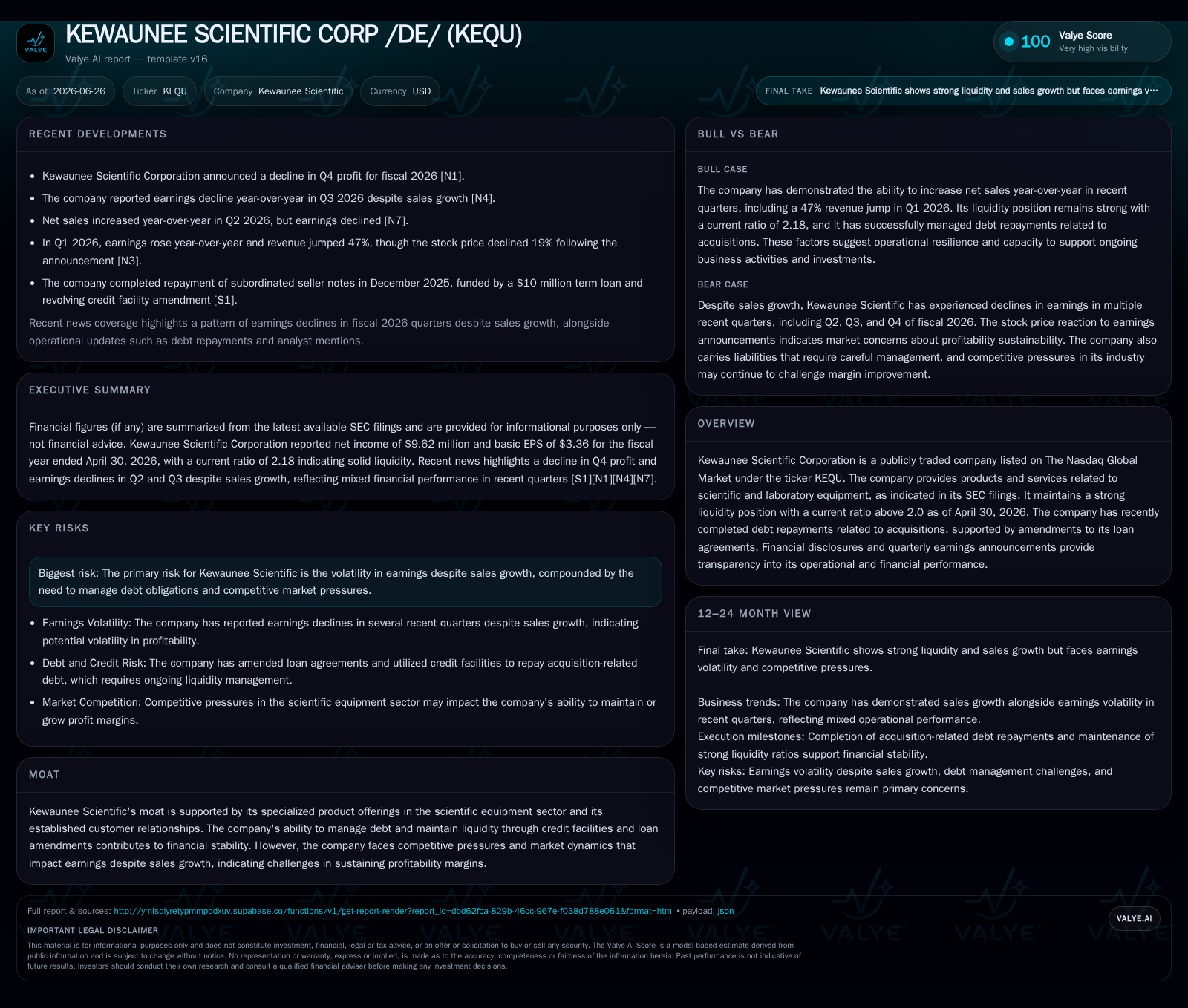
Kewaunee Scientific reported a revenue decline in its latest quarter primarily due to timing shifts in order backlog execution rather than an underlying demand drop. The company’s specialized laboratory furniture and scientific instrument offerings rely on project-based contracts, where delivery scheduling significantly impacts revenue recognition. While sales trends show growth, competitive pricing and supply chain challenges continue to suppress margin expansion. Strong liquidity and debt repayment progress support financial stability as Kewaunee navigates volatile project timings and margin headwinds.
Quarterly Order Backlog Dynamics Driving Revenue Volatility
Kewaunee Scientific's most recent quarterly filing for Q3 fiscal 2026 revealed a counterintuitive revenue decrease despite underlying sales growth trends. This paradox is explained by fluctuations in the company's order backlog size combined with the timing of project completions. The company's heavily project-based contract model means that when installations and deliveries occur can shift revenues between quarters without necessarily reflecting changing customer demand [S2]. Recent news sources corroborate this timing effect by linking Q4 revenue declines directly to project scheduling delays rather than market contraction [N1]. This recurring rhythm—where backlog growth can be robust yet quarterly top-line figures erratically fluctuate—is a hallmark of capital equipment suppliers with long sales-to-revenue conversion cycles in the scientific instruments sector.
This pattern aligns with sector-wide book-to-bill dynamics seen in companies like Thermo Fisher Scientific and Labconco Corporation, where backlogs provide a pipeline indicator but also introduce near-term earnings variability pending final project delivery and acceptance. For Kewaunee, careful attention to backlog size trends against reported revenues is essential for proper forecasting since reported sales figures alone may misrepresent short-term business momentum.
Business Model Breakdown: Specialized Equipment and Installation Services Mix
Kewaunee generates revenue primarily through designing, manufacturing, and selling laboratory furniture alongside precision scientific instruments tailored for institutional customers such as research labs, hospitals, and universities. These products often require custom laboratory solutions shaped by client specifications, entailing complex engineering and longer lead times [S1]. Beyond capital equipment sales, installation services represent a meaningful segment that not only generates incremental revenue but also improves customer retention through hands-on engagement during facility buildouts or renovations.
Further supporting stable margins are maintenance and service contracts typically associated with project completions. These recurring service agreements serve as a defense against cyclical capital spending dips by embedding the company deeper into customers’ operational lifecycles. The cumulative mix—capital equipment plus customization plus installation plus after-sales servicing—reflects the value-chain mechanics common among scientific instruments manufacturers who must balance product innovation with long project life cycles and supply chain management challenges.
Competitive Forces Pressurizing Margins Despite Sales Expansion
While Kewaunee has managed to sustain nominal sales expansion over recent periods, gross margin compression remains a significant concern. The company faces intensifying competitive pricing pressures typical in the laboratory furniture space, where differentiation derives mainly through customization capabilities rather than pure product innovation [S2], [S1]. Additionally, supply chain disruptions encountered industry-wide have increased raw material costs and extended component lead times, further squeezing margins in recent quarters.
Operational difficulties linked to sourcing delays exacerbate challenges in delivering projects on schedule, which not only delays revenue recognition but also inflates overhead allocation per unit sold. These factors combine to create earnings volatility despite stable or growing revenues—a key financial risk highlighted in Kewaunee’s risk disclosures [S15]. Unlike analytical instrument manufacturers who can command higher technology premiums (such as Agilent Technologies), suppliers specializing in lab furniture are typically more exposed to commoditized pricing dynamics.
Growth Engines: Backlog Expansion, Custom Solutions, and Service Renewals
Kewaunee’s future growth levers are anchored chiefly in expanding its order book driven by rising research and development funding across life sciences, healthcare infrastructure enhancement, and biotechnology sectors [S1]. Project-based contracts remain central; winning sizeable multi-year installations translates into prolonged customer engagement cycles with opportunities for follow-on upgrades or expansions.
The company’s investment in R&D ensures ongoing product refinement to meet evolving regulatory compliance demands and safety standards within laboratories—factors critical for customer acquisition in this niche. Moreover, installation and maintenance service offerings generate recurring revenue beyond initial equipment sale cycles, providing some insulation from cyclicality inherent in capital equipment spending.
Risks Lurking in Project Delays, Pricing Pressures, and Regulation
Several key risks shape Kewaunee’s operational outlook. The most immediate is the volatility introduced by uneven project delivery schedules impacting the timing of revenue recognition; protracted delays can strain cash flows despite a healthy order backlog [S13], [S15]. Rising raw material prices alongside inflationary labor costs threaten to erode gross margins further unless offset by pricing power or operational efficiencies. Regulatory environments governing laboratory safety standards impose additional complexity on product lifecycles requiring constant innovation investment.
Customer concentration could amplify these risks if large institutional clients delay or cancel orders amidst budgetary cutbacks tied to government research funding cycles or healthcare spending fluctuations. Finally, supply chain fragility remains an ongoing hurdle especially given recent global disruptions affecting component availability within the scientific equipment manufacturing ecosystem.
What to Watch for Next Quarter: Backlog, Completion Timelines, and Cost Control
Investors tracking Kewaunee's operational execution should focus on several actionable KPIs in upcoming quarters. Principal among these will be any shifts in the book-to-bill ratio signaling whether new orders outpace delivered shipments or vice versa—critical for anticipating future top-line patterns beyond raw sales figures [S3], [N2]. Progress toward timely completion of existing projects will indicate management’s capability to manage backlog-driven revenue volatility.
Simultaneously monitoring gross margin trends will help decipher if supply chain pressures ease or intensify amid cost-control initiatives. Liquidity metrics including cash flow generation stemming from working capital improvements following recent debt repayments must also be assessed to evaluate financial resilience.
Financial Profile Discussion: Liquidity Strength Amid Debt Reduction
As of April 30, 2026, Kewaunee Scientific exhibits a robust liquidity profile with cash and equivalents totaling approximately $9.95 million against current liabilities around $48 million, yielding a strong current ratio above 2.18 that reflects comfortable short-term solvency [F1]. Total debt stands nominal at roughly $229 thousand as last reported in 2019 [F1]. Recent loan agreement amendments have allowed repayment of higher-cost subordinated seller notes linked to prior acquisitions [S2], [S3], supporting improved financial flexibility critical for weathering episodic revenue swings caused by backlog timing while investing selectively in R&D necessary to maintain competitive positioning.
Disclaimer: This analysis is based solely on publicly available SEC filings and news reports as of June 2026. It does not constitute investment advice or research view regarding any security or financial instrument related to Kewaunee Scientific Corporation.
Disclaimer: This is research-only, informational analysis and not investment advice. It may include AI-generated interpretation and general industry context. Always verify important details using primary sources.

Comments