
Universal Safety Products Advances Decentralized Finance Strategy Despite Elevated Losses
Universal Safety Products is investing heavily in blockchain infrastructure and tokenization services, driving increased operating losses amid strong liquidity.
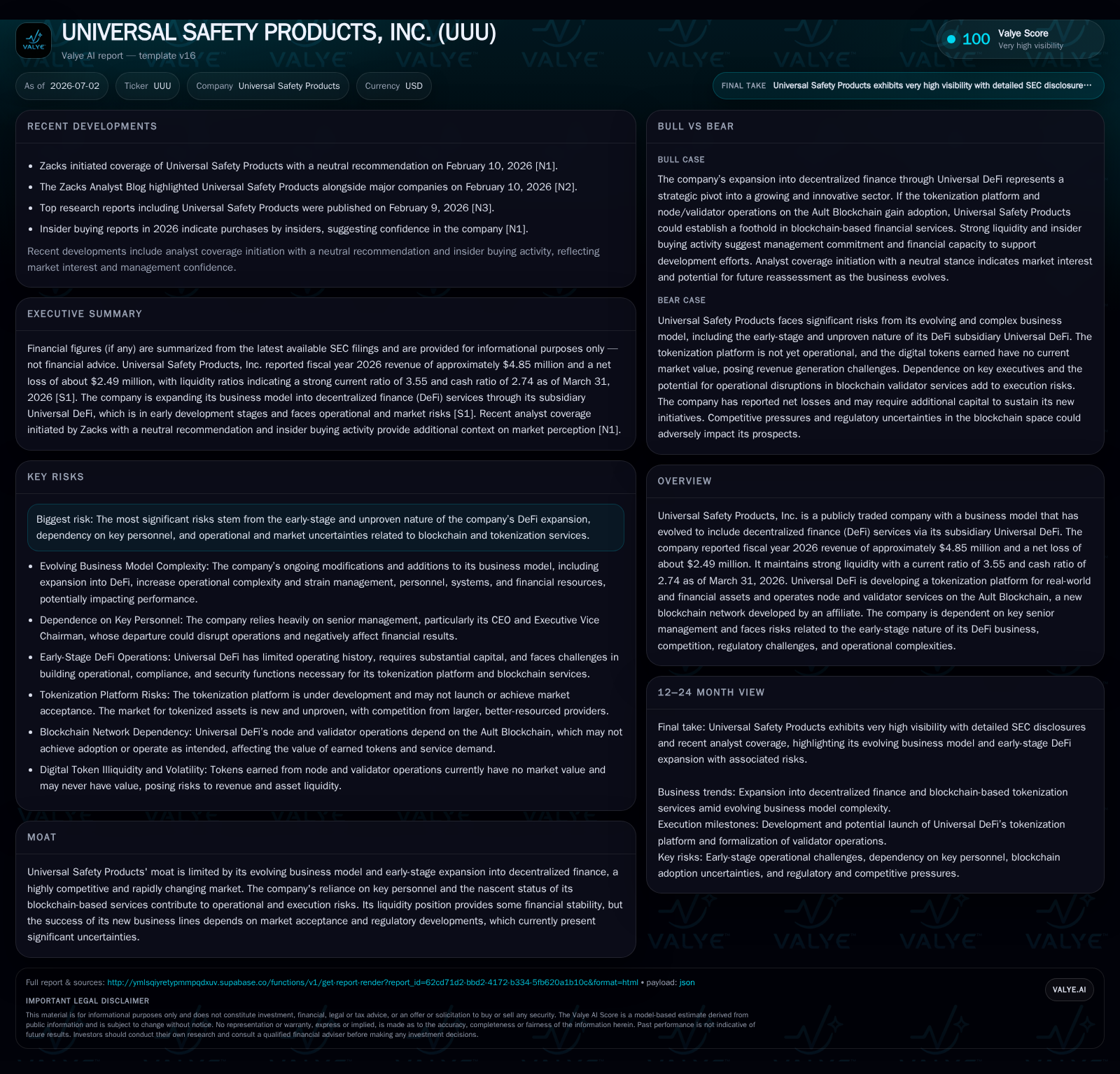
In its latest quarterly filing ending December 2025, Universal Safety Products (UUU) reported a net loss of $1.48 million for the nine-month period, reflecting intensified spending on DeFi platform development and strategic alternatives. The company issued convertible notes totaling $2.75 million to fuel these expansion efforts and maintains a robust liquidity profile with a current ratio of 3.55 as of March 31, 2026. While Universal is transitioning from legacy safety products to blockchain node operations, validator services, and token issuance via its subsidiary Universal DeFi, it faces significant execution and regulatory risks typical for early-stage DeFi ventures. Key milestones ahead include monitoring convertible note conversions, validator scaling, and adoption metrics that will validate the long-term viability of its evolving business model.
Q3 2026 Operational Shifts Illuminate Strategic Pivot to Decentralized Finance
Universal Safety Products, Inc. (UUU) reported a net loss of $1.48 million for the nine months ended December 31, 2025, reflecting intensified investments in its decentralized finance (DeFi) platform development and strategic alternatives [S2]. The company issued convertible promissory notes totaling up to $2.75 million at 8% interest during 2025 to fund these expansion efforts, with a portion of this debt converted early in 2026 into approximately 405,000 shares of common stock, representing $1.54 million principal plus accrued interest exchanged and signaling an evolving shareholder base [S2], [S3].
Despite mounting losses linked to expansion spending and the divestiture of its smoke and carbon monoxide alarm segment, Universal maintains a strong liquidity position. As of March 31, 2026, cash and cash equivalents stood at approximately $3.47 million, supported by current assets of $4.5 million against current liabilities of $1.27 million, yielding a healthy current ratio of 3.55 [F1]. This liquidity cushion is notably robust compared to many early-stage DeFi peers that often operate with constrained reserves. Operating cash flow remained positive for the nine months ended December 31, 2025, generating $1.35 million primarily due to improved working capital management despite net losses [S2]. These financial resources underpin ongoing development activities at Universal DeFi LLC, the company’s wholly owned subsidiary focused exclusively on blockchain infrastructure and decentralized finance services, while also supporting residual operations in legacy business lines retained post-divestiture.
From Traditional Legacy to Blockchain Infrastructure: Business Model Transformation and Revenue Mechanisms
Universal Safety Products historically operated as a distributor of safety and security hardware products marketed through retail and electrical trade channels. However, the company is undergoing a strategic pivot to leverage blockchain infrastructure to deliver decentralized financial services [S1], [S2]. This transformation centers on operating blockchain nodes and validator services on the affiliated Ault Blockchain network, which employs a proof-of-stake (PoS) consensus mechanism. By running validator nodes, Universal earns staking rewards, a non-sales-based revenue stream that depends on the number of active validators and their uptime reliability [S1].
In parallel, Universal is developing a tokenization platform under its Universal DeFi subsidiary aimed at converting real-world assets—such as physical commodities and financial instruments—into cryptographic tokens. These tokens can be transacted within decentralized applications (dApps), enhancing liquidity and accessibility beyond traditional financial systems. Revenue streams from this platform are expected to include transaction fees per token exchange or asset transfer executed via smart contracts, platform usage fees for token issuance and management, and potentially consulting or licensing fees related to proprietary blockchain technology deployments [S1], [F1].
While fiscal year 2026 revenue remains modest at approximately $4.85 million, reflecting early-stage commercial activity, the company’s elevated operating expenses highlight substantial upfront capital deployment required for technology development, regulatory compliance preparation, and market entry efforts typical of nascent DeFi ventures [F1]. Key operational KPIs influencing revenue potential include the number of active validators operated, staking participation rates, transaction volume processed on the platform, and token issuance volume, all of which directly impact staking rewards and transaction fee income.
Market Positioning Within a Fragmented DeFi Ecosystem: Emerging Moat or Competitive Drift?
The decentralized finance industry is highly fragmented and competitive. Large incumbents like Coinbase and Binance dominate broad-spectrum platforms offering exchange and wallet services, while specialized infrastructure providers such as Block.one and ConsenSys focus on blockchain development and validator operations. Universal Safety Products positions itself primarily as a blockchain infrastructure operator by providing validator services on the Ault Blockchain network and developing asset tokenization capabilities that bridge real-world assets with digital financial ecosystems.
However, given Universal’s early developmental stage and sub-$5 million revenue scale, it currently lacks the network effects and scale advantages that underpin durable moats in DeFi markets. Management acknowledges significant operational risks, including heavy reliance on key executives such as Executive Vice Chairman Milton C. Ault III, whose specialized DeFi expertise is critical for technical development and ecosystem growth; his departure could materially disrupt progress [S1]. Additionally, regulatory uncertainty surrounding digital asset governance and securities laws remains a significant headwind, constraining aggressive scaling strategies commonly pursued by larger pure-play DeFi competitors with dedicated compliance teams.
Unlocking Growth Potential: Tokenization Adoption and Validator Scale as Demand Signals
Universal’s growth prospects hinge on accelerating adoption trends prevalent across the DeFi sector. Rising institutional interest in tokenizing traditionally illiquid assets, increasing regulatory clarity, and expanding staking participation rates are key demand drivers. Success in scaling validator operations—measured by the number of active nodes and uptime consistency—and growing token issuance volumes across diversified asset classes will be critical to building sustainable revenue streams.
Monitoring operational KPIs such as validator count, staking participation rates, transaction volumes, and platform user growth will provide concrete evidence of market traction. Increased staking participation signals meaningful network engagement, while rising transaction volumes and token issuance confirm monetization effectiveness through transaction fees and platform usage charges.
Key Challenges Ahead: Regulatory Hurdles, Execution Complexity, and Key Person Dependency
Universal faces several significant risks typical of early-stage DeFi ventures. Regulatory uncertainties include evolving interpretations of securities laws as they apply to tokenized assets and decentralized financial products, which could impose compliance costs or restrict offerings. Technology execution risks involve maintaining validator node security and uptime to avoid network disruptions or hacking incidents.
The company’s dependence on key personnel, particularly Milton C. Ault III, heightens operational risk, as his expertise is pivotal to product development and strategic direction [S1]. Market acceptance challenges persist given the novel nature of Universal’s offerings and limited track record, while competition from established DeFi platforms necessitates rapid innovation to avoid marginalization. Additionally, scaling blockchain infrastructure requires significant capital investment, balanced against dilution risks from convertible note conversions and concentrated financing relationships, such as the Securities Purchase Agreement granting SJC Lending LLC a right of first refusal on future equity or debt offerings through mid-2027 [S3].
Milestones to Track: Conversion of Convertible Notes, Validator Growth Metrics, and Platform User Adoption
Near-term operational milestones will shed light on Universal’s progress in executing its strategic pivot. Key indicators include:
- The conversion rate of convertible notes held by SJC Lending LLC, with conversions exceeding 19.99% of outstanding common stock shares triggering shareholder approval and governance implications [S3].
- Growth in the number of active validator nodes operated and their uptime percentages, reflecting technical scalability and network security.
- Increases in transaction fee revenue aligned with user onboarding and token issuance volumes, evidencing commercial adoption of the tokenization platform.
- Public disclosures regarding regulatory developments or litigation that may impact the company’s ability to operate or scale its DeFi services.
Tracking these KPIs will provide investors and stakeholders with tangible metrics to assess whether Universal can transition from an experimental stage to a scalable blockchain infrastructure provider.
Supporting Financial Position Anchors Pursuit of Growth Amid Elevated Losses
Financially, Universal reported a net loss of approximately $2.49 million for the nine months ended December 31, 2025, driven by investments in blockchain infrastructure and strategic initiatives [F1]. Despite these losses, the company’s liquidity remains solid, with cash and cash equivalents of $3.47 million and a current ratio of 3.55 as of March 31, 2026, indicating strong short-term solvency [F1]. Traditional debt levels remain minimal, with convertible promissory notes issued in 2025 serving as the primary external financing source supporting working capital and technology development [S2], [S3].
This financial flexibility enables Universal to continue funding its technology development and market expansion efforts without immediate liquidity pressures, a notable advantage compared to many early-stage DeFi startups reliant solely on external fundraising rounds vulnerable to market volatility. The company continues to explore strategic alternatives, including potential mergers or additional capital raises, to support its evolving business model [S3], [S1].
This analysis integrates Universal Safety Products’ recent operating results with sector-specific insights relevant to early-stage decentralized finance firms transitioning from legacy product distribution to blockchain infrastructure and tokenization services. The company’s liquidity position provides runway security amid elevated losses typical of incubation phases in the DeFi industry. Success will depend on disciplined execution in scaling validator services, growing token issuance volumes, navigating regulatory complexities, and retaining key management expertise.
Disclaimer: This is research-only, informational analysis and not investment advice. It may include AI-generated interpretation and general industry context. Always verify important details using primary sources.

Comments