
Concentrix Corp Advances AI Integration Amid Margin Pressures in Q2 2026
Q2 2026 results highlight Concentrix’s strategic AI adoption in customer experience services, with margin compression reflecting ongoing investment and inflationary impacts.
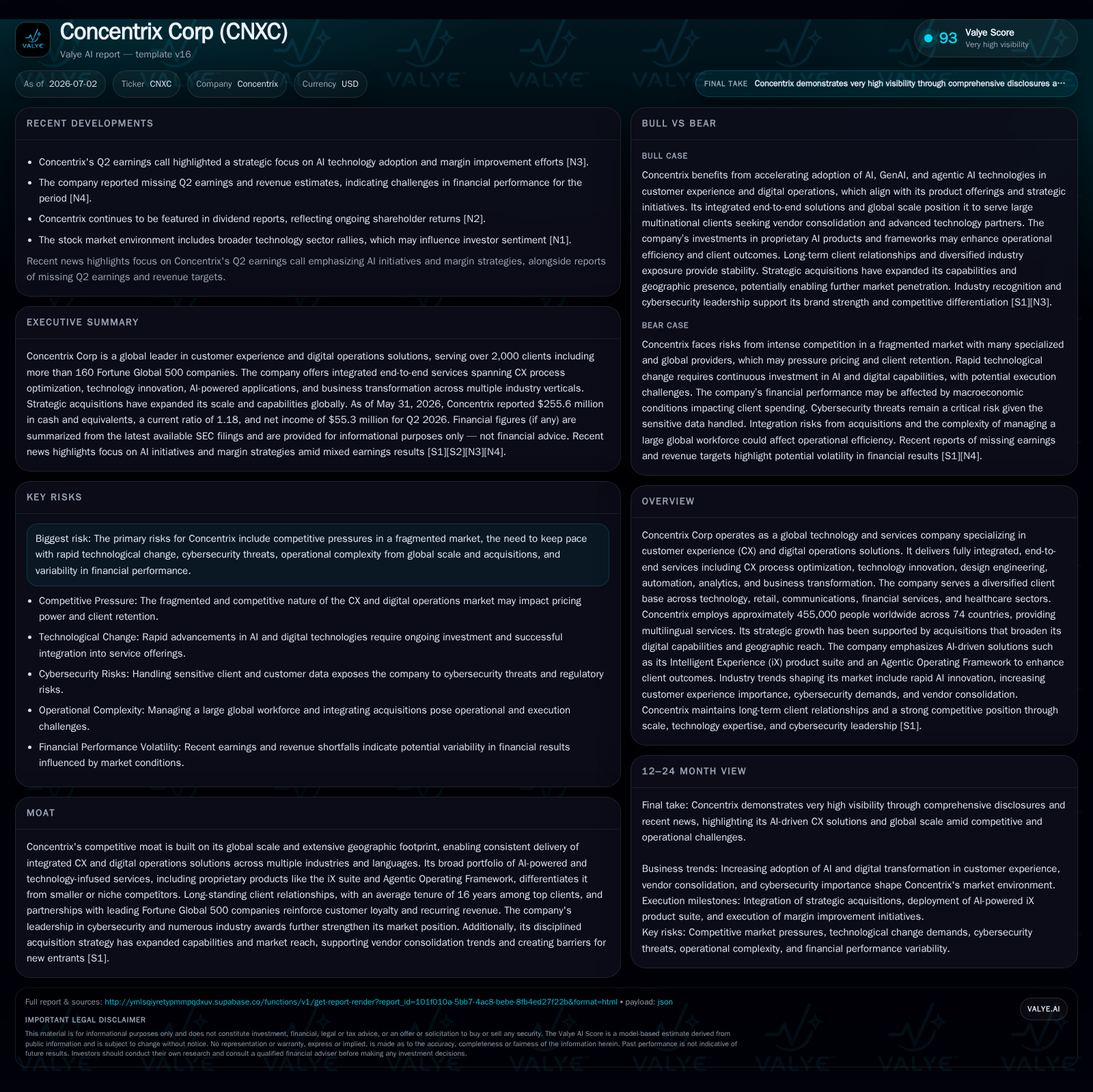
In its Q2 2026 filing, Concentrix underscored growth driven by expanded use of generative and agentic AI technologies within its customer experience (CX) and digital operations portfolio. Despite top-line momentum, operating margins declined due to elevated technology investments and labor cost inflation, a common transitional phase in BPO firms embracing automation. The company’s extensive global footprint, multilingual capabilities, and long client tenure provide a competitive foundation as it targets growth in fintech, healthcare, retail, and technology sectors. Key metrics to monitor include automation adoption rates and contract renewals, which will be critical indicators of sustainable margin recovery and client retention.
Q2 2026 Operating Update: Accelerated AI Adoption during Margin Pressure
Concentrix’s latest quarterly report reveals a deliberate push to embed generative AI (GenAI) and agentic AI technologies into its customer experience (CX) offerings to enhance efficiency and scalability [S2][N1]. This integration supports improved process optimization through the Intelligent Experience (iX) platform and Agentic Operating Framework. However, these advancements coincided with operating margin compression driven by increased spending on technology development and persistent inflationary pressures on labor costs—reflecting the typical investment cycle in BPO firms transitioning to automation-led delivery models [S2][N2].
The company also noted variability in client demand forecasts impacting utilization rates—a crucial operational metric that influences staffing efficiency and gross margins. The path to margin recovery hinges on accelerating automation adoption that reduces manual effort without compromising service quality or client satisfaction.
Business Model: Long-Term Contracts Backed by Integrated Digital Solutions
Concentrix operates primarily through multi-year contracts with large enterprises across technology, retail, financial services, communications, and healthcare sectors [S1]. These contracts encompass comprehensive front-office customer interactions as well as back-office digital operations such as B2B sales support, compliance monitoring, collections management, data analytics, and business intelligence.
Revenue is predominantly generated from recurring fees tied to service delivery augmented by licensing proprietary AI-driven platforms that enable scalable CX transformation. This hybrid approach aligns vendor incentives with clients’ digital maturity progression while stabilizing cash flows. The emphasis on embedding automation workflows and analytics differentiates Concentrix within traditional outsourcing markets increasingly converging with digital transformation demands.
Competitive Position: Scale and Multilingual Capabilities as Differentiators
With operations in approximately 74 countries and a workforce exceeding 450,000 employees, Concentrix offers extensive multilingual support tailored to diverse regional needs—a critical advantage for servicing its broad Fortune Global 500 client base [S1]. This global footprint supports consistent service level agreements across voice channels, email, social media engagement, asynchronous messaging platforms, and AI-powered self-service interfaces.
While this scale introduces operational complexity, it simultaneously creates significant barriers for smaller or niche providers lacking comparable geographic reach or integrated digital capabilities. Furthermore, an average client tenure of around 16 years among top clients underscores strong relationship depth that fosters client retention amid industry consolidation trends.
AI Integration: Enhancing Service Metrics Amid Cost Challenges
Deployment of advanced AI models has improved key performance indicators including average handle time (AHT), first contact resolution (FCR), and customer satisfaction scores (CSAT) by increasing process accuracy and reducing manual intervention [S2][N1]. Nonetheless, these benefits are partially offset by short-term cost headwinds linked to platform development expenses, employee reskilling for hybrid human-AI workflows, and wage inflation.
This tension typifies the sector’s challenge where upfront investments in automation temporarily depress operating margins before efficiencies are realized at scale. Comparable peers such as Teleperformance and Genpact report similar dynamics during phases of technology-driven growth.
Long-term margin improvement depends on balancing enhanced workforce utilization with sustaining or improving CSAT scores against evolving client budget constraints.
Growth Drivers: Expansion in High-Complexity Vertical Markets
Concentrix targets growth in verticals characterized by complex compliance requirements coupled with high transaction volumes—fintech, healthcare, retail/e-commerce, and technology hardware/software sectors stand out [S1]. These industries increasingly demand integrated digital engagement solutions combining automated workflows with real-time analytics to drive actionable customer insights.
Industry vendor consolidation trends favor large-scale providers like Concentrix capable of bundling services under unified contracts. This bundling strategy facilitates cross-selling opportunities while enhancing client stickiness relative to smaller specialists.
Risks: Competitive Pressure, Technology Evolution & Operational Complexity
The global BPO market remains fragmented with intense competition exerting pricing pressure despite ongoing innovation investments [S1][S7]. Rapid technological advances require continuous capital allocation toward AI readiness including upgrades to generative models embedded in customer-facing tools—an expensive necessity without guaranteed near-term returns.
Cybersecurity risks are elevated given the handling of sensitive data across dispersed global delivery centers; maintaining rigorous privacy controls is essential to avoid reputational damage or contractual liabilities. Additionally, operational complexity from recent acquisitions poses integration risks that may affect agility and cost synergies.
Client concentration risk is mitigated through industry diversification but adverse budget cuts or contract non-renewals would increase earnings volatility relative to current assumptions.
Key Milestones: Contract Renewals & Automation Adoption Rates
Upcoming quarters will provide clarity on renewal trends among long-tenured clients who remain sensitive to macroeconomic factors influencing discretionary outsourcing spend [N1][S2]. Concurrently, the pace of automation penetration into core processes will serve as a leading indicator for margin recovery potential.
Successful scaling beyond pilot phases toward full deployment accompanied by improvements in utilization rates or reductions in AHT will signal positive inflection points for profitability. Conversely sustained margin erosion amid weak renewals would indicate challenges balancing growth investments against client budgets.
Financial Profile Discussion
As of May 31, 2026, Concentrix held $255.6 million in cash equivalents against total debt of approximately $3.95 billion resulting in a net debt position near $3.69 billion—reflecting leverage levels typical for large BPO providers investing heavily in technology platforms [F1]. The current ratio was approximately 1.18, indicating a moderate level of short-term liquidity relative to current liabilities [F1].
This leverage profile necessitates disciplined financial management to balance capital allocation towards innovation while meeting debt servicing requirements. No recent covenant breaches have been reported; however ongoing focus on cash flow generation and deleveraging remains prudent amid market uncertainties.
This analysis synthesizes recent filings with public commentary to position Concentrix within the evolving BPO landscape where digital CX transformation drives both opportunity and operational complexity.
Disclaimer: This is research-only, informational analysis and not investment advice. It may include AI-generated interpretation and general industry context. Always verify important details using primary sources.

Comments