
TD SYNNEX Expands Technology Solutions amid Supply Chain and Currency Challenges
The company reported solid Q2 2026 growth driven by strategic acquisitions and cloud-oriented portfolios while navigating global IT demand fluctuations.
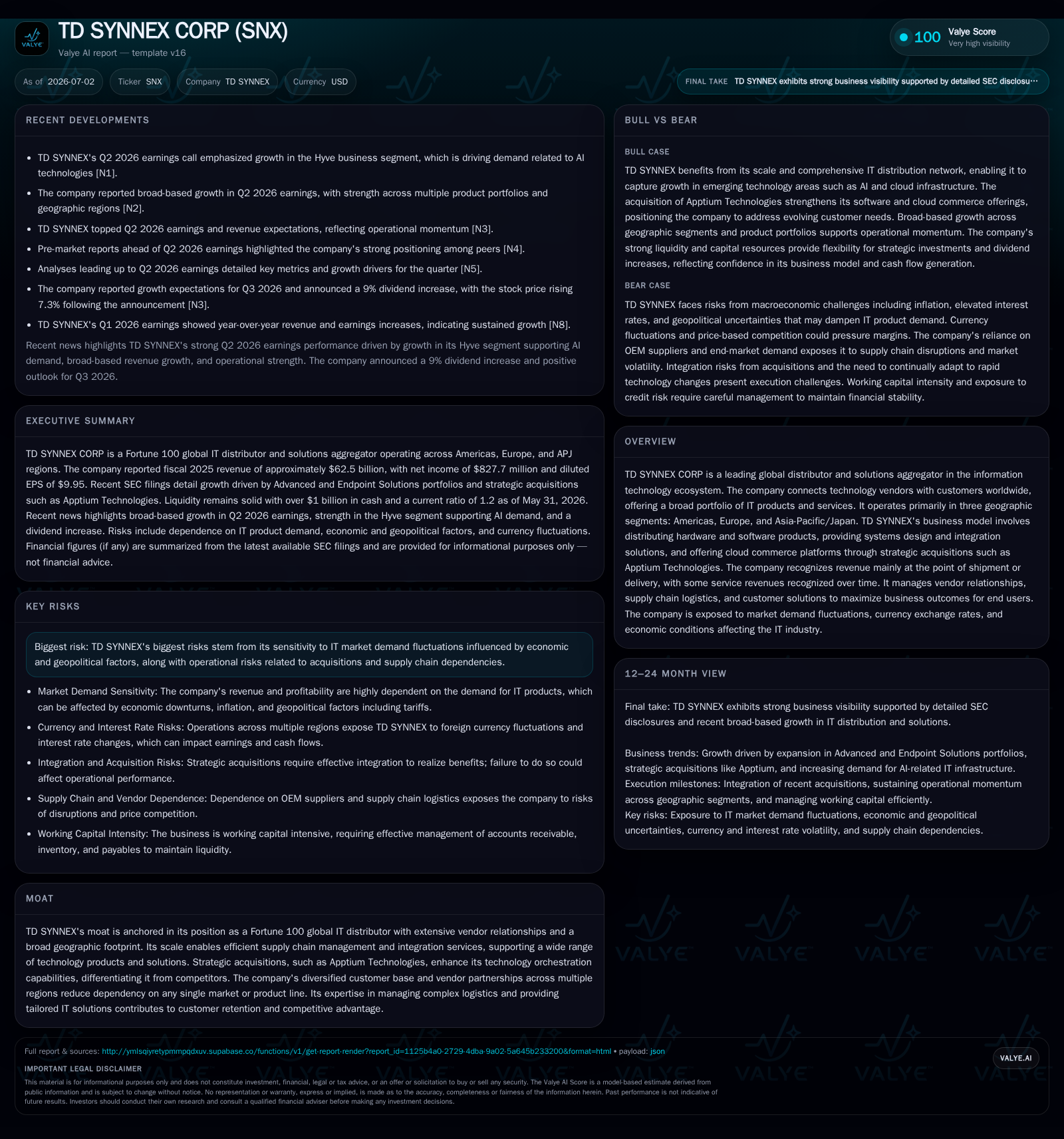
TD SYNNEX's Q2 2026 results demonstrate broad-based revenue growth backed by its acquisition of Apptium Technologies and strength in AI-related cloud solutions, highlighting the company's evolving technology orchestration strategy. The business model remains centered on IT hardware and software distribution with growing integration and cloud commerce services. However, its global footprint exposes it to currency risk and supply chain variability that could pressure margins. TD SYNNEX enjoys scale advantages and diversified vendor relationships that underpin its moat but faces operational risks from market demand cyclicality and geopolitical uncertainty. Managing working capital efficiently while leveraging its receivables securitization program will be key to sustaining financial flexibility.
Recent Operating Update
TD SYNNEX reported strong second-quarter results for the period ending May 31, 2026, reflecting broad-based revenue growth across its Americas, Europe, and Asia-Pacific/Japan (APJ) segments [S2]. The company emphasized robust demand for AI-related infrastructure, particularly through its Hyve brand, which has become a key driver of its cloud-oriented portfolio expansion [N1]. The July 2025 acquisition of Apptium Technologies, a cloud commerce platform provider, significantly enhanced TD SYNNEX’s technology solutions orchestration capabilities, marking a strategic evolution from traditional IT hardware and software distribution toward integrated cloud commerce and systems integration services [S1][S23].
Despite ongoing challenges from supply chain variability and currency exchange fluctuations inherent in its global operations, TD SYNNEX maintained stable gross profit margins in Q2 2026. This stability was supported by improved vendor rebate programs and a favorable product mix shift toward higher-value cloud and software offerings, partially offsetting inflationary pressures on personnel costs [S1][S14]. The company’s scale and vendor relationships contributed to operating leverage benefits, with operating margins expanding modestly despite incremental investments in strategic technologies and workforce expansion.
In June 2026, TD SYNNEX launched a European receivables securitization program, complementing its existing U.S. arrangement that provides up to $1.5 billion in borrowing capacity secured by trade accounts receivable [S3][S4][S11]. This financing structure enhances working capital efficiency by optimizing cash conversion cycles and reducing reliance on term loans to fund inventory growth associated with expanding demand.
Business Model and Strategic Strengths
TD SYNNEX operates as a critical intermediary in the IT value chain, connecting original equipment manufacturers (OEMs) such as Apple—accounting for approximately 12% of revenues—and HP with a global network of resellers, value-added resellers (VARs), system integrators, enterprises, and public-sector customers [S18][S22]. The company’s revenue primarily derives from purchasing IT hardware and software products from OEMs under negotiated terms and reselling them through an extensive supply chain logistics network. Revenue recognition occurs predominantly at shipment or delivery, with a growing portion recognized over time from value-added services including systems design, integration, and cloud commerce platforms enabled by strategic acquisitions like Apptium [S1][S23].
This multi-channel business model allows TD SYNNEX to capture incremental value beyond traditional distribution by orchestrating complex hybrid and multi-cloud IT environments, which are increasingly demanded by customers undergoing digital transformation. The company’s scale as a Fortune 100 entity supports preferential vendor rebate agreements that underpin gross margin expansion [S25]. Additionally, TD SYNNEX’s tailored integration services and efficient supply chain logistics foster strong customer retention and sticky relationships.
Revenue growth is driven by volume expansion among resellers responding to end-user demand cycles influenced by economic conditions, technology refresh rates, and emerging trends such as AI infrastructure investments. Margin dynamics benefit from a product mix shift favoring higher-margin software and cloud solutions over commoditized hardware, alongside operational efficiencies in inventory turnover and accounts payable management.
Industry Structure and Competitive Positioning
Operating within the Information Technology Distribution and Solutions industry, TD SYNNEX competes with global peers including Avnet, Ingram Micro, Arrow Electronics, and Insight Enterprises. While many distributors focus primarily on high-volume hardware resale with thin margins, TD SYNNEX differentiates itself by expanding into technology solution orchestration, encompassing cloud commerce platforms and systems integration services specialized in emerging technologies like AI workloads [N1]
The company’s geographic diversification across the Americas, Europe, and APJ regions mitigates concentration risk but introduces currency exchange volatility, which TD SYNNEX manages through hedging strategies that partially offset earnings translation impacts [S1][S18]. Vendor diversification reduces supplier concentration risk, though maintaining close OEM relationships remains critical amid competitive pressures in the distribution landscape.
Key operating KPIs in the sector include days sales outstanding (DSO), inventory turnover, accounts payable turnover, customer retention rates, vendor partnership breadth, gross profit margin, operating margin, and cash conversion cycle (CCC) [S15][S28]. TD SYNNEX’s CCC of approximately 16 days reflects effective working capital management, balancing receivables collection and payables extension without compromising vendor relations or order fulfillment velocity.
Growth Drivers
Long-term growth is supported by rising global IT spending driven by digital transformation initiatives emphasizing cloud migration and AI-enabled workflows. TD SYNNEX’s Hyve platform directly addresses the expanding AI data center infrastructure market, broadening its addressable opportunity [N1].
Strategic acquisitions such as Apptium enhance the company’s proprietary SaaS-like cloud commerce platform offerings, creating recurring revenue streams layered atop traditional transaction-based distribution. Geographic expansion into emerging markets opens new avenues for product and solutions penetration, while hybrid and multi-cloud adoption sustains demand for integrated IT solutions.
Vendor portfolio expansion and deepening OEM partnerships enable cross-selling across endpoint computing and advanced technology stacks. Investments in supply chain automation and regional fulfillment centers support improvements in order fulfillment cycle times and operational scalability.
Risks and Watchpoints
TD SYNNEX faces risks from cyclical fluctuations in IT market demand tied to macroeconomic conditions, inflationary pressures, and geopolitical tensions affecting global trade flows and tariffs [S10]. Price competition among distributors can compress gross margins, particularly in commoditized hardware segments.
Integration risks persist as the company assimilates acquisitions to expand solution capabilities, requiring effective cultural alignment, systems harmonization, and realization of cost synergies [S1][S23]. Currency exchange volatility remains a challenge despite hedging efforts, potentially impacting reported earnings [S13].
Credit risk associated with a substantial trade receivables portfolio necessitates rigorous credit assessment, as macroeconomic shocks could impair end-customer solvency and profitability [S24]. Cybersecurity threats also pose operational risks that could disrupt supply chain continuity or compromise sensitive data.
What to Watch Next
Key indicators to monitor include consistent quarterly revenue growth across geographic segments, particularly within cloud commerce platforms and Hyve solutions as AI workloads scale. Operating margin trends will reveal the sustainability of vendor rebate programs and the company’s ability to offset cost inflation.
Further strategic acquisitions or divestitures could signal shifts in portfolio focus, impacting organic growth and leverage. Utilization levels of receivables securitization programs will provide insight into working capital liquidity management amid inventory expansion.
Effectiveness of currency hedging will be reflected in operating income variances relative to constant currency sales in upcoming earnings releases. Broader industry adoption of technologies such as generative AI and hybrid cloud deployments will serve as demand barometers.
Financial Profile Discussion
As of May 31, 2026, TD SYNNEX held $1.09 billion in cash and equivalents against $3.61 billion in total debt, resulting in net debt of approximately $2.52 billion and a current ratio near 1.2, indicating solid near-term liquidity [F1]. The company benefits from a revolving credit facility with commitments up to $4 billion maturing in April 2029, alongside accounts receivable securitization programs that enhance short-term liquidity without materially increasing traditional debt levels [S4][S11][S12].
Following the Q2 earnings announcement, TD SYNNEX increased its dividend, reflecting a balanced capital return policy aligned with funding organic growth and strategic acquisitions that expand its role in the IT ecosystem [N9][S19]. Maintaining disciplined cost control and vigilant receivables quality assessment will be essential to sustaining net income margins amid external macroeconomic headwinds.
This analysis is prepared solely for informational purposes without providing investment research views or advice. It relies exclusively on publicly disclosed data referenced accordingly.
Disclaimer: This is research-only, informational analysis and not investment advice. It may include AI-generated interpretation and general industry context. Always verify important details using primary sources.

Comments