
JFB Construction Expands Franchise Buildouts and Real Estate Development Amid Public Market Transition
JFB Construction Holdings reported strong Q1 revenue growth and advances strategic U.S. market expansion while preparing for an AI defense merger.
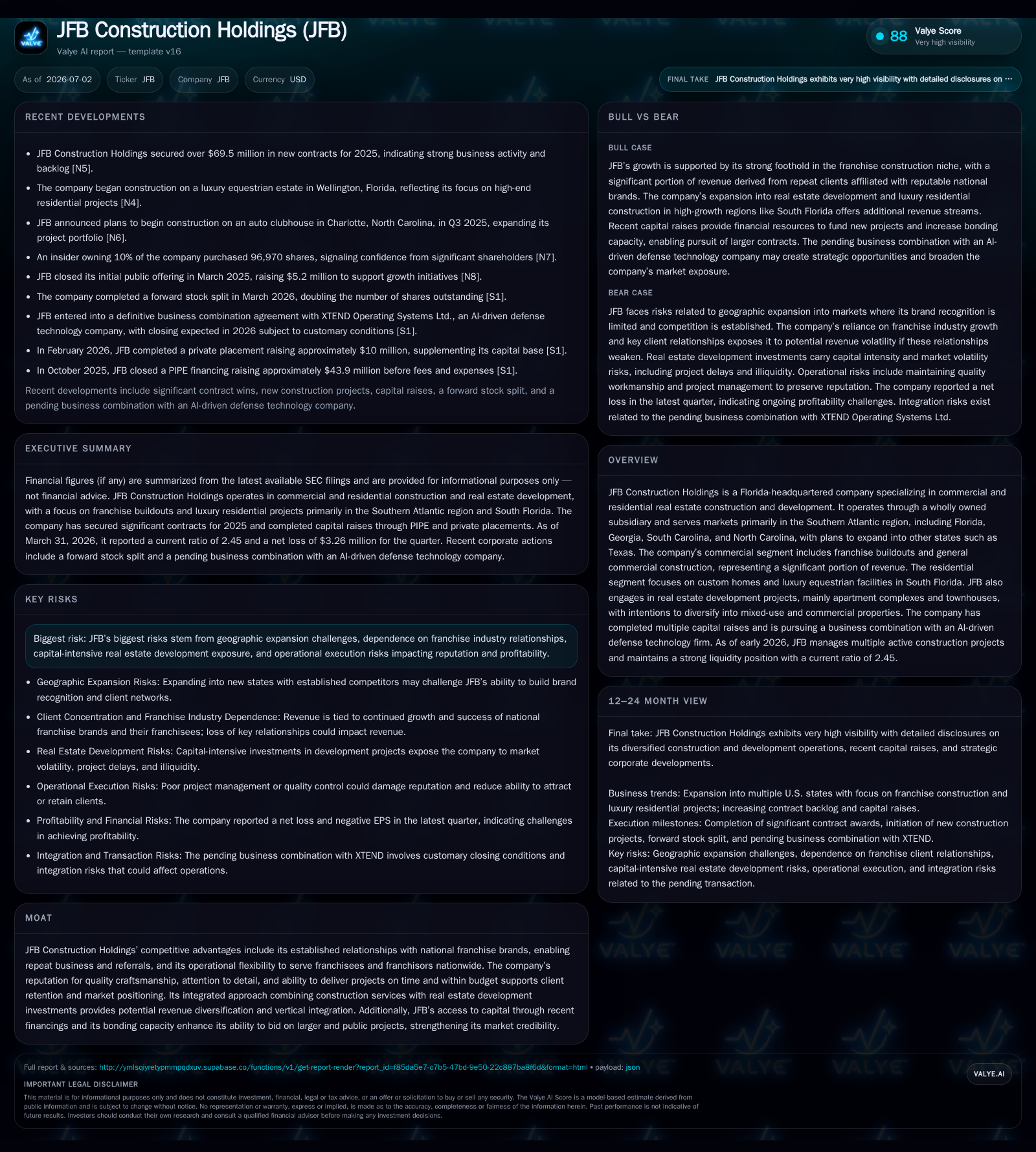
JFB Construction Holdings, a Florida-based builder specializing in commercial franchise buildouts, general contracting, and residential development, posted a 115% revenue increase in Q1 2026 versus Q1 2025 [S2][S5]. The company is actively expanding beyond its Southern Atlantic base into states like Texas, targeting franchise relationships to fuel commercial contracting growth and joint ventures to drive larger real estate development projects [S1][S18]. JFB is also pursuing a merger with an AI-driven defense technology firm to diversify its business model and market exposure [S1][S17]. Key risks include execution challenges around geographic expansion, labor and material cost inflation, and management’s limited public company experience [S1][S24].
Recent Operating Update
JFB Construction Holdings reported a robust 115% increase in revenue for the first quarter of 2026 compared to the same period in 2025, driven primarily by growth in its commercial franchise buildouts and general contracting segments [S5][S2]. This surge reflects the company’s expanding footprint beyond its traditional Southern Atlantic base, with projects completed in 36 states historically and an increasing focus on franchise-related commercial construction nationwide [S1][S29]. In June 2026, JFB issued 25,000 shares as a transaction achievement bonus to its Chief Operating Officer, underscoring executive alignment with the ongoing all-stock merger with Xtend Reality Expansion Ltd., an AI-driven defense technology firm. This merger, valued at approximately $1.5 billion, is anticipated to close mid-2026 pending regulatory and shareholder approvals, marking a strategic diversification beyond JFB’s core construction and development operations [S3][S11][S17].
Business Model Overview
JFB Construction Holdings operates across three primary segments: commercial construction, residential construction, and real estate development [S1][S18]. The commercial construction segment, which accounted for roughly half of the company’s 2025 revenue, specializes in franchise buildouts and general contracting services. These projects typically involve fixed-price or guaranteed maximum price contracts awarded by franchisors and franchisees seeking consistent, reliable builders capable of delivering turnkey retail and shopping center spaces. JFB’s established relationships with franchise networks enable it to secure repeat contracts across multiple states, providing operational flexibility uncommon among regionally focused contractors [S1][S29]. The company has delivered over two million square feet of commercial retail space across 36 states, demonstrating a broad geographic reach supported by a bonding capacity that facilitates bidding on larger multi-state projects.
The real estate development segment focuses on multifamily housing projects concentrated in South Florida, including apartment complexes and townhouses. JFB plans to expand this segment into other southern U.S. markets such as Texas and South Carolina through joint ventures with aligned partners, leveraging its regional success to scale development activities [S1][S18]. This segment generates revenue through property sales and leasing income post-development, complementing construction contract revenues and enhancing overall profitability through vertical integration.
Residential construction centers on luxury custom homes, particularly within South Florida’s equestrian market. This segment remains geographically concentrated, reflecting the bespoke nature of high-end residential builds and the importance of local design and construction expertise [S18][S29].
JFB’s vertically integrated business model combines direct construction contracting with real estate development investment, creating multiple monetization streams. This approach captures value both from billable construction services and from investment returns on developed properties. However, it also introduces capital intensity and exposure to real estate market cycles, requiring careful management of financing and project risk.
Industry Structure and Competitive Positioning
The construction and real estate development industry is characterized by cyclical demand, capital intensity, and reliance on strong client relationships, bonding capacity, and efficient project management [S29]. JFB competes with national and regional general contractors as well as specialized real estate developers. While publicly traded peers include firms like Tutor Perini and Fluor Corporation in construction, and Lennar or Toll Brothers in residential development, JFB’s competitive advantage lies in its trusted franchise relationships that drive repeat commercial contracting opportunities nationwide
Operationally, the company’s ability to manage subcontractors, control change orders, and mitigate cost overruns is critical to maintaining project margins, although specific KPIs such as project margin or change order frequency are not publicly disclosed. Expansion into new states introduces challenges including weaker brand recognition, more intense local competition, and increased regulatory complexity, especially given Florida’s stringent building codes and permitting processes [S26]. Labor market tightness and skilled workforce shortages remain significant risks, as the ability to recruit and retain qualified project managers and subcontractors directly impacts project completion rates and profitability [S1].
Growth Drivers
JFB’s growth is supported by favorable demographic and economic trends in the Sunbelt region, including population migration to Florida and Texas, which fuels demand for retail franchise expansions and multifamily housing developments. The company’s strategic capital raises—$43.9 million gross proceeds from a late-2025 private placement and an additional $10 million raised in early 2026—have strengthened its financial flexibility to pursue larger-scale real estate projects and expand its commercial contracting footprint [S17]
The planned merger with Xtend AI Robotics represents a strategic diversification into defense technology, potentially enhancing corporate resilience against construction sector cyclicality and opening new revenue streams [S1][S17]. This transaction also signals JFB’s ambition to evolve beyond traditional construction and real estate development into technology-driven markets
Risks and Watchpoints
Key risks include execution challenges associated with geographic expansion, where JFB must build brand awareness and compete against entrenched local contractors with established client and supplier networks. The company faces operational complexity in managing a geographically dispersed workforce and subcontractor base, with potential cost overruns and delays impacting project margins [S1][S29].
Labor shortages and wage inflation pose ongoing threats to profitability, as does volatility in construction material costs exacerbated by tariffs and supply chain disruptions. Fixed-price contracts common in franchise buildouts increase exposure to cost overruns if inflationary pressures are not effectively managed [S1][S26].
Governance and compliance risks stem from management’s limited experience operating a publicly traded company. JFB has disclosed deficiencies in internal controls over financial reporting, necessitating investments in compliance infrastructure and potentially increasing legal and accounting expenses [S1][S24].
Capital intensity in real estate development exposes the company to liquidity risks if financing conditions tighten or market demand softens [S17]. The merger integration with Xtend AI Robotics also carries typical risks, including management distraction and unanticipated integration costs
What To Watch Next
The successful closing of the Xtend merger, expected mid-2026, is a critical near-term milestone [S28][S17]. Stockholder approvals have been secured via written consent from major shareholders, including founding family trusts, but regulatory clearance and integration execution remain key watchpoints
Operationally, monitoring JFB’s ability to scale bidding activity and contract wins outside its core Southern Atlantic region will indicate progress toward establishing a sustainable national footprint. Key performance indicators such as backlog size and composition, project completion rates, subcontractor utilization, change order frequency, and margin trends will be important metrics to assess operational health, though current disclosure remains limited.
Financially, further capital raises or debt financings to support larger developments will signal confidence in the company’s project pipeline and liquidity position. Leadership changes, particularly the addition of executives with public company experience, will be important to watch as JFB strengthens governance and compliance capabilities.
Financial Profile Discussion
As of March 31, 2026, JFB reported current assets of $20.64 million against current liabilities of $8.43 million, resulting in a strong current ratio of approximately 2.45, indicating solid liquidity to support working capital needs and capital-intensive development projects [F1]
Despite a trailing twelve-month operating loss of $5.65 million and net loss of $5.27 million ending December 31, 2025, these results reflect upfront investments typical of a growing construction and development firm transitioning to larger-scale operations post-public listing [F1]. The capital raises completed in late 2025 and early 2026, totaling roughly $53 million in gross proceeds, have materially enhanced JFB’s financial flexibility to pursue expansion initiatives and larger project bids [S17].
In summary, JFB Construction Holdings is demonstrating strong operational momentum fueled by franchise-driven commercial construction demand and strategic real estate development growth. The upcoming merger with an AI-driven defense technology company marks a significant strategic evolution, diversifying the company’s business model and market exposure. Execution risks related to geographic expansion, labor market conditions, and public company governance remain critical factors to monitor as JFB scales its operations nationally.
Disclaimer: This is research-only, informational analysis and not investment advice. It may include AI-generated interpretation and general industry context. Always verify important details using primary sources.

Comments