
Blaize Holdings Battles Customer Concentration and Margin Pressure While Advancing AI Chips for Edge Applications
Latest quarterly results highlight customer concentration risks, supply chain dependencies, and ongoing R&D investments in next-gen automotive AI chips.
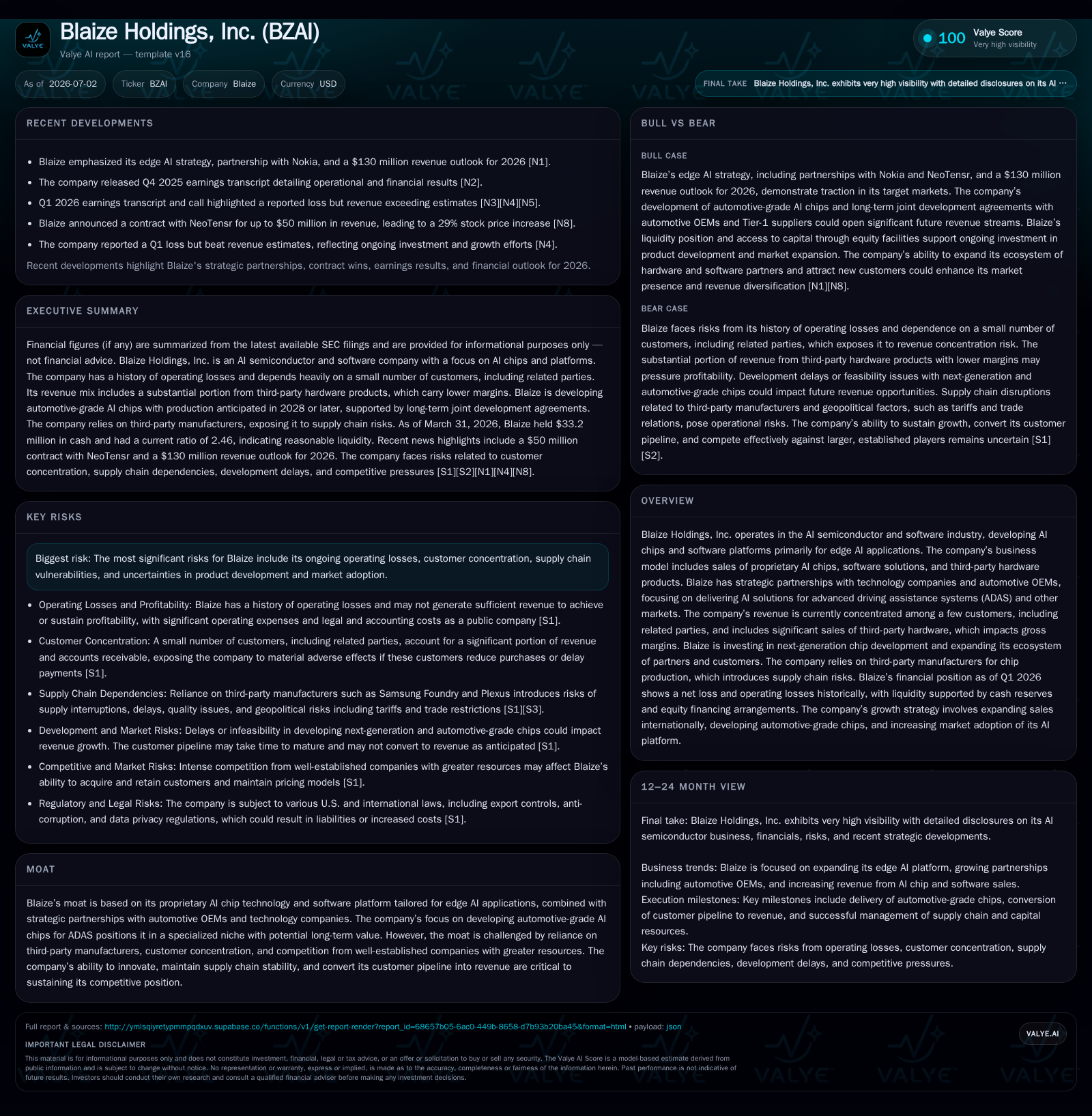
Blaize Holdings, Inc. reported Q1 2026 results indicating modest revenue with persistent operating losses weighed down by significant sales of lower-margin third-party hardware alongside proprietary AI chips. The company’s business model revolves around AI semiconductors and software platforms tailored for edge AI, emphasizing automotive ADAS applications through key OEM partnerships. Blaize faces critical challenges including high revenue concentration among few customers, supply chain reliance on third-party foundries, and a lengthy sales cycle typical in its sector. Investments in next-generation chip development and ecosystem expansion remain central to its growth strategy, though financial sustainability hinges on diversifying customers and improving gross margins.
Recent Operating Update
Blaize Holdings, Inc. reported preliminary revenue of approximately $2.7 million for the first quarter ended March 31, 2026, reflecting continued moderate growth amid a concentrated customer base [S2],[S14]. The company disclosed a new potential contract with NeoTensr valued at up to $50 million within the first year, contingent on purchase order issuance, signaling efforts to diversify beyond historically concentrated related-party customers who have accounted for over 90% of revenues in prior periods [S4],[S13],[S6],[S9]. However, as of the latest filing, no firm purchase orders had been received under this agreement.
Liquidity remains solid with cash and cash equivalents of approximately $33 million as of March 31, 2026, and a current ratio of 2.46, supported by low total debt of about $1.5 million measured at the end of 2024 [F1]. This financial position underpins ongoing investments in research and development despite sustained operating losses.
Business Model Overview
Blaize operates at the intersection of AI semiconductor chip design and software platform development, specializing in edge AI applications that require real-time, low-latency processing, particularly in automotive Advanced Driver Assistance Systems (ADAS) [S1]. The company’s revenue is primarily generated through sales of proprietary AI chips optimized for energy-efficient, high-performance inference at the edge, alongside licensing or providing software platforms that enable seamless integration of these chips into customer systems. Additionally, Blaize sells third-party hardware products, which contribute to revenue but typically carry lower gross margins [S1].
The company outsources semiconductor fabrication to Samsung Foundry and relies on Plexus for assembly and testing, making it dependent on these key partners amid industry-wide foundry capacity constraints and supply chain risks [S1]
Customer contracts are largely long-term collaborations with automotive OEMs and Tier-1 suppliers targeting auto-grade AI chips that meet stringent reliability and safety standards required for ADAS applications. Revenue recognition is often contingent on achieving validation milestones, reflecting the extended product development cycles typical in automotive markets [S1]
Industry Structure and Competitive Position
Blaize competes in a specialized segment focused on edge AI accelerators that balance computational performance with power efficiency under strict physical and thermal constraints. The competitive landscape includes established semiconductor firms such as NVIDIA, Qualcomm, Ambarella, Intel, and AMD/Xilinx, which benefit from scale in R&D, manufacturing partnerships, and extensive OEM relationships.
While Blaize’s proprietary chip-software integration tailored for ADAS use cases and select strategic partnerships provide differentiation, the company faces challenges related to customer concentration, with a small number of related-party customers historically accounting for over 90% of revenue, which poses risks to revenue stability and bargaining leverage [S6],[S9].
Supply chain vulnerabilities are significant given reliance on third-party foundries like Samsung, where disruptions or capacity limitations could delay production and increase costs [S1],[S9].
Growth Drivers
Blaize’s growth strategy is supported by several structural demand trends:
- Increasing adoption of edge AI computing driven by the proliferation of automotive ADAS systems requiring local, low-latency AI inference to enhance vehicle safety.
- Expansion into adjacent markets such as industrial IoT, where edge intelligence improves automation and operational efficiency.
- Ecosystem expansion through strategic OEM partnerships that facilitate broader deployment and recurring revenue opportunities.
- Continued development of next-generation AI chips aimed at improving performance-per-watt metrics to differentiate from legacy solutions.
- Growing adoption of proprietary software platforms that provide scalable integration frameworks across diverse customer deployments.
- Geographic expansion beyond domestic markets leveraging cross-border collaborations.
These drivers align with industry trends favoring distributed intelligence models over centralized cloud processing for latency-sensitive edge applications.
Risks and Watchpoints
Despite promising structural tailwinds, Blaize faces several execution risks:
- Customer Concentration: Heavy dependence on a few customers, including related parties, exposes Blaize to revenue volatility and credit risk if these customers reduce orders or switch to competitors [S6],[S9].
- Supply Chain Dependencies: Outsourcing manufacturing to third-party foundries like Samsung introduces risks of capacity bottlenecks, geopolitical trade disruptions, and challenges in qualifying alternative suppliers [S1],[S9].
- Margin Pressures: A significant portion of revenue from lower-margin third-party hardware sales suppresses overall gross margins; improving profitability depends on increasing the share of proprietary chip sales [S1].
- Long Sales Cycle: Enterprise and OEM procurement processes are lengthy and resource-intensive, requiring extensive technical validation before volume production contracts are secured, limiting near-term revenue visibility [S1].
- Product Development Risks: Advancing next-generation AI chips from prototype to commercial production requires substantial R&D investment and faces technical challenges that could delay market entry or impair competitiveness [S1].
- Competitive Intensity: Established semiconductor firms with deeper resources and broader ecosystems may constrain Blaize’s market share growth and pricing power.
What to Watch Next
Key developments to monitor include:
- Confirmation and ramp-up of the NeoTensr contract, with particular attention to purchase order issuance and revenue realization from this $50 million potential deal [S4],[S13].
- Progress milestones in next-generation chip development, including silicon tapeouts, partner validations, and readiness for commercial shipments.
- Changes in customer concentration metrics, with successful onboarding of new customers reducing dependency risks.
- Gross margin trends indicating a shift toward higher-margin proprietary products versus third-party hardware.
- Supply chain status, especially foundry capacity utilization and any disruptions impacting production schedules.
- Sales pipeline evolution reflecting the pace at which enterprise and OEM customers progress through validation to volume commitments.
- Capital raising or financing activities that could affect liquidity and capital structure amid ongoing operating losses.
Financial Profile Discussion
Blaize’s balance sheet remains adequately liquid, with approximately $33 million in cash and cash equivalents as of March 31, 2026, and a current ratio of 2.46, supported by low total debt of around $1.5 million as of end-2024 [F1]. This liquidity provides a runway to fund ongoing R&D and commercialization efforts despite operating losses exceeding $100 million and net losses over $200 million in the prior fiscal year [F1],[S1].
The company has accessed capital through private placements and equity facilities, which are critical to sustaining operations during this high R&D intensity phase [S7],[S26]. Monitoring cash burn relative to progress on commercialization milestones will be essential to assess financial sustainability.
Disclaimer: This analysis is based on publicly available filings and is for informational purposes only. It does not constitute investment advice or endorsement. Readers should consult primary sources for verification.
Disclaimer: This is research-only, informational analysis and not investment advice. It may include AI-generated interpretation and general industry context. Always verify important details using primary sources.

Comments