
Luda Technology’s Strategic Pivot into AI Data Centers amid Manufacturing Revenue Decline
Lower manufacturing sales pressure margins while entry into AI infrastructure signals diversification.
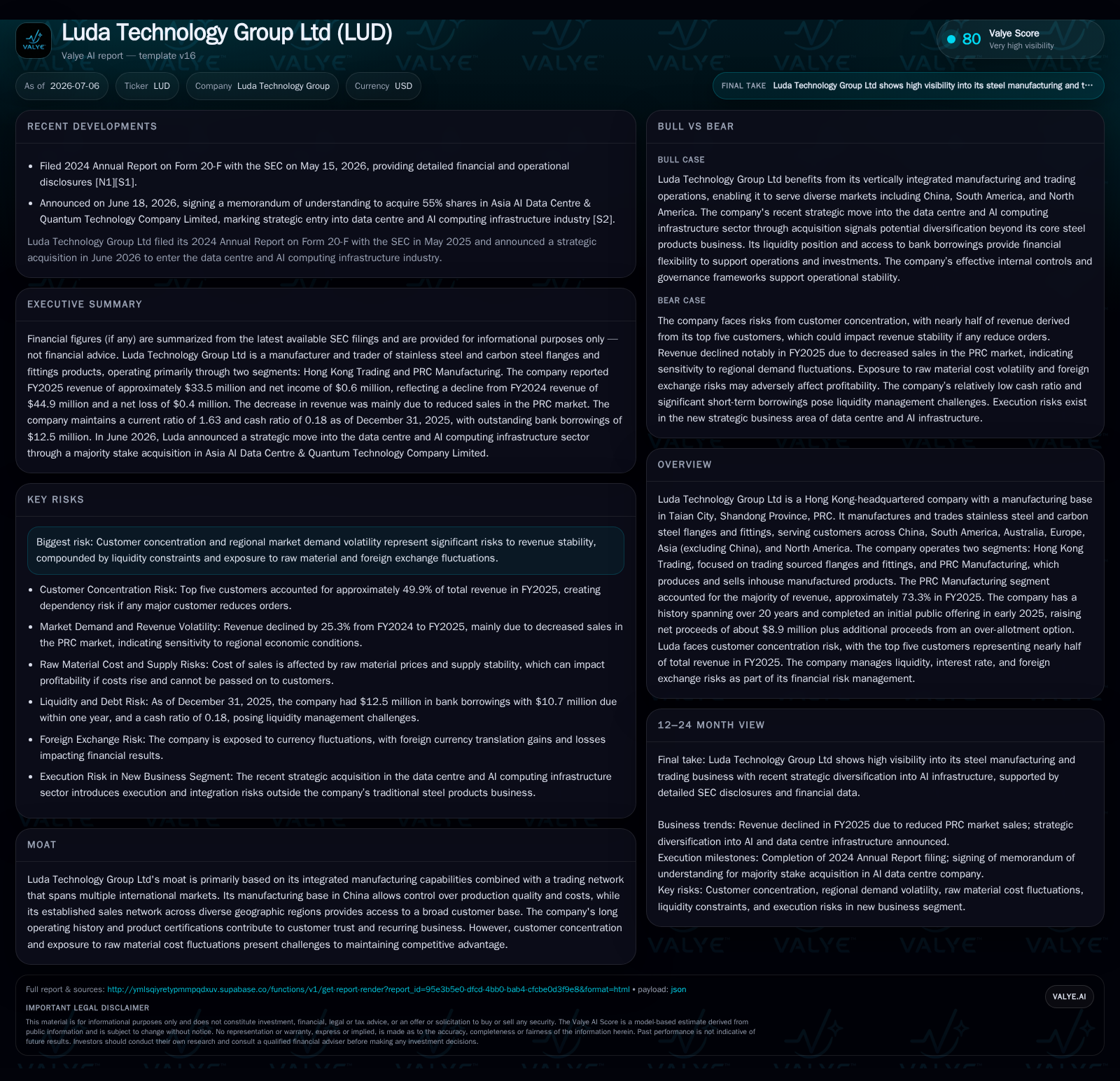
Luda Technology Group Ltd reported a 25% revenue decline in FY2025 driven chiefly by lower in-house manufacturing sales in China, which remains its dominant market. Gross profit margins contracted sharply as cost improvements lagged revenue erosion. The company is pursuing strategic diversification into AI data center infrastructure through a new acquisition agreement, marking a material shift from its traditional steel flange and fittings focus. Customer concentration and exposure to raw material costs continue to pose downside risks. Operationally, managing working capital and foreign exchange will remain key given Luda’s international distribution. Monitoring execution of the AI infrastructure expansion alongside stabilizing manufacturing volumes will provide critical evidence on reshaping its growth trajectory.
Recent Operating Update
Luda Technology Group Ltd's most recent update highlights a pronounced shift in its business dynamics during FY2025. The company experienced a significant decline in total revenue by approximately $11.3 million or 25.3%, falling from $44.9 million in FY2024 to $33.5 million in FY2025. This contraction predominantly stems from lower in-house manufactured products sales within its PRC Manufacturing segment, which accounted for about 73.3% of total revenues in FY2025 down from 83.8% in the prior year [S1]. This underlines an ongoing weakening demand environment within its largest geographic and operational footprint — the Chinese industrial market.
Concurrently, Luda signed a memorandum of understanding (MOU) on June 18, 2026, to acquire a controlling interest (55%) in Asia AI Data Centre & Quantum Technology Company Limited. This deal marks the company's strategic diversification into data center and artificial intelligence computing infrastructure sectors [S2]. The move represents a fundamental addition outside traditional steel flange manufacturing and trading activities, potentially offsetting some cyclical pressures the core business faces.
Additionally, board-level changes occurred with the resignation of Ms. Liu Liangping from her directorship while retaining COO responsibilities focused on mergers and acquisitions efforts, indicating internal prioritization of corporate development initiatives alongside operational leadership continuity [S3].
Business Model Analysis
Luda operates through two primary segments: Hong Kong Trading and PRC Manufacturing. The trading segment involves sourcing and distributing flanges and fittings sourced externally, contributing roughly 27% of FY2025 revenues but with generally thinner margins compared to manufacturing operations which leverage the company’s Taian City-based facility for production control and cost management [S1]
Revenue is mostly generated from sales of stainless steel and carbon steel flanges used as essential components across chemical processing, petrochemical plants, maritime vessels, and general manufacturing systems requiring durable piping connections. Customers are mainly manufacturers or traders operating at industrial sites requiring certified quality components for plant construction or maintenance.
Revenue mechanics hinge on order volume influenced by industrial capital expenditures and infrastructure projects within China and internationally across South America, Australia, Europe, Asia (excluding China), and North America — regions that comprise Luda's diversified sales network but remain secondary markets relative to China dominance [S1]. Margins fluctuate materially with raw material costs—steel prices—labor overheads, production efficiency gains or disruptions, and logistics expenses impacting cost of goods sold (COGS).
The business monetizes via conventional product unit sales contracts; pricing power depends heavily on product certifications and established customer relationships given intense competition from low-cost manufacturers around Asia's steel hubs.
Industry Structure and Competitive Positioning
The steel flanges and fittings market is broadly cyclical with demand tied tightly to macroeconomic industrial investment cycles such as chemical plant expansions or maritime fleet upgrades. Enterprises like Luda face cost pressures from volatile raw material prices typically set by larger steel mills upstream as well as foreign exchange risk due to currency mismatches between RMB-denominated production expenses and USD-denominated international sales.
Luda’s integrated model combining manufacturing—with direct control over product quality—and trading through its Hong Kong base aims to provide flexibility and geographic reach but also exposes it to execution complexity balancing both segments efficiently.
Peer companies include both dedicated flange manufacturers focusing solely on production efficiency and trading houses specializing exclusively in distribution networks without owning upstream capacity—positioning Luda into the middle stream of the value chain.
Key competitive challenges include managing customer concentration—with top five customers accounting for nearly half revenue—a factor increasing bargaining power risk against large industrial clients; navigating price competition particularly from lower-cost Southeast Asian producers; integrating supply chains reliably amidst recent global disruptions; plus sophistication needed for compliance certifications trusted by petrochemical majors.
Growth Drivers
Historically growth has relied on expanding domestic Chinese market share leveraging proximity advantages plus developing international channels especially into South America where Luda posted revenue increases despite wider contraction domestically [S1]. Rising demand for corrosion-resistant stainless steel flanges supports moderate pricing power potential given limited substitution options.
Operational efficiency improvements reducing overheads or waste could boost gross margins if volume stabilizes or recovers.
Most notably, the acquisition MOU targeting AI data center infrastructure domain opens potential high-margin growth avenues beyond traditional industrial hardware products—a sector benefiting structurally from exponential digitalization trends requiring specialized computing facilities across Asia-Pacific region [S2]
If executed well, this strategic pivot could diversify revenue streams away from cyclical metallurgy demand corridors toward growing tech asset management segments.
Risks and Constraints
Customer concentration heightens risk that loss or reduction of major contracts could cause sharp revenue drops without immediate recompense; contract renewal cycles warrant close monitoring.
Foreign exchange fluctuations contributed positively in FY2025 compared with losses previously ([S20]), but currency exposures still require active management given cross-border sales receipts versus RMB cost bases.
Regulatory uncertainties affecting trade policies or environmental standards in China or abroad may raise compliance costs or constrain expansion plans.
What to Watch Next
Investors should monitor quarterly updates for signals that Luda stabilizes or rejuvenates PRC manufacturing sales volumes especially after initial pandemic-related headwinds appear abating globally.
Progress regarding the Asia AI Data Centre acquisition—including completed due diligence milestones, capital deployment pace, integration success metrics—and any subsequent financial impact disclosures will be crucial indicators of growth strategy viability.
Margin trends reflecting raw material pricing stabilization alongside sustained reduction in selling expenses (especially consulting fees) would suggest improved operating discipline aligned with revenues.
Working capital metrics such as inventory turnover rates or receivables aging will reveal how effectively management manages cash conversion cycles amid inventory buildup risks prevalent within steel product manufacturing.
Tracking changes in customer diversification efforts or new contract wins would mitigate concentration risk perceptions over time.
Financial Profile Discussion
Interest expense remained stable around $0.52–0.56 million annually despite sizable bank loan balances indicating effective cost containment of funding costs but susceptible to future rate rises given floating rate structure noted between about 2.64% and 6.95% annual effective rate range [S7],[S19].
Disclaimer: This is research-only, informational analysis and not investment advice. It may include AI-generated interpretation and general industry context. Always verify important details using primary sources.

Comments