
Helen of Troy’s Strategic Reset Targets Innovation and Brand Strength Amid Operational Challenges
Recent quarterly results highlight the company’s focus on product innovation, brand portfolio optimization, and supply chain resilience to drive long-term growth.
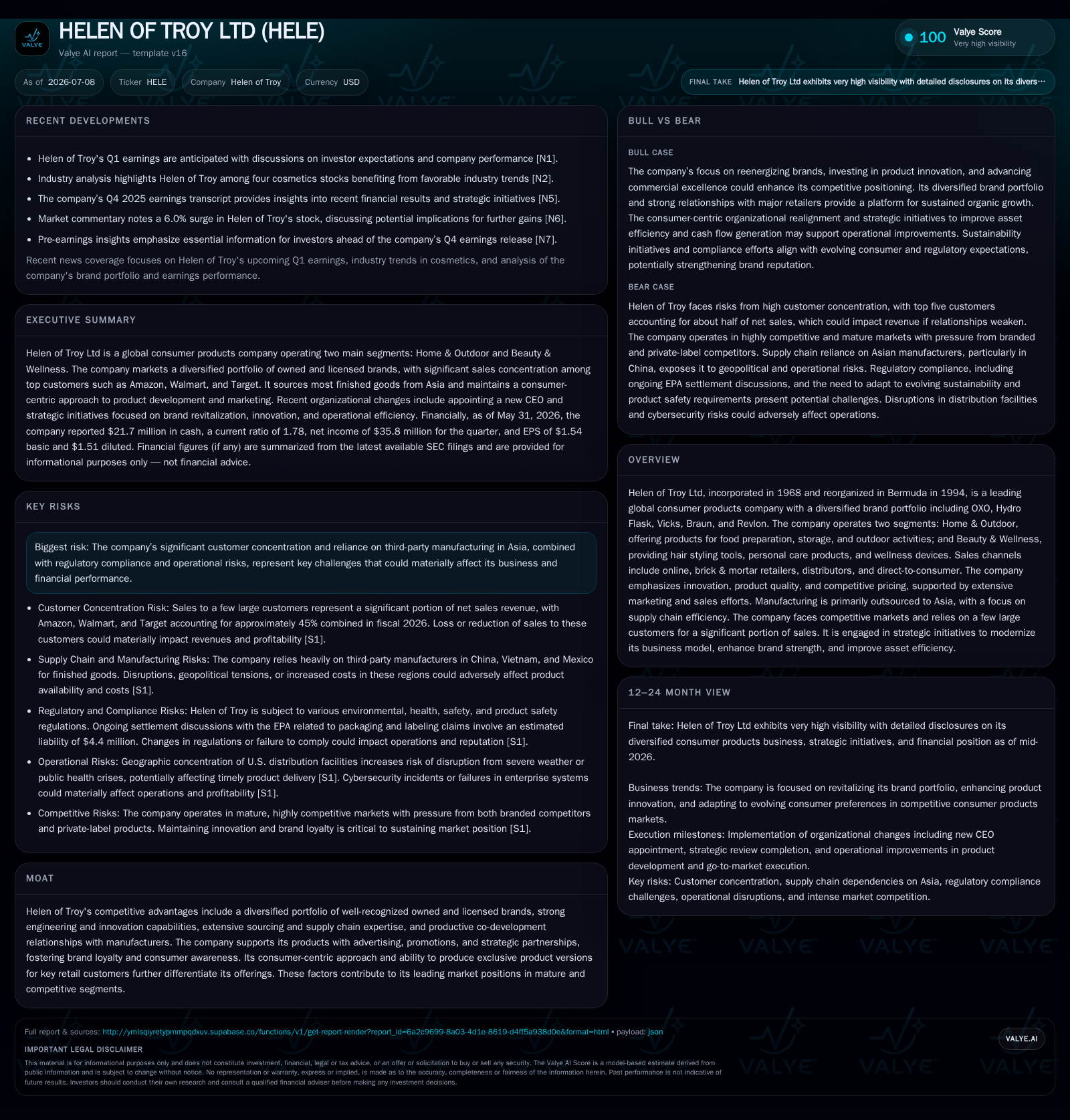
Helen of Troy Ltd reported a swing to profitability in Q1 fiscal 2027, signaling early benefits from its strategic initiatives under new leadership. The company operates two key segments—Home & Outdoor and Beauty & Wellness—with a diversified portfolio including OXO, Hydro Flask, Vicks, Braun, and Revlon. Its business model relies heavily on third-party Asian manufacturing and multi-channel distribution encompassing online, brick-and-mortar, and direct-to-consumer sales. Significant customer concentration, supply chain risks, and regulatory compliance remain key challenges. Going forward, innovation pipeline execution, channel mix shifts toward e-commerce, and leveraging brand equity will be critical for sustainable revenue and margin expansion.
Recent Operating Update
The quarterly update did not indicate changes in risk exposure compared to the prior annual filing but reaffirmed ongoing challenges stemming from customer concentration risks—particularly sizable reliance on Amazon—and supply chain vulnerabilities largely tied to third-party manufacturing centered in Asia [S2][S17][N3].
Business Model Overview
Helen of Troy operates through two primary reportable segments—Home & Outdoor and Beauty & Wellness—that collectively address diverse consumer needs through a broad spectrum of branded products. The Home & Outdoor segment offers kitchenware (under OXO), beverageware (Hydro Flask), food storage solutions (OXO Good Grips), and outdoor equipment like backpacks (Osprey), targeting both everyday use at home and active lifestyle consumers. Beauty & Wellness encompasses personal care appliances (Braun electric razors), hair styling tools (Hot Tools, Drybar), nail care (Olive & June), as well as wellness devices like humidifiers and air purifiers under brands such as Vicks [S1].
Revenue derives fundamentally from designing innovative products that resonate with consumers followed by monetization through wholesale channels including major brick-and-mortar retailers and online platforms as well as direct-to-consumer e-commerce channels that have been growing importance [S24][S25]. Profitability hinges on effective supply chain management since manufacturing is almost entirely outsourced to third-party vendors in China (57% of goods), Vietnam, and Mexico (83% total Asia-based manufacturing), where Helen of Troy benefits from cost efficiencies but faces geopolitical risks including tariffs and labor cost inflation
The company also manages a complex brand portfolio mixing wholly owned brands with licensed properties such as Revlon in beauty segments. This dual approach allows scale leverage but adds licensing compliance complexity.
Marketing investments coupled with timely product innovation cycles are critical levers driving consumer loyalty, allowing Helen of Troy to develop exclusive product versions negotiated alongside large retail partners which imposes both opportunity for differentiation as well as operational requirements like shorter lead times and customized packaging that impact margins [S1][N12].
Industry Structure and Competitive Position
Within the branded consumer products sector specializing in home goods and personal care appliances, Helen of Troy competes against diversified peers such as Procter & Gamble for general consumer household items; Estée Lauder or Revlon for beauty/wellness products; Newell Brands offering similar multi-category goods; plus specialty firms focusing on either wellness devices or kitchenwares like Spectrum Brands or container manufacturers.
Helen of Troy’s competitive moats encompass a diversified yet cohesive portfolio featuring widely recognized brands supported by investment in engineering innovation which helps sustain differentiated product offerings[S1][N12]. Its extensive supplier network across Asia provides agility but also elevates exposure relative to peers pursuing more geographically consolidated sourcing strategies.
Brand loyalty metrics combined with marketing spend efficiency underpin consumer traction particularly important amid fragmented retail attention spans. However, sizeable revenues concentrated among a handful of customers—Amazon accounting for one-fifth annually—and high dependence on third-party manufacturers introduce volatility uncommon in firms with broader retail penetration or vertically integrated production models [S17][S24]
Growth Drivers
Key growth drivers arise from several avenues. First is accelerating product innovation by intensifying R&D investments aimed at delivering world-class innovations aligned with evolving consumer preferences for health-conscious wellness devices or convenient home solutions [S12][N12]. Keeping pace here mitigates risk from shifting trends.
Second is expansion of direct-to-consumer sales channels which allow margin improvements versus wholesale while stimulating stronger customer engagement data for future targeting. This reflects an industry-wide shift favoring omnichannel presence blending e-commerce with traditional retail reach.
Thirdly comes strategic diversification away from heavy reliance on Chinese manufacturing toward suppliers in Vietnam or Mexico aiming at tariff avoidance and supply chain risk reduction[S25]. Such initiatives impact cost base gradually but are essential considering geopolitical uncertainties.
Further potential derives from selectively adding new brands or acquiring complementary categories that fit within Helen of Troy’s portfolio framework without diluting focus.
Finally, enhancing marketing effectiveness through targeted promotions improves brand recall and boosts loyalty critical amidst numerous competing alternatives available to consumers.
Risks and Watchpoints
Notwithstanding positive momentum in Q1 FY2027 results, Helen of Troy remains exposed to several salient risks [S17]. Customer concentration persists as a double-edged sword—it facilitates high-volume orders but heightens vulnerability should any major retailer curb purchases due to economic downturns or competitive repricing demands given loose purchasing agreements absent guaranteed volumes
Reliance on Asian third-party manufacturers presents persistent threat vectors including supply disruptions caused by pandemics, escalating labor costs triggered by government policies affecting wages or workforce availability in China or Vietnam, extended ocean freight delays impacting inventory turnover rates negatively impacting working capital cycles[S24][S25].
Regulatory matters stemming from the EPA settlement over labeling compliance in certain Beauty & Wellness segment humidifiers impose financial liabilities ($4.4 million accrued) alongside reputational risks that could disturb product acceptance if not managed properly [S21]
Cybersecurity vulnerability poses material risk as reliance on global ERP systems creates exposure points that could disrupt operations materially if breached[S1][S9]. Industry-wide tightening privacy laws also create evolving compliance burdens potentially increasing operating expense.
Macroeconomic conditions remain a wildcard affecting discretionary spending patterns at retail partners; prolonged downturns or public health crises may pressure volumes further given Helen of Troy’s product positioning skewed toward lifestyle discretionary categories[S1][S24].
Lastly operational execution risk surrounds translating strategic priorities into concrete performance improvements efficiently without excessive capital deployment or margin dilution which has historically been challenging.
What to Watch Next
Investors should closely monitor upcoming quarterly earnings updates for evidence that the company’s strategic reset translates into sustained top-line growth and margin recovery. Key indicators include acceleration in product innovation throughput measured by new SKU introductions supported by rising sales penetration rates across both reportable segments.
Tracking channel mix evolution—particularly growth rate acceleration in direct-to-consumer sales versus wholesale—would provide early signals regarding successful omnichannel adoption enhancing margin profiles.
Supply chain developments related to diversification progress outside China will be pivotal given current geopolitical uncertainties impacting input costs. Observing vendor lead times alongside inventory turnover metrics can illuminate operational resilience improvements.
Additionally monitoring gross margin trends vis-à-vis tariff cost pass-through capability will reveal pricing power durability in competitive categories.
Any updates on EPA settlement progress could influence provisioning outlooks while legal disclosures around cybersecurity incidents or privacy compliance adjustments would warrant attention due to cost implications.
Finally monitoring cash flow generation within the context of mentioned strategic investments serves as a barometer for balance sheet strength supporting long-term value creation initiatives [N3][S2][S12]
Financial Profile Discussion
As of May 31, 2026, Helen of Troy held cash and equivalents totaling approximately $21.7 million against current liabilities around $480 million with current assets near $856 million yielding a healthy current ratio of approximately 1.78 indicating adequate short-term liquidity to meet obligations[F1]. Total debt reported stood at about $937 million with net debt slightly lower by cash balances reflecting substantial leverage consistent with industry peers managing large portfolios reliant on external financing structures[F1].
Operating income has fluctuated significantly with the latest annual figures showing large operating losses ($782 million) reflecting recent restructuring charges and operational challenges that the new strategy seeks to ameliorate[F1]. Net income similarly swung negative reflecting those impairments ($899 million net loss) underscoring urgency for sustainable earnings recovery.[F1] Cash flow generation efficiency improvements combined with working capital management enhancements remain critical financial KPIs moving forward.
Given these factors along with amendment flexibility obtained under its credit facility extending covenant holidays during challenging periods,[S7] liquidity constraints have been alleviated but continued debt servicing obligations will require firm cash flow projections reaffirmed by profitable operations over the medium term.[S4]
Helen of Troy’s capital allocation emphasis now prioritizes debt repayment alongside selective investment into innovation initiatives supporting reenergized brands poised for long-term sustainable growth [S12]
Disclaimer: This analysis is based solely on publicly available SEC filings up to July 8, 2026,[S2][S3] market news reports,[N3] and industry knowledge frameworks without endorsing any security or providing investment advice.
Disclaimer: This is research-only, informational analysis and not investment advice. It may include AI-generated interpretation and general industry context. Always verify important details using primary sources.

Comments