
Saratoga Investment Corp. Navigates Middle-Market Lending with Focused Credit Strategy and Active Capital Management
Saratoga Investment Corp. continues to execute a disciplined middle-market lending strategy, leveraging tailored debt investments and prudent capital deployment amid evolving market conditions.
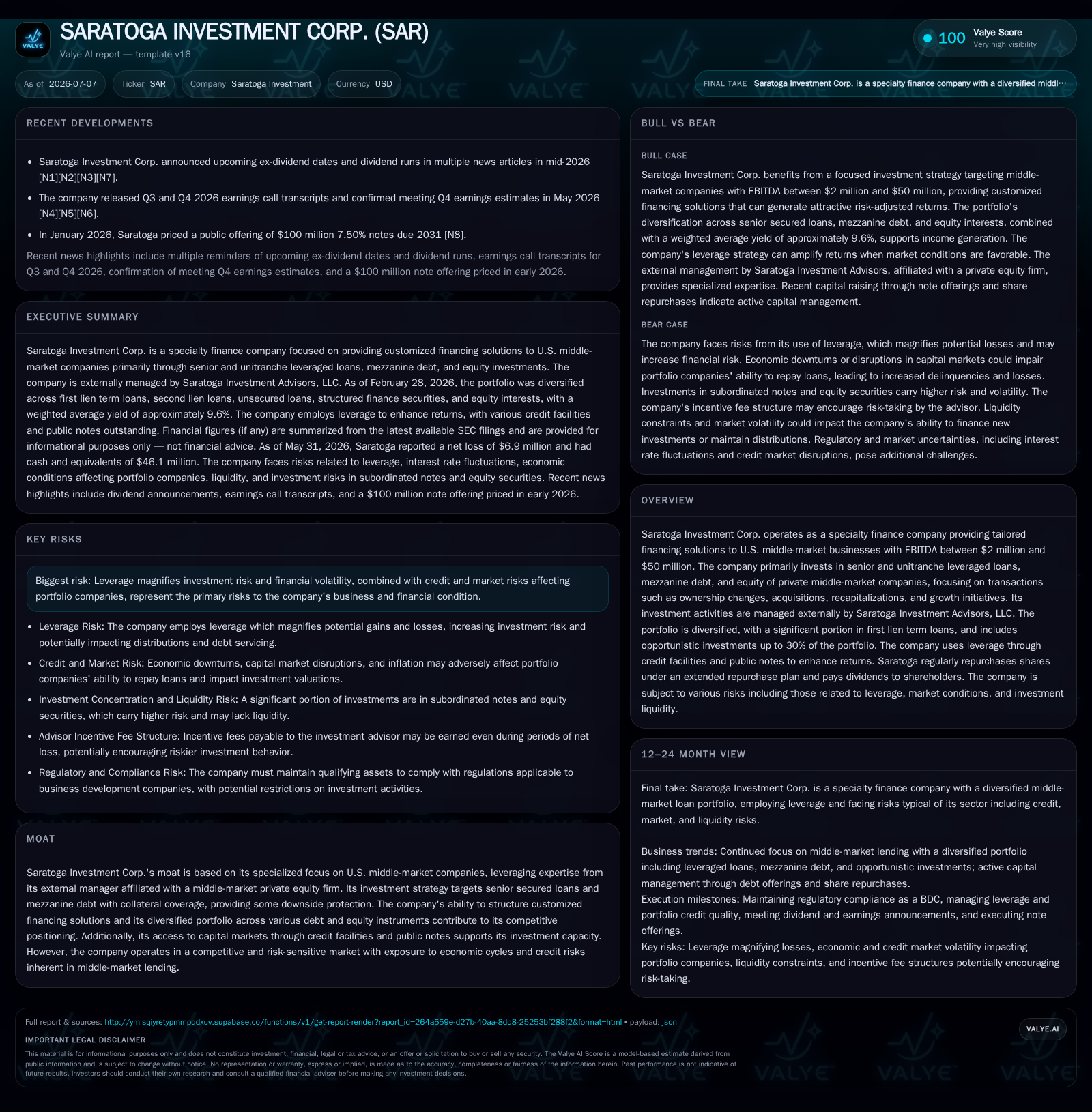
Saratoga Investment Corp., an externally managed specialty finance company, invests primarily in senior secured and mezzanine debt of U.S. middle-market companies with EBITDA between $2 million and $50 million. Its portfolio, diversified across 49 companies, emphasizes first lien term loans that provide collateral support and income stability. The firm employs leverage via credit facilities and public notes within regulatory asset coverage constraints to enhance returns, while actively managing capital through dividends and a long-standing share repurchase plan. Although recent quarterly disclosures show stable performance without senior security defaults, the company remains exposed to credit risk, interest rate fluctuations, and economic uncertainties inherent in middle-market lending. Saratoga’s external management ties to middle-market private equity expertise underpin its sourcing and underwriting capabilities but also introduce fee structure considerations.
Latest Quarterly Update: Operating Stability Amid Market Challenges
In its July 7, 2026 quarterly filing [S2], Saratoga Investment Corp. reaffirmed stable operational execution without any defaults on senior securities during the period. The company did not repurchase shares under its open-market share repurchase program during the quarter but continues this program extended through January 2027 [S2]. A contemporaneous press release [S3] highlighted dividend payments supported by net investment income from its leveraged loan portfolio.
This update underscores Saratoga’s ability to maintain portfolio quality and capital return discipline despite ongoing capital market volatility characterized by fluctuating interest rates and tighter credit conditions. The absence of default events signals effective underwriting and risk management focused on middle-market borrowers.
Business Model: Targeted Specialty Finance in Middle-Market Lending
Saratoga operates as an externally managed specialty finance company targeting U.S. middle-market businesses with EBITDA between $2 million and $50 million [S1]. It primarily invests in senior secured leveraged loans—including unitranche facilities—and mezzanine debt, complemented by selective equity positions. These investments are often structured for change-of-ownership transactions, acquisitions, recapitalizations, or growth initiatives.
The portfolio emphasis on senior secured first lien term loans provides collateralized downside protection while generating current income through interest payments [S1]. Up to 30% of the portfolio may be deployed into opportunistic investments such as distressed debt, structured finance vehicles like collateralized loan obligations (CLOs), or joint ventures aimed at enhancing overall yield
Capital is raised via credit facilities—the Live Oak Credit Facility and Valley Credit Facility—and through issuance of public notes with fixed coupons ranging approximately from mid-6% to high-8% due through 2031 [S10]. These borrowings are subject to asset coverage requirements under RIC/BDC regulations mandating minimum ratios that limit excessive leverage.
Capital return policies balance regular dividend distributions funded by net investment income with opportunistic share repurchases executed when common stock trades below net asset value (NAV), promoting shareholder value under a program extended annually since 2014 [S2]
Industry Context and Competitive Positioning
Within the specialty finance sector serving middle-market companies, Saratoga competes alongside business development companies (BDCs) such as Ares Capital Corporation and Golub Capital BDC, as well as private credit funds managed by firms like Blackstone Credit and Oaktree Specialty Lending. Saratoga’s external management relationship with a middle-market private equity affiliate provides differentiated sector expertise enhancing underwriting rigor and tailored financing execution [S1].
This positioning supports deal origination focused on sponsor-backed transactions where traditional banks have retreated due to regulatory constraints post-financial crisis. Portfolio diversification across industries mitigates idiosyncratic risk while concentration in first lien loans offers collateral support relative to higher-risk mezzanine lenders.
Competition remains intense given overlapping investor demand for yield in constrained bank lending environments. Saratoga’s core advantage lies in relationship-driven sourcing paired with disciplined credit selection designed to protect returns across economic cycles.
Growth Drivers: Disintermediation & Expanding Private Credit Demand
Ongoing disintermediation of traditional banks from middle-market lending creates sustained demand for non-bank lenders capable of providing customized financing solutions like unitranche loans that blend senior and subordinated tranches into one facility.
Investor appetite for private credit strategies continues expanding globally as these vehicles offer attractive spreads over public fixed income markets historically characterized by low yields; although rising rates introduce complexities balancing cost of funds against incremental yield opportunities [S1]. Economic expansion fuels mergers & acquisitions activity along with ownership transitions that require specialized financing products Saratoga offers.
Innovations in loan structuring—such as incorporating payment-in-kind (PIK) interest options—allow tailoring to borrower cash flow profiles supporting origination volumes [S10]. Access to SBA-guaranteed debentures alongside staggered public note maturities enhances leverage capacity while managing refinancing risks effectively
Risks & Watchpoints: Credit Quality & Leverage Exposure
Leverage amplifies gains but also magnifies losses given significant borrowings relative to equity base [S10]. This heightens vulnerability to borrower defaults or repayment delays especially since most leveraged loans lack amortization prior to maturity concentrating principal risk.
Credit risk intensifies cyclical sensitivity; economic downturns could increase non-performing loans leading to write-downs impacting NAV directly [S1]. Interest rate volatility poses dual challenges: rising rates increase funding costs potentially compressing net yields if loan coupons reset slowly or remain fixed; falling rates reduce cost but may narrow spreads.
Limited liquidity inherent in private debt restricts Saratoga’s ability to divest assets promptly without discounts under stress scenarios complicating risk management [S1]. CLO holdings add tranche-specific collateralization test risks which could reduce cash flows absent remedial actions [S18].
Externally managed fee arrangements may create incentive misalignments where base fees persist irrespective of performance while incentive fees might encourage heightened risk-taking unless controlled effectively [S1]. Regulatory compliance under the Investment Company Act imposes operational constraints limiting strategic flexibility.
What To Monitor Going Forward
Investors should track quarterly net investment income against dividend payouts as indicators of distribution sustainability alongside trends in non-performing assets disclosed periodically [S3]. Share repurchase activity signals management’s assessment of valuation relative to NAV.
Shifts toward higher-risk opportunistic investments versus senior secured loans may indicate evolving risk appetite or yield-seeking behavior.
Origination volumes relative to repayments will gauge growth momentum; macroeconomic indicators including middle market M&A activity will indirectly influence pipeline strength.
Financial Profile Discussion
As of May 31, 2026, Saratoga held approximately $46.1 million in cash and equivalents against total debt of approximately $0.8 million as of August 31, 2024, implying a net cash position supportive of near-term liquidity despite sizable current liabilities reflecting operational payables rather than long-term borrowings [F1]. This positions the company conservatively on balance sheet liquidity notwithstanding off-balance-sheet leverage via credit facilities.
Net debt was negative $45.3 million as of August 31, 2024, indicating a strong net cash position [F1]. All financial figures are cited explicitly from referenced periods.
Disclaimer: This is research-only, informational analysis and not investment advice. It may include AI-generated interpretation and general industry context. Always verify important details using primary sources.

Comments