
UniFirst’s Scale and ERP Investment Confront Inflation and Margin Pressure in Q3 2026
UniFirst’s latest quarter reflects cost headwinds and execution risks balanced against operational scale and integrated service offerings.
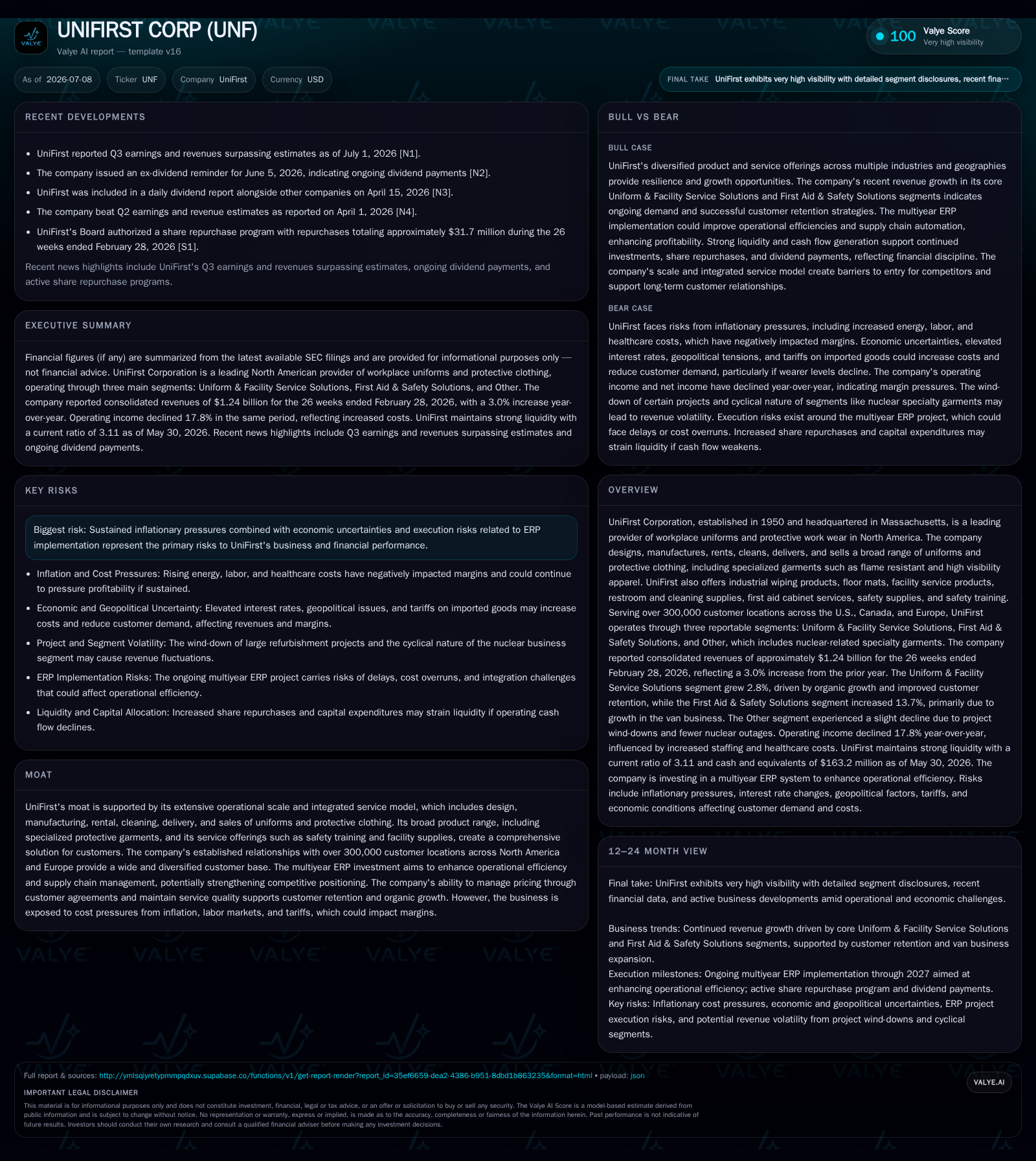
UniFirst Corporation reported solid revenue growth but a notable decline in operating income margin in its fiscal Q3 ended May 2026, driven by inflationary pressures and investment in systems modernization. The company’s vertically integrated uniform rental and facility services model across North America continues to anchor customer retention, despite margin compression from higher textile, cleaning, and logistics costs. A multiyear ERP rollout aimed at supply chain automation is progressing but presents execution risk. UniFirst’s diversified service portfolio, including protective apparel, safety training, and first aid supplies, supports recurring revenue streams and cross-selling opportunities amid competitive pressure from peers such as Cintas. Monitoring customer contract renewal trends and cost management post-ERP will be key.
Recent Operating Update
UniFirst Corporation released its Q3 fiscal 2026 results for the quarter ending May 30, 2026, reporting revenues benefiting from modest volume growth in rental garments and facility services but facing earnings pressure. Revenues for the quarter increased approximately 2.7%, illustrating resilience in customer demand across its uniform rental and safety solutions business lines despite external economic challenges [S3]. However, operating income declined roughly 17.8%, compressing the operating margin to 5.7% from 7.2% in the prior-year period [S9]. This discrepancy highlights significant inflationary cost pressures impacting margins.
The company also noted ongoing investment in a multiyear enterprise resource planning (ERP) system aimed at financial operations modernization and supply chain automation slated to continue through 2027 [S17]. While this initiative is designed to drive lower operating costs via enhanced inventory utilization and vendor management over time, it represents a near-term execution risk factor during implementation phases
Business Model Analysis
UniFirst operates an integrated business model combining design, manufacturing, rental, cleaning (laundering services), delivery, and direct sales of workplace uniforms and specialty protective garments primarily across North America with some European exposure. The core revenue engine is recurring rental contracts for uniforms that include cleaning and maintenance services supported by proprietary garment inventories tracked through logistics software. Customers typically include manufacturing plants, healthcare facilities, hospitality firms, construction sites, and government institutions requiring regulated protective apparel such as flame-resistant or high-visibility workwear.
Revenues are driven by several levers: number of customer locations served (over 300,000), average revenue per location derived from uniform counts plus additional facility supplies like floor mats or first aid products sold or rented separately. Pricing models incorporate contractual price escalations tied to inflation indexes or negotiated annually to offset rising textile costs or service expenses while maintaining customer retention through high service quality standards.
Complementary offerings under First Aid & Safety Solutions include safety training programs and wholesale distribution of safety supplies that increase stickiness with customers by bundling workplace compliance solutions with uniform programs. The 'Other' segment provides nuclear-related specialty garments reflecting a niche market requiring higher-value protective apparel.
Margins depend heavily on efficient operational scale: managing rental garment inventory size versus utilization rate is critical since additional garment installations increase operating costs upfront while new customers mature into stable recurring revenue streams with optimized inventory turnover. Labor constitutes a substantial portion of cost (laundering plants and delivery logistics), so productivity gains from ERP-driven process improvements could expand future margins.
Industry Structure & Competitive Position
The uniforms and facility services sector is fragmented yet capital- and labor-intensive with significant economies of scale benefiting larger integrated operators capable of nationwide coverage with fleet management capabilities. UniFirst competes directly with large peers such as Cintas Corporation—known for sophisticated technology integration—and Aramark in building services including uniform rental.
Smaller regional players often specialize either in industrial laundry services or facility supply distribution without full-service uniform programs. UniFirst's historical moat derives from its broad geographic footprint combined with vertically integrated manufacturing plus value-added safety training that creates switching costs difficult for competitors to replicate quickly.
Customer relationships span long-term contracts incentivizing renewal based on reliability of garment replacement cycles and on-time delivery rates. Price competition exists but is mitigated by contract-included adjustment clauses allowing UniFirst to maintain margins during inflation spikes—a critical capability amid ongoing raw material cost volatility.
Growth Drivers
Multiple structural factors support UniFirst’s steady growth opportunities:
- Continued regulatory emphasis on workplace safety expands demand for certified protective apparel integrating flame resistance or antimicrobial fabrics.
- Outsourcing trends among industrial customers who prefer bundled uniform rental combined with cleaning reduce in-house laundry capital expenditures.
- Cross-selling facility supplies such as floor mats or first aid cabinets deepens customer wallet share.
- Geographic expansion opportunities exist particularly in underserved mid-size markets where integrated service solutions have yet to saturate.
- The ERP rollout targeted at supply chain digitalization promises improved inventory use efficiency potentially freeing capital tied up in rental merchandise while reducing stockouts enhancing customer satisfaction.
- Sustainability initiatives promoting eco-friendly textiles align with corporate social responsibility mandates increasingly influencing purchasing decisions.
Customer retention metrics such as contract renewal rates remain pivotal KPIs; stable renewals coupled with slight price increases drive organic growth concealed beneath headline inflation adjustments.
Risks & Growth Constraints
Key risks impacting UniFirst’s operations include:
- Persistent inflation beyond anticipated levels could outpace contractual price escalations limiting margin recovery despite operational efficiencies [S2].
- ERP implementation risks encompass possible delays or system integration failures increasing IT spend or disrupting service delivery continuity affecting customer loyalty [S17].
- Labor cost volatility especially for facility laundries and delivery drivers may reduce productivity margins given tight labor markets.
- Supply chain disruptions—particularly sourcing raw textiles affected by geopolitical tensions or tariff changes—may increase input costs or delay deliveries.
- Competition from customers insourcing uniform programs or alternative providers offering niche technologies threatens market share.
- Regulatory compliance expenses related to environmental laws governing laundry effluents or workplace safety certifications add incremental cost burdens.
- Any negative impact from labor unionization drives within operations could impair flexibility or wage structures.
Monitoring these risk factors alongside key operating metrics will define execution success going forward.
What to Watch Next
Investors should focus on operational updates regarding:
- Progress milestones announced around the ERP program's upcoming phases targeting supply chain automation capabilities expected through fiscal 2027 [S17].
- Trends in the rental garment inventory size relative to utilization rates indicating efficiency gains or excess capacity buildup.[S2]
- Quarterly customer contract renewal rates signaling stickiness amid pricing pass-through efforts.
- Capital expenditure patterns supporting fleet expansion or factory modernization reflecting capacity enhancement plans.[S24]
- Cost structure evolution identifying whether inflationary pressures persist beyond pricing adjustment mechanisms.[S3]
- Announcements detailing any strategic acquisitions expanding footprint or product/service breadth that could leverage existing logistics networks.
Financial Profile Discussion
UniFirst maintains a conservative financial position amid investments in growth initiatives. As of May 30, 2026, the company held $163 million in cash plus equivalents against minimal long-term debt reported at about $7.9 million dating back years earlier [F1], resulting in an effectively net debt-negative balance exceeding $150 million. Current assets stand robust at roughly $920 million compared to current liabilities near $296 million yielding a strong current ratio around 3.11 indicating liquidity adequacy for near-term operational needs [F1].
Operating cash flows have softened recently due primarily to higher working capital requirements linked to installment of rental garments for major customers along with upfront prepayments related to IT contracts under the ERP upgrade program evidenced by detailed cash flow analyses over recent quarters [S6][S7]. Meanwhile capital expenditures have ramped substantially reflecting fleet buyback cycles and facility upgrades essential for sustaining service quality scores vital for retention in this industry segment [S7][S24].
Share repurchase activity continues consistent with past policies though near-term cash used here moderately increased compared to prior years illustrating a balanced capital allocation approach between shareholder returns and reinvestment strategies [S5][S24]. Overall free cash flow dynamics will need monitoring through upcoming quarters during intensive ERP deployment stages due to potential timing mismatches between initial costs incurred versus realized process savings.
This report presents an analytical view based on UniFirst Corporation's public filings through July 2026 without providing investment advice or research views. The narrative integrates recent performance data with industry context essential for understanding operational challenges amid inflationary headwinds coupled with strategic technology investments reshaping their business model sustainability.
Disclaimer: This is research-only, informational analysis and not investment advice. It may include AI-generated interpretation and general industry context. Always verify important details using primary sources.

Comments