
Capital Positioning and Deal Execution Challenges Shape Legato Merger Corp. IV’s Outlook
Legato Merger Corp. IV’s latest quarterly report highlights liquidity status, operating expenses, and acquisition timeline risks amid volatile market conditions.
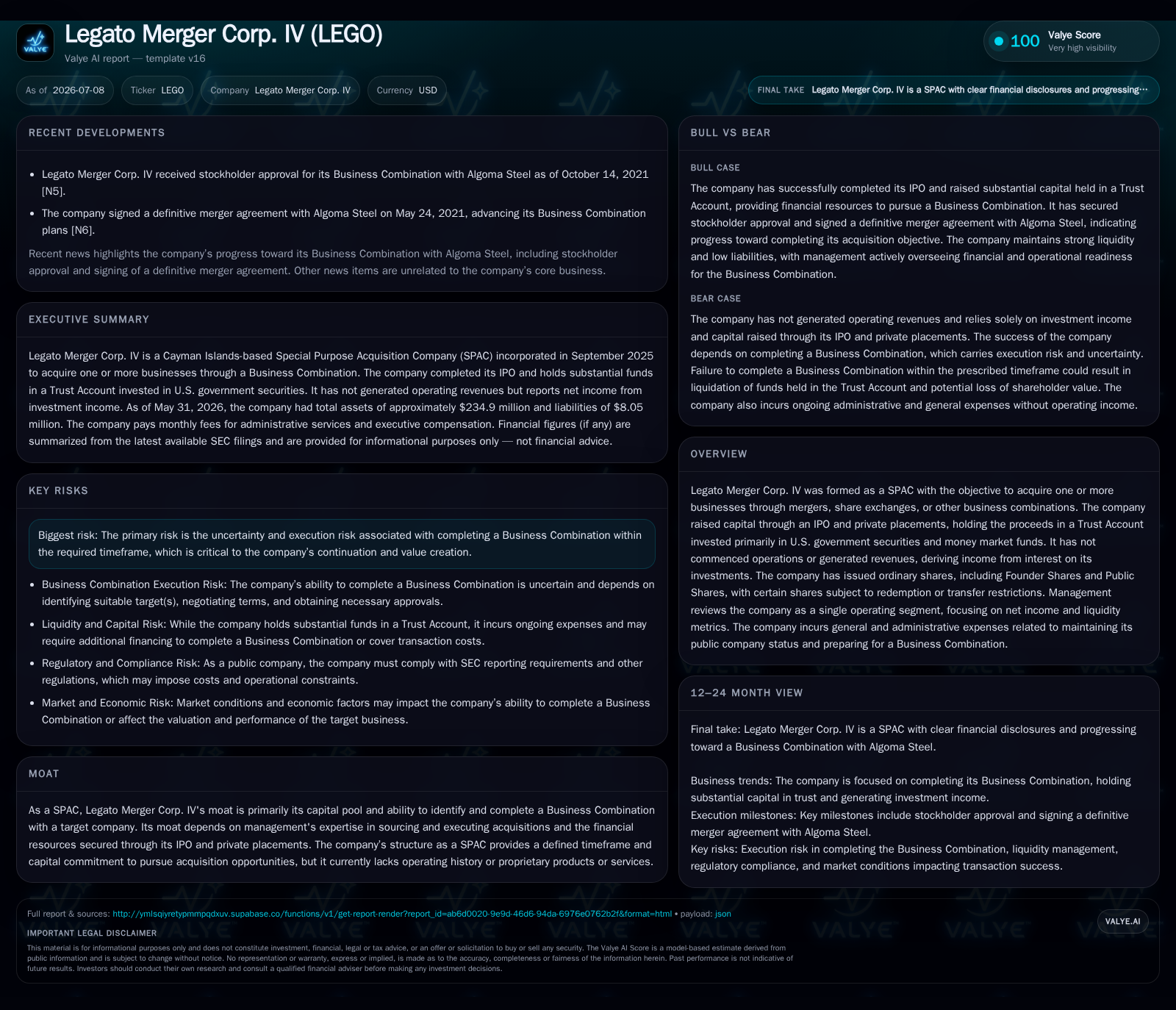
Legato Merger Corp. IV remains in the critical pre-Business Combination phase, with a capital structure anchored by IPO proceeds held in trust and a finite timeline to complete an acquisition. The latest 10-Q reveals stable trust account holdings alongside increasing operating expenses which pressure net income derived from interest income. Execution risk remains elevated due to geopolitical tensions affecting capital markets and complicating deal sourcing. Management’s access to Working Capital Loans offers some strategic flexibility, while redemption rights of public shareholders present a potential constraint on available funds post-deal. Investor appetite and sector conditions shape growth prospects but key milestones ahead will clarify value creation potential.
Quarterly Operating Dynamics Reflect Market Disruptions and SPAC-Specific Pressures
Legato Merger Corp. IV's Q3 2026 filing dated July 8 reveals how ongoing geopolitical instability is exacerbating challenges common to SPACs in sourcing attractive acquisition targets [S2]. Heightened volatility arises from NATO deployments and sanctions targeting aggressor countries’ financial institutions, creating a complex backdrop for deal execution within the limited timeframe mandated for completing a Business Combination.
As expected for a SPAC yet to consummate an acquisition, Legato reports no operating revenues; its net income is generated almost exclusively from interest income on marketable securities held in its Trust Account established at IPO [S2],[F1]. However, rising general and administrative expenses linked to legal, financial reporting, auditing compliance, and due diligence activities have increased the pre-combination cost base. The company recorded an operating loss near $291,000 for the quarter ending May 31, 2026, yet net income remains positive at approximately $1.79 million due to interest income offsetting these expenses [F1],[S2]. This highlights the typical operational burn profile for SPACs during their search phase.
Controlling these expenses is crucial: excessive administrative costs diminish capital available for financing acquisitions or providing working capital post-merger. In a broader context where investor sentiment toward SPACs can be volatile amid macroeconomic stresses, disciplined cost management directly impacts Legato’s capacity to pursue favorable transactions.
Capital Structure Essentials: Funds Held With Conditional Redemption Rights
Legato raised approximately $230 million gross proceeds through its January 2026 Initial Public Offering by selling 23 million Units at $10 each, with each Unit comprising one ordinary share plus one-third of one redeemable warrant exercisable at $11.50 per share [S2],[S21]. A concurrent private placement contributed an additional $5.5 million from insiders related to Founder Shares issuance [S6],[S21].
IPO proceeds are securely held in an interest-bearing Trust Account until a qualified Business Combination is completed or the SPAC liquidates [S2]. This mechanism protects public investor principal but restricts liquidity strictly to acquisition purposes or shareholder redemptions.
Public shareholders own about 23 million shares subject to redemption rights exercisable at roughly $10.10 per share as of May 31, 2026 [S2]. This creates contingent liquidity risk whereby significant redemptions could reduce cash availability post-transaction.
Founder Shares total approximately 8.27 million shares issued and outstanding excluding redeemable shares; these shares carry transfer restrictions without redemption rights but align management incentives with shareholder value creation [S2]. Additionally, insiders may extend Working Capital Loans up to $1.5 million to finance transaction costs before closing the Business Combination; such loans can be repaid without interest or converted into equity units mirroring Private Placement Units [S2],[S6].
This arrangement balances public shareholder protections with insider capital commitment—a standard SPAC feature essential to managing investor confidence alongside transaction feasibility.
Management Expertise as Linchpin for Value Creation Through Business Combination Execution
Without operations or revenue streams pre-acquisition, Legato’s value proposition hinges primarily on its management team's ability to identify suitable private companies for merger or purchase that enable efficient public market entry [N/A evidence absent; see industry knowledge layer]. Their skills in due diligence, structuring deals competitively, regulatory navigation, and timing execution within prescribed deadlines critically influence shareholder outcomes.
The availability of Working Capital Loans from insiders provides financial flexibility to cover upfront transaction costs ahead of accessing Trust Account proceeds post-merger—an important strategic lever during uncertain deal-closing phases [S2],[S6].
Experience-backed sponsor teams in comparable SPACs often demonstrate higher success rates in completing Business Combinations quickly while preserving financing structures that minimize dilution.
Competitive Context: How Legato Stacks Against Other SPAC Routes
Operating within a competitive SPAC environment characterized by finite deal timelines (typically 18-24 months post-IPO), Legato faces peer pressures from entities like Pershing Square Tontine Holdings and Churchill Capital Corp., which differ by sponsor profile, scale of capital raised, timing, and redemption behaviors.
These peers also compete against traditional IPOs—often preferred by private companies seeking less complex routes despite longer timelines—highlighting alternative pathways for public listing.
SPACs must carefully manage elevated redemption rates that can constrict available cash balances post-deal, potentially prompting renegotiations or supplemental financing needs.
Drivers Behind Investor Appetite and Growth Potential for Legato's Acquisition Strategy
Private companies continue seeking alternatives to traditional IPOs that offer faster market access with reduced pricing uncertainty. Regulatory frameworks remain generally supportive of de-SPAC transactions pending ongoing SEC scrutiny focused on disclosures and governance.
Institutional demand persists for vehicles providing structured access to growth sectors via experienced management teams leveraging broad networks.
Legato’s capitalization through IPO plus insider placements positions it competitively relative to contemporaneous SPAC launches enabling credible bids on attractive targets otherwise facing valuation pressures in late-stage funding rounds.
However, macroeconomic uncertainties linked to geopolitical conflicts impose cautionary limits on aggressive deal pricing or rushed announcements until market visibility improves.
Execution Risks: Time Constraints, Costs, Redemption Exposure To Monitor Closely
Legato’s primary operational risk remains failure to consummate a Business Combination within mandated timeframes—typically resulting in liquidation with return of Trust Account proceeds less offering costs—destroying implied shareholder value,[S2].
Rising G&A expenses coupled with fixed overhead consume liquidity needed for acquisition financing unless tightly controlled. High potential redemption volumes threaten to erode cash reserves available post-combination necessitating contingency plans such as insider Working Capital Loans or alternative funding sources [S2],[S6].
Geopolitical-driven market volatility further clouds timing and valuation certainty.
Investors should closely monitor emerging disclosures regarding target candidates as these provide early signals impacting deal success probabilities.
What Investors Should Watch Next: Milestones Signaling Deal Progress
Key indicators include:
- Formal announcement or progress updates on target identification,
- Filing of proxy statements or tender offers related to proposed combinations,
- Utilization or extension decisions concerning Working Capital Loans,
- Redemption activity following tender offers signaling liquidity dynamics,
- Additional fundraising efforts via convertible debt or private placements enhancing transaction solvency. These milestones will clarify management's capacity to close deals amidst current challenges alongside evolving shareholder sentiment trends.
Financial Profile Discussion: Liquidity Stability Amid Pre-Acquisition Expense Burn
As of May 31, 2026, Legato reported zero cash & equivalents outside its Trust Account while total current assets stood around $2.61 million supported mainly by Trust Account holdings; current liabilities were minimal near $32 thousand yielding an exceptionally strong current ratio above 81—reflecting high-quality liquid assets reserved specifically for business combination use rather than day-to-day operations [F1],[S2].
Net income remains positive primarily due to interest earned on Trust Account securities offsetting modest operational expense draws—a typical transient profile until deal completion alters revenue generation dynamics [F1]
Overall financial condition supports ongoing search activities but depends heavily on timely Business Combination closure preserving invested capital while limiting unexpected cash drains through effective expense management.
This analysis relies exclusively on official filings through July 8, 2026 ([S2], [F1]) combined with sector context inherent in Special Purpose Acquisition Companies (SPACs). No speculative forecasts on target identities or transaction valuations were made given lack of disclosed specifics. Readers should monitor subsequent filings closely for material updates clarifying Legato Merger Corp. IV’s evolving strategic trajectory and industry positioning.
Disclaimer: This is research-only, informational analysis and not investment advice. It may include AI-generated interpretation and general industry context. Always verify important details using primary sources.

Comments