
PepsiCo’s Brand and Distribution Strategies Drive Resilience in Q2 2026
The company leverages its extensive brand portfolio and sales incentive management to maintain volume growth and margin stability despite inflationary pressures.
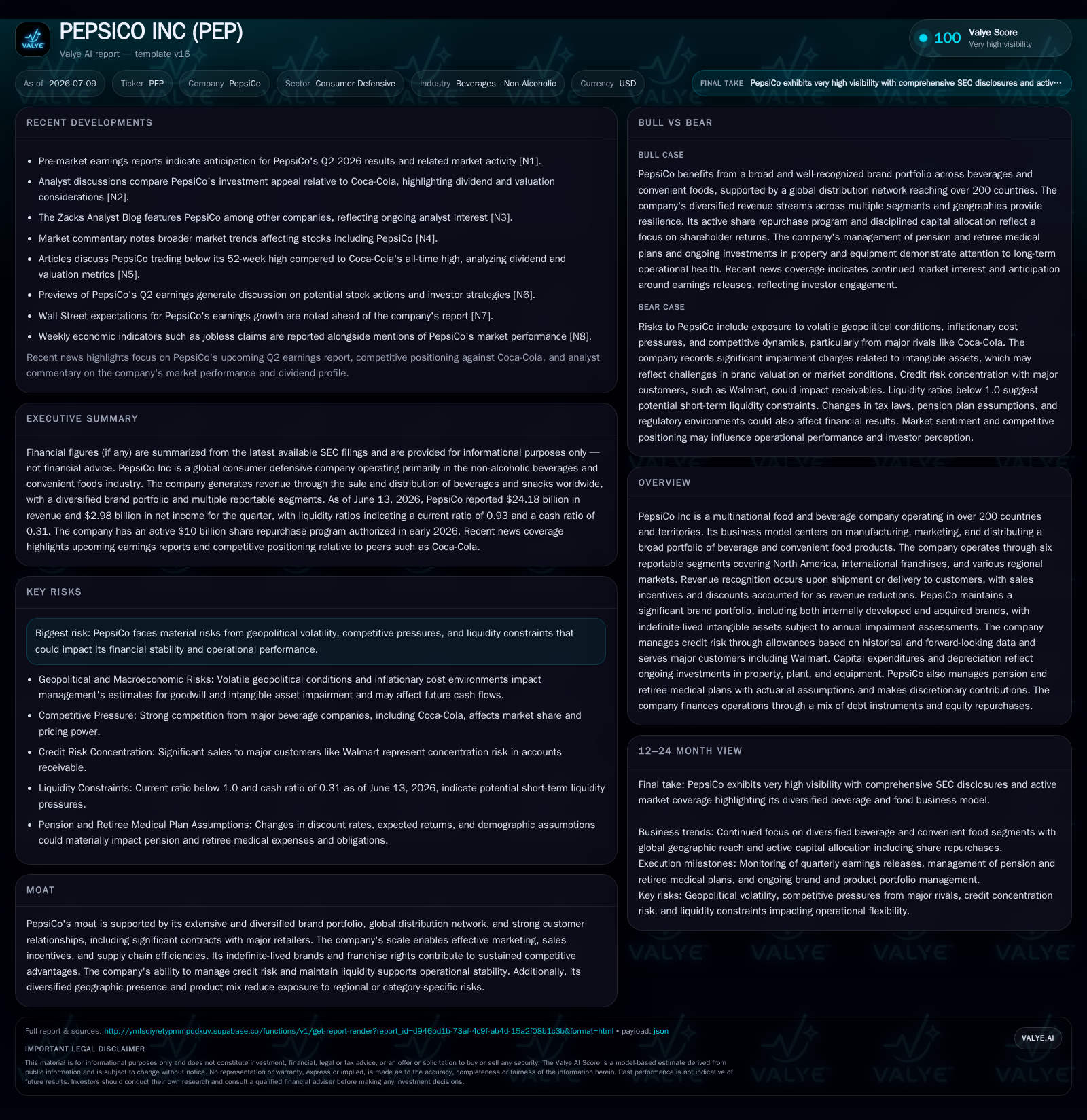
PepsiCo’s Q2 2026 results demonstrate effective management of sales incentives and marketing investments to support volume growth across diverse geographic segments. The company’s broad product mix and global distribution network underpin operational resilience amid margin pressures from rising costs. While sales incentives remain significant, prudent accrual accounting and established customer relationships contribute to revenue quality. Capital allocation continues to focus on share repurchases, supported by a solid balance sheet, while risks from regulatory and geopolitical factors persist.
Recent Quarter Operating Dynamics Highlight Sales Incentive Management
In Q2 2026, PepsiCo demonstrated resilience in net revenue growth driven by stable volume gains across its diverse geographic segments, despite ongoing inflationary pressures impacting input costs. The company’s net revenue growth was partly offset by elevated sales incentives, which remain a significant reduction factor in reported top-line figures. These incentives include bottler funding—payments to independent bottlers to support advertising and marketing activities—and customer volume rebates that are contingent on annual targets and estimated through accrual accounting practices requiring considerable management judgment [S1], [S2]. The accrual-based nature of these incentives means revenue recognition occurs net of expected payouts, which are reconciled post-year-end, ensuring revenue quality but adding complexity to margin analysis.
Marketing spend also remained elevated as PepsiCo continued to invest in brand awareness and consumer engagement initiatives to maintain competitive positioning in a crowded marketplace. The interplay of marketing expenses and sales incentives contributes to margin pressure, with operating income volatility influenced by shifts in pricing, product mix, and incentive intensity [S1]. Monitoring these dynamics is critical for assessing underlying profitability trends
Strategic Leverage from a Diversified Product Portfolio and Global Distribution Network
PepsiCo operates through multiple global segments, balancing a strong North American core with international franchise rights that provide geographic diversification and risk mitigation. This footprint spans traditional carbonated soft drinks, bottled water, juices, teas, energy drinks, and convenient foods, enabling the company to cater to evolving consumer preferences worldwide [S1]. The company’s business model centers on owning an extensive portfolio of strong brands, many accounted for as indefinite-lived intangible assets, supported by rigorous annual impairment testing based on discounted cash flow analyses aligned with strategic marketing investments [S1].
PepsiCo’s distribution network leverages third-party and company-owned bottlers and distributors operating under franchise agreements, allowing the company to focus on brand management, innovation, and marketing while outsourcing capital-intensive production and logistics [S1]. This structure captures upstream branded product margins while transferring certain operational costs downstream, enhancing capital efficiency and supply chain flexibility
The breadth of PepsiCo’s product portfolio and distribution reach provides resilience against regional demand fluctuations and category-specific downturns, offering a competitive moat relative to peers with narrower focus. This scale also supports tailored promotional strategies and marketplace spending effectiveness.
Sales Incentives Compression: Implications for Revenue Quality and Margins
Sales incentives remain a complex and material factor affecting PepsiCo’s revenue quality and gross margin profile. Bottler funding payments, designed to enable local advertising campaigns at the bottler level, can inflate shipment volumes but reduce net revenue after deductions. These arrangements are common industry practices, with peers such as The Coca-Cola Company employing similar mechanisms, though contract terms and incentive scale vary [S1], [S2].
Competitive Position Enhanced by Brand Equity and Supply Chain Efficiencies
PepsiCo’s competitive advantage is anchored in its extensive brand portfolio, which includes globally recognized names supported by indefinite-lived intangible asset accounting. The company’s annual impairment tests incorporate strategic plans emphasizing sustained marketing spend to maintain brand strength and consumer loyalty [S1]. This entrenched brand equity fosters favorable demand elasticity compared to competitors.
Supply chain scale and efficiency further bolster PepsiCo’s market position by enabling cost-effective production, distribution, and inventory management. Compared to peers like The Coca-Cola Company, PepsiCo benefits from a complementary food division, adding cross-category leverage and diversification. Its comprehensive distribution network facilitates optimized marketplace spending and promotional effectiveness, reinforcing brand presence across retail and foodservice channels.
Growth Opportunities Via Innovation Aligned with Consumer Preferences Trends
Innovation remains a key growth driver as consumer preferences shift toward healthier and functional beverages. PepsiCo prioritizes developing low-sugar and functional beverage offerings that align with these trends, contributing to product mix improvement and volume resilience amid softness in traditional soft drink segments [S1]. While specific pipeline details are not publicly disclosed, incremental volume from such innovations supports ongoing growth
Emerging markets present additional expansion opportunities, driven by urbanization and rising disposable incomes. PepsiCo’s franchise rights model enables agile local adaptation while leveraging global brand equity. Furthermore, enhanced penetration of e-commerce channels opens direct-to-consumer pathways, complementing traditional retail and foodservice partnerships.
Watchpoints: Regulatory, Pricing, and Geopolitical Risks
Regulatory risks remain salient, with increasing sugar taxes globally imposing excise burdens on sweetened beverages that may dampen consumer demand or compress margins. Compliance with evolving labeling requirements adds further cost layers [S1]. Intense competition sustains pricing pressure, limiting the company’s ability to fully pass through commodity inflation to consumers.
Geopolitical volatility introduces currency fluctuations affecting reported results, particularly in international segments, alongside potential supply chain disruptions. Credit risk exposure to large retail customers, including major chains such as Walmart, requires ongoing monitoring, though PepsiCo manages these risks through allowances based on historical data [S1]. Maintaining brand reputation amid these external challenges is critical for sustaining market share and consumer trust.
Capital Allocation Underpinned by Share Repurchases Amid Liquidity Constraints
During Q2 2026, PepsiCo repurchased approximately $286 million of common stock under its $10 billion share repurchase program authorized in early 2026, reflecting management’s commitment to returning capital to shareholders while balancing liquidity needs [S2], [S5]. This repurchase activity occurred despite a current ratio slightly below one (0.93) as of June 30, 2026, indicating tight but manageable liquidity conditions [F1].
The company’s capital allocation strategy balances share repurchases with sustaining marketplace investments essential for brand equity and volume growth. PepsiCo’s sizable total debt load of approximately $42.6 billion, offset by cash and equivalents near $10.3 billion, results in net debt around $32.4 billion, reflecting moderate leverage that supports strategic flexibility [F1]. Recent refinancing efforts have preserved liquidity access through revolving credit facilities without covenant constraints, underpinning operational funding and innovation initiatives [S3], [S23], [S26].
Financial Profile Discussion: Balance Sheet Strength Supports Strategic Flexibility
As of June 13, 2026, PepsiCo’s balance sheet reflects a cash position of approximately $10.3 billion against total debt of $42.6 billion, yielding net debt near $32.4 billion and a current ratio of 0.93x [F1]. This financial profile indicates moderate leverage consistent with investment-grade credit metrics, enabling continued capital deployment toward marketing, innovation, and shareholder returns.
The company’s liquidity is further supported by revolving credit agreements and recent refinancing activities that maintain access to capital markets without immediate covenant pressures [S3]. This financial flexibility is critical for navigating inflationary cost environments and geopolitical uncertainties while sustaining competitive marketplace presence.
This analysis is based solely on publicly filed SEC documents as of July 2026 ([S1]-[S28]) supplemented by validated companyfacts data ([F1]). It aims to provide a comprehensive understanding of PepsiCo's operating status within its industry context without offering investment advice or speculative conclusions.
Disclaimer: This is research-only, informational analysis and not investment advice. It may include AI-generated interpretation and general industry context. Always verify important details using primary sources.

Comments