
Byrna Technologies Strengthens IP and Brand with HERO Acquisition While Facing Regulatory and Market Challenges
Byrna’s Q2 2026 results reflect strategic repositioning fueled by HERO asset acquisition and leadership-driven brand transformation amid industry headwinds.
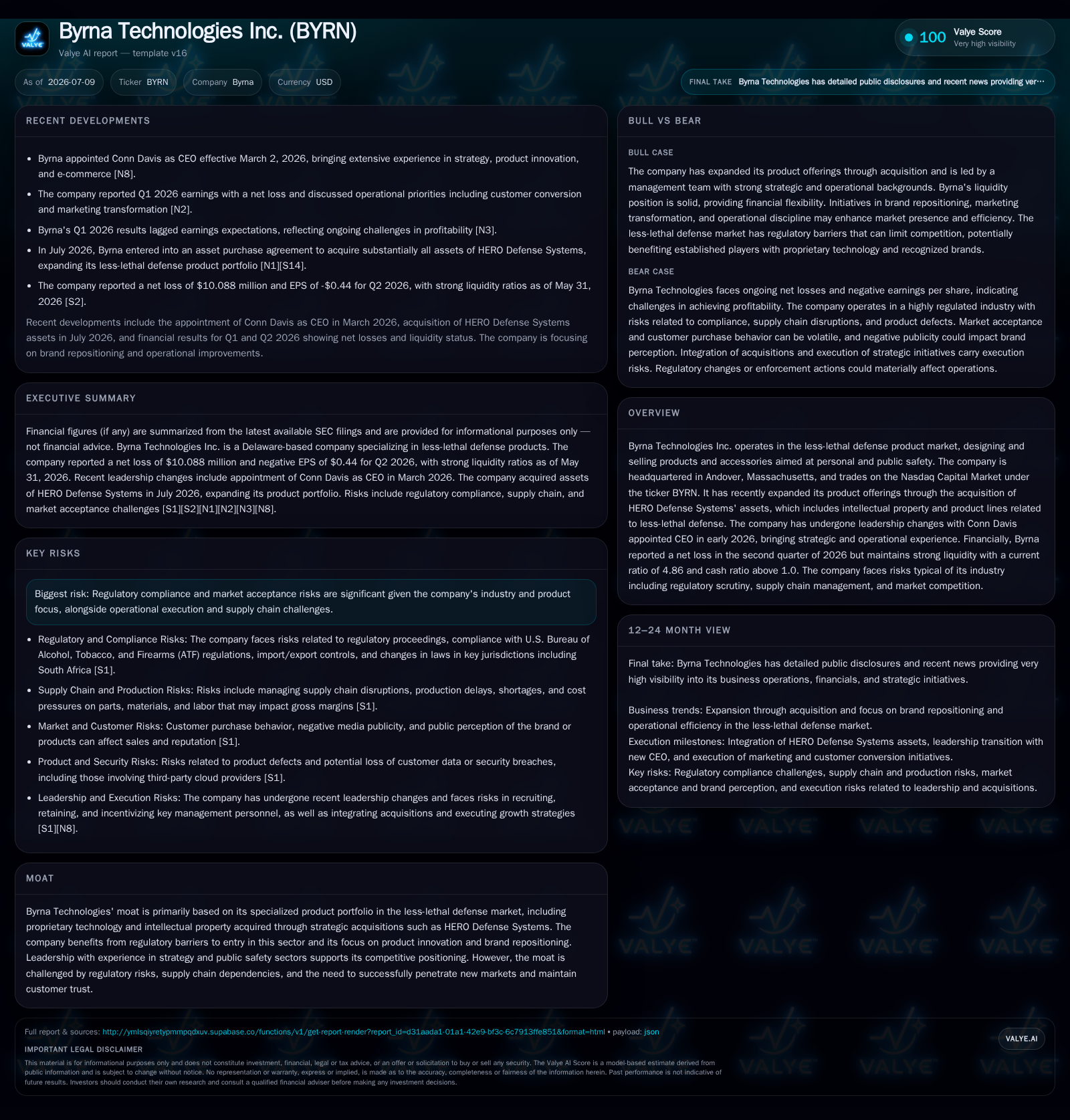
Byrna Technologies reported its second quarter results in July 2026, highlighting the recent acquisition of HERO Defense Systems’ assets which expands its intellectual property portfolio in less-lethal defense products. The company is actively repositioning its brand under CEO Conn Davis to improve retail channel productivity and customer conversion. Despite strong liquidity, Byrna continues to face regulatory compliance and supply chain challenges typical of the less-lethal defense industry. Peer comparisons emphasize the importance of innovation pipelines and regulatory navigation as critical for gaining law enforcement and consumer market traction.
Acquisition-Fueled Product Innovation Enhances IP Moat but Requires Execution Focus
In July 2026, Byrna Technologies entered into an Asset Purchase Agreement to acquire substantially all assets from HERO Defense Systems, including intellectual property and product lines centered on less-lethal defense devices [S23][S5]. This strategic move extends Byrna’s product portfolio with patented technologies that can potentially raise barriers to entry and enhance the company’s pipeline for new product launches within the personal defense device segment. Structurally, the deal involves $1.25 million consideration split evenly between cash and restricted stock issuance, supplemented by a royalty on net sales of HERO-derived products capped at $5 million or five years — aligning incentives for revenue generation from acquired IP [S23][S27].
The addition of HERO's assets underscores Byrna's intent to strengthen competitive differentiation through product innovation in a sector where proprietary technology confers a meaningful moat given regulatory hurdles limiting new entrants. However, integrating such acquisitions tends to place strain on operational execution and supply chain management, prompting close monitoring of unit sales volumes against product return rates as indicators of market acceptance and quality control effectiveness [S2][S5]. Confirmation of successful integration would manifest in improved retail channel productivity metrics coupled with reduced supply chain lead times.
Transformation Under New Leadership Drives Brand Repositioning and Channel Productivity
Since early 2026, newly appointed CEO Conn Davis has prioritized repositioning Byrna’s brand with particular emphasis on enhancing customer conversion rates across retail outlets while driving marketing transformation initiatives [S6]. With consolidated leadership following the departure of the previous President in June 2026, Davis assumed both CEO and President roles to tighten operational cadence and impose greater cash discipline [S19]. This leadership change signals a strategic pivot towards more disciplined commercial execution aimed at scaling retail distribution efficiency — a vital growth lever in consumer-oriented less-lethal defense product markets.
Byrna’s efforts extend beyond mere cost controls: they aim to optimize average selling price realization by shifting sales mix towards higher-margin offerings supported by clear messaging around safety standards compliance and product innovation stories. This approach reflects broader trends seen among competitors such as Sabre Red pepper spray brands focusing on consumer education and Axon Enterprise targeting institutional contracts with technologically advanced non-lethal deterrents.
Success here should be measurable through steady increases in retail channel productivity — encompassing enhanced sell-through rates per store and reduced customer acquisition costs — which in turn would validate the effectiveness of ongoing brand repositioning strategies [S6][S3].
Regulatory Dynamics and Supply Chain Constraints Frame Operating Risks for Byrna
Operating within the niche less-lethal defense products industry exposes Byrna to persistent regulatory scrutiny that shapes both product design constraints and go-to-market access [S2]. Regulatory approvals often involve protracted cycle times complicated by evolving jurisdictional standards addressing safety compliance and usage restrictions. These dynamics necessitate adaptive R&D capabilities alongside vigilant risk management practices to avoid production delays or market-entry blocks.
Additionally, supply chain disruptions remain a material risk given the reliance on specialized components for personal defense launchers and accessories. Recent filings highlight ongoing efforts to mitigate these risks but also caution about potential cost volatility impacting gross margins [S2]. Industry peers like TASER demonstrate how proactive supply chain management coupled with robust inventory turnover can serve as competitive advantages; Byrna must similarly reduce lead times while maintaining quality to meet rising demand efficiently.
Market acceptance also hinges on maintaining low product return rates — an indicator closely watched by retailers due to implications for after-sales service costs and brand reputation.
Peer Perspectives Illuminate Byrna’s Market Penetration Opportunities and Challenges
In benchmarking against notable peers such as Axon Enterprise—renowned for embedding cutting-edge technology into law enforcement non-lethal weapons—and TASER’s established innovation pipeline, Byrna's newly acquired HERO IP assets provide a foundation to close capability gaps. However, consistent execution in regulatory navigation remains critical given these peers’ extensive experience handling multi-jurisdictional compliance.
In consumer segments, products like Sabre Red pepper sprays exemplify successful market penetration strategies driven by strong retail relationships and brand recognition backed by efficacy claims meeting safety standards. Byrna’s challenge lies in translating its enhanced technological base into similar consumer trust metrics through sustained marketing efforts post-repositioning.
Growth in law enforcement budgets allocating toward less-lethal alternatives presents demand tailwinds but also imposes intensified competition for contracts requiring demonstrated product reliability supported by accessible after-sales services [S1][S6]. Monitoring developments in contract wins or institutional adoption will serve as directional signals for long-term market share gains.
Demand Drivers Shaped by Evolving Safety Awareness and Institutional Adoption Patterns
The broader industry demand vectors underpinning Byrna’s growth opportunity include rising public consciousness regarding personal safety solutions amid urban security concerns alongside increasing preference for non-lethal deterrents over conventional firearms. Technological advancements improving usability without compromising effectiveness further stimulate adoption among both consumers seeking self-defense options and institutional clients focused on de-escalation tactics.
Expanding into new geographic markets remains an open avenue for revenue growth contingent on navigating varying regulations across jurisdictions [S6]. Parallel growth in e-commerce channels complements traditional retail pathways, offering direct reach opportunities accelerating customer conversion rates when combined with brand repositioning
Strategic acquisitions such as that of HERO enable broadening of addressable market segments via diversified product lines tailored to distinct use cases — from consumer handheld launchers to law enforcement tactical accessories.
Key Operational Watchpoints: Conversion Rates, Regulatory Approvals, Supply Continuity
Investor focus should prioritize unit sales volume trends reflecting end-customer uptake juxtaposed against average selling price movements revealing mix shifts toward premium offerings. Retail channel productivity improvements measured via sell-through rates per distribution outlet will indicate success of recent marketing transformation efforts under Conn Davis’ leadership.
Regulatory approval cycle times will materially affect new product launch pacing; any significant delay could stall revenue contributions from recent innovations or acquire IP derivatives. Simultaneously, monitoring supply chain lead times alongside inventory turnover rates will provide visibility into operational efficiencies or bottlenecks impacting order fulfillment capabilities.
Heightened regulatory oversight may increase product liability risks; thus observing changes in return rates or warranty claims could signal emerging quality or design issues warranting management attention.
Financial Profile Discussion: Strong Liquidity Supports Growth but Losses Persist
At quarter-end May 31, 2026, Byrna held $9.4 million in cash and equivalents against current liabilities just over $10 million resulting in a robust current ratio approximating 4.86 — indicative of strong short-term liquidity enabling continued investment in R&D, marketing transformation initiatives, and integration activities post-acquisition [F1][S2][S3]
Despite these favorable liquidity metrics, the company reported a net loss for Q2 FY2026 underscoring persistent profitability challenges common within innovative defense technology firms balancing growth investments against slower revenue ramp phases. Sustained cash discipline under new leadership appears central to preserving capital runway while scaling operations.
Limited debt exposure further insulates balance sheet risk allowing flexibility amid volatile macroeconomic or industry-specific conditions related to regulation or competition.
This analysis is based solely on publicly available filings up to July 9, 2026. It does not constitute investment advice but aims to provide an informed perspective grounded in operating data combined with sector context relevant to less-lethal defense product companies.
Disclaimer: This is research-only, informational analysis and not investment advice. It may include AI-generated interpretation and general industry context. Always verify important details using primary sources.

Comments