
Simply Good Foods Expands Nutritional Snacking Portfolio Amid Margin Pressures
Recent Q3 results highlight strategic brand innovation and distribution growth balanced against cost challenges in a competitive snacking market.
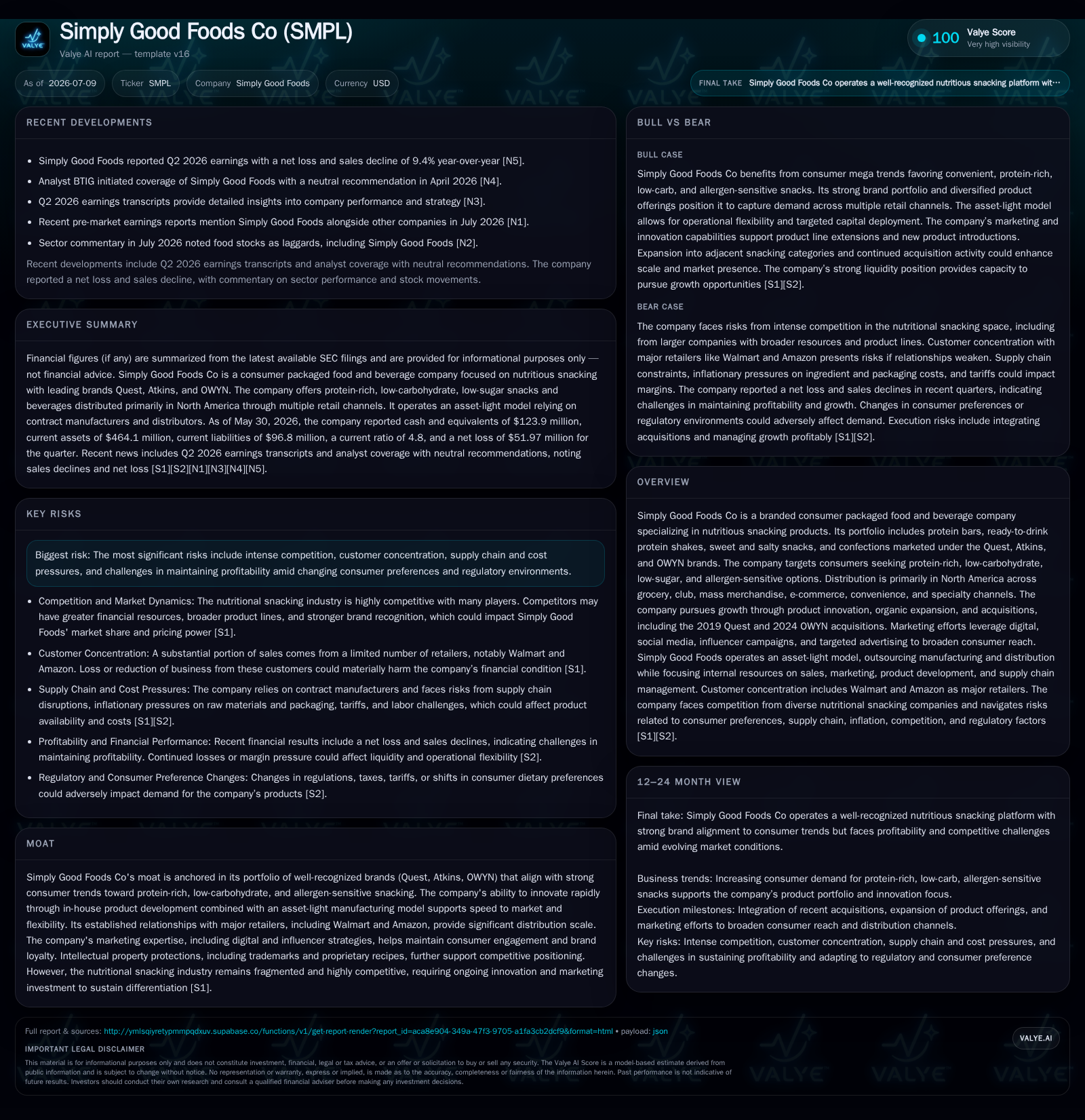
Simply Good Foods Co reported its third quarter results ending May 30, 2026, with a mixed operational performance marked by ongoing investment in product innovation and expanded retail penetration. Its portfolio, featuring the Quest, Atkins, and OWYN brands, targets consumers seeking protein-rich, low-carb snacks aligned with wellness trends. The company maintains an asset-light manufacturing model supporting speed to market but faces margin compression due to inflationary cost pressures and supply chain complexities. Growth continues to be driven by new product introductions and channel expansion, notably in e-commerce, while risks stem from customer concentration and competitive intensity.
Recent Operating Update
In its fiscal third quarter ended May 30, 2026, Simply Good Foods Company reinforced its strategic focus on product innovation and expanded distribution across multiple retail channels. The company reported continued revenue growth driven by new product launches within its core brands—Quest, Atkins, and OWYN—each targeting distinct consumer segments seeking protein-rich, low-carbohydrate, low-sugar, and allergen-sensitive snacks [S2][N1]. The asset-light business model, relying on third-party contract manufacturing and outsourced logistics, enables the company to rapidly introduce new formats such as protein bars, cookies, salty snacks, and ready-to-drink (RTD) protein shakes without significant fixed capital investment, supporting agility in a dynamic nutritional snacking market [S1][S16].
Business Model Analysis
Simply Good Foods operates primarily as a branded consumer packaged foods company specializing in better-for-you nutritional snacks that align with evolving health and wellness trends. Its revenue is predominantly generated through wholesale sales to large North American retailers, including grocery chains, club stores, mass merchandisers, specialty outlets, convenience stores, and e-commerce platforms. Notably, Walmart accounts for approximately 31% of sales, while Amazon contributes around 18%, reflecting a significant customer concentration risk [S24]. The company also engages in direct-to-consumer (DTC) sales via brand websites such as QuestNutrition.com, enhancing consumer engagement and data capture.
The company’s portfolio segmentation addresses nuanced consumer needs: Quest offers a broad range of protein bars, chips, confections, and RTD shakes targeting consumers seeking high-protein, low-sugar options; Atkins focuses on low-carbohydrate lifestyle adherents aiming for weight management or blood sugar control; and OWYN provides plant-based, allergen-tested RTD protein shakes and powders catering to allergen-sensitive consumers [S1][S24]. This segmentation supports targeted marketing and product innovation strategies.
Simply Good Foods’ asset-light model leverages contract manufacturers and third-party logistics providers, minimizing capital expenditures and enabling scalable production capacity [S16][S26]. This approach allows the internal team to concentrate on brand management, consumer insights, innovation pipeline development, and digital marketing initiatives, including influencer campaigns that drive brand loyalty and repeat purchase rates
Product innovation remains a critical growth driver, with continuous reformulation efforts to enhance taste and nutritional profiles, alongside new product introductions expanding into adjacent categories such as salty snacks and confections. Proprietary R&D capabilities combined with third-party flavor houses and iterative consumer testing accelerate innovation cycles, helping the company maintain differentiation in a fragmented and competitive landscape [S26][S29].
Industry Structure & Competitive Position
The branded nutritional snacking sector is highly fragmented, featuring competitors ranging from global food conglomerates like PepsiCo (Frito-Lay) to specialized health-focused brands such as Clif Bar and Hormel Foods’ protein platforms. Competition hinges on brand equity, product formulation quality (including macronutrient and allergen profiles), taste, convenience, pricing, retail shelf placement, and digital presence across e-commerce channels.
Simply Good Foods benefits from well-established brand recognition and proprietary formulations that protect its product differentiation. Its portfolio aligns with consumer mega trends favoring increased snacking occasions, convenient better-for-you options, and dietary preferences such as ketogenic, low-carb, and plant-based diets. The company’s ability to innovate rapidly and maintain strong digital marketing efforts helps defend against private-label encroachment and pricing pressures prevalent in mass retail channels [S27][S1]
Risks include intense competitive rivalry that could compress margins, customer concentration—particularly reliance on Walmart’s mass retail channel—supply chain cost inflation, regulatory scrutiny over labeling and health claims, cybersecurity threats, and integration challenges from recent acquisitions like OWYN in 2024 [S25][S6]. Maintaining marketing spend efficiency, especially through digital and influencer campaigns, is essential to sustaining shelf relevance and consumer loyalty.
Growth Drivers
Simply Good Foods’ growth is supported by several structural and strategic factors:
- Consumer Health Trends: Rising demand for protein-enriched, low-sugar, and allergen-friendly snacks aligns with the company’s product offerings targeting weight management and allergen-aware consumers.
- Product Innovation Pipeline: Introduction of new flavors and formats, including expansion into salty snacks and confections, broadens the addressable market and meets evolving consumer preferences [S26].
- Channel Expansion: Growth in e-commerce penetration, particularly via Amazon and DTC platforms, complements traditional brick-and-mortar retail, enhancing consumer reach and engagement.
- Acquisitions: Strategic acquisitions such as OWYN add differentiated plant-based, allergen-tested products, expanding portfolio breadth and consumer appeal.
- Marketing Expertise: Digital-first marketing and influencer partnerships improve brand awareness and repeat purchase velocity, critical KPIs in the consumer packaged goods sector [S1][N3].
- White Space Penetration: Efforts to expand into underpenetrated retail categories and geographic markets increase shelf presence and consumer accessibility.
Risks & Constraints
Despite positive momentum, Simply Good Foods faces several operational and market challenges:
- Rising Input Costs: Inflationary pressures on raw materials such as nuts, dairy proteins, and packaging, combined with contract manufacturer price increases, compress gross margins.
- Customer Concentration: Heavy reliance on a limited number of large retailers, especially Walmart, introduces negotiation leverage risks and potential volume volatility due to "at-will" contracts lacking guaranteed purchase commitments [S24].
- Competitive Intensity: The fragmented market requires sustained marketing investment to maintain brand relevance amid private-label competition and pricing pressures.
- Supply Chain Vulnerabilities: Ongoing global supply chain disruptions and logistical bottlenecks pose risks to inventory availability and fulfillment efficiency.
- Regulatory Environment: Compliance with FDA labeling requirements and evolving health claim regulations demands continuous vigilance.
- Cybersecurity Risks: Increasingly sophisticated cyber threats necessitate ongoing investment in information security to prevent operational disruptions [S1][S6].
- Innovation Execution: Maintaining the pace and quality of product innovation is critical to meeting shifting consumer dietary trends and sustaining competitive advantage.
What To Watch Next
Key performance indicators and developments to monitor include:
- Quarterly net sales growth, with emphasis on contributions from new product launches.
- Gross margin trends reflecting the company’s ability to manage input cost inflation and pricing strategies.
- Expansion of e-commerce sales penetration and effectiveness of DTC initiatives.
- Progress on integration and performance of recent acquisitions, as well as announcements of potential bolt-on deals.
- Marketing spend efficiency, particularly the return on investment from digital and influencer campaigns.
- Changes in customer concentration and renewal status of major retail contracts.
- Inventory turnover rates as a measure of supply chain resilience.
- Regulatory developments impacting product formulation, labeling, or marketing claims.
- Cybersecurity incident disclosures and mitigation effectiveness.
Management’s quarterly earnings calls and investor presentations provide ongoing insights into these metrics and strategic priorities. Observers may also consider broader category consumption trends reported by peers such as Hormel Foods and The Hershey Company for comparative sector context.
Financial Profile Discussion
As of May 30, 2026, Simply Good Foods reported cash and cash equivalents of approximately $124 million and total debt of about $400 million, resulting in net debt near $276 million [F1]. The company’s current assets stood at $464 million against current liabilities of $97 million, yielding a strong current ratio of approximately 4.8x, indicative of solid short-term liquidity and financial flexibility to support organic growth and selective acquisitions
This capital structure supports the company’s asset-light model and strategic investments in product innovation and marketing while maintaining prudent leverage levels. Monitoring leverage ratios and free cash flow generation will be important to assess ongoing financial health amid margin pressures.
This analysis is based on publicly available filings up to July 9, 2026, including the latest quarterly report [S2], annual filing [S1], and corroborative news sources [N1][N3]. It provides an industry-contextualized perspective grounded in documented evidence.
Disclaimer: This is research-only, informational analysis and not investment advice. It may include AI-generated interpretation and general industry context. Always verify important details using primary sources.

Comments