
Aircastle LTD Advances Fleet Growth Amid Supply Chain Constraints and Capital Market Activity
Recent quarterly results highlight Aircastle's strategic fleet expansion, lease management, and financing moves within a complex aircraft leasing landscape.
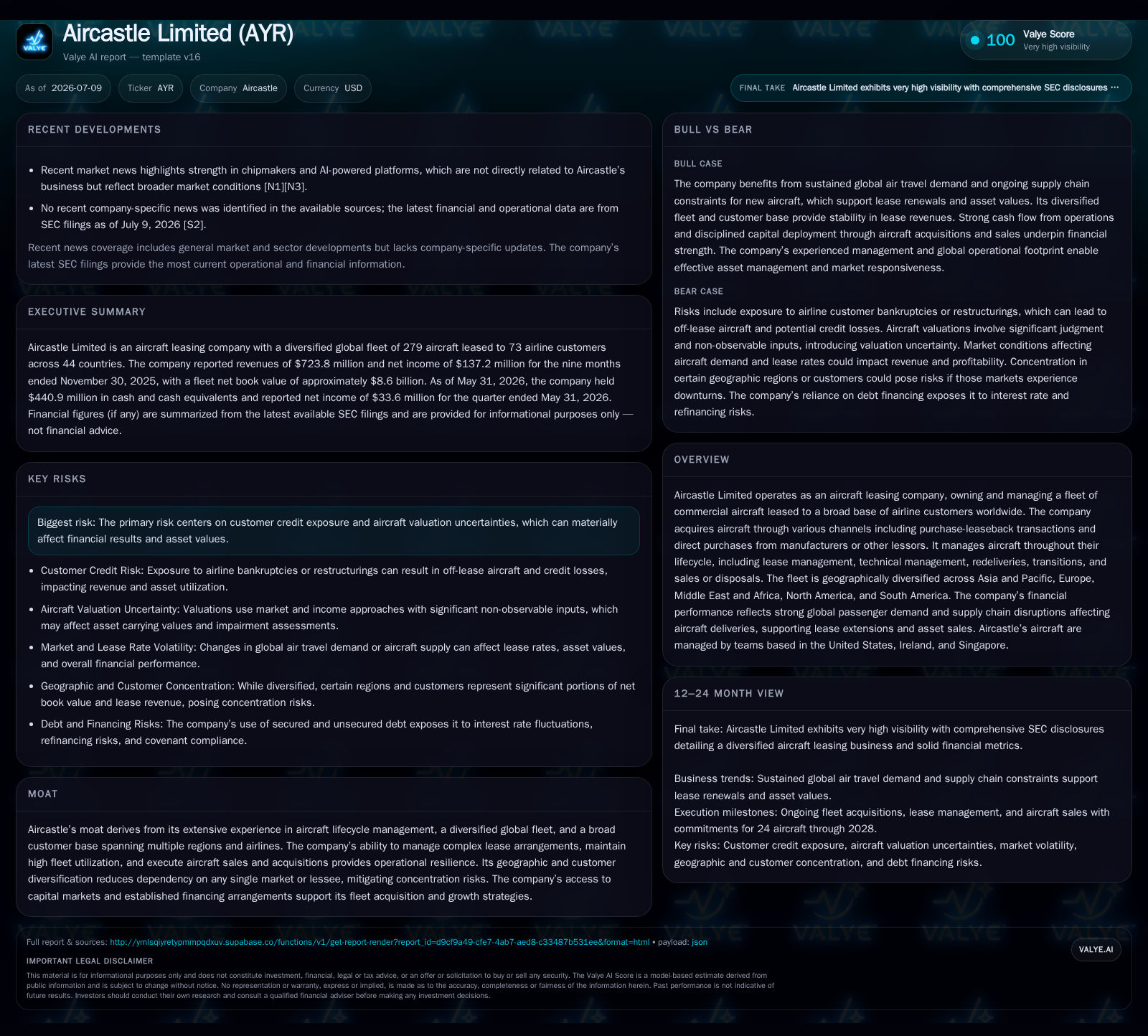
In its latest quarter ending May 31, 2026, Aircastle LTD maintained strong operational momentum with a high fleet utilization rate and expanded net book value amid ongoing airline demand and OEM delivery delays. The company continues to source aircraft via diverse channels including purchase-leaseback transactions, managing a geographically broad lease portfolio which mitigates credit concentration risk. Aircastle’s recent execution of a $600 million unsecured term loan supplements its capital structure, enabling further acquisitions amid an environment of supply chain disruptions and resilient passenger traffic growth. Key risk factors remain lessee credit exposure and residual value uncertainties that could influence future earnings and asset valuations.
Recent Operating Update
In the quarter ending May 31, 2026, Aircastle LTD reaffirmed its position as a leading secondary market investor in commercial aircraft leasing, leveraging an experienced team across the U.S., Ireland, and Singapore. The company disclosed a fleet net book value (NBV) of roughly $8.5 billion as of late February 2026, signifying an approximate 8% increase year-over-year (YOY), highlighting ongoing fleet growth through various acquisition channels including purchase-leasebacks and direct purchases from manufacturers or other lessors [S2], [F1]. Notably, the weighted average utilization rate was sustained close to full capacity at 99%, underscoring robust demand amidst broader industry supply constraints driven by OEM delivery delays and global supply chain issues that constrain new aircraft availability [S1], [S2].
Strategically, Aircastle benefits from sustained lease extension activity due to these delivery delays — a trend that boosts recurring lease rental income while enabling profitable asset sales in the secondary market. These dynamics reflect structural growth drivers in the aircraft leasing industry rooted in airlines’ preference for leasing rather than ownership to maintain fleet flexibility under uncertain delivery timelines.
In May 2026, Aircastle Advisor LLC secured a $600 million unsecured term loan facility arranged by major banks including Fifth Third Bank and PNC Capital Markets LLC [S3]. This new debt instrument carries floating interest tied to Term SOFR plus a spread of 1.40% per annum with covenants aligned to preserve key financial metrics such as minimum net worth and interest coverage ratios. This financing expands Aircastle’s liquidity runway to fund fleet acquisitions or refinance existing obligations within a competitive capital markets environment that remains sensitive to interest rate fluctuations [S3].
Business Model
Aircastle’s core business generates revenue primarily by acquiring commercial jet aircraft assets and leasing them to airlines globally through long-term leases typically averaging just over five years in remaining duration. The monetization mechanics encompass lease rental payments supplemented by gains from aircraft sales either with attached leases or through part-outs. The company actively manages contractual lease terms and employs technical management expertise covering redeliveries, maintenance oversight, transitions between lessees, and remarketing activities—which together help maintain above-industry-average utilization rates.
The broad customer base—about 76 airline lessees spanning Asia-Pacific, Europe/Middle East/Africa (EMEA), North and South America—reduces exposure to any single geography or operator credit risk [S1]. Such diversified lessee profiles are essential given the volatile nature of airline economics influenced by fuel prices, geopolitical risks, and evolving regulatory requirements like carbon emissions schemes (CORSIA). Lease extensions have proved vital in smoothing revenue streams during supply shortages.
Asset valuation plays a critical role given residual value uncertainty at lease expirations; Aircastle's ability to time asset sales during favorable market cycles supports profitability [S1]. Sales gains heavily supplement operating results especially during periods where OEM production bottlenecks elevate used aircraft demand
Industry Structure and Competitive Position
The aircraft leasing industry is highly capital intensive, positioned between manufacturers such as Boeing and Airbus who supply new equipment, and airline operators seeking flexible fleet access without upfront capital expenditure. Leading peers include AerCap Holdings, Avolon Holdings, and SMBC Aviation Capital—all emphasizing global scale fleets often surpassing several hundred aircraft versus Aircastle's approximate sub-300 owned-and-managed unit count [S1].
While smaller than sector giants, Aircastle leverages specialization as a secondary market-focused lessor with seasoned operational teams capable of comprehensive lifecycle asset management including sophisticated technical support and remarketing expertise. This distinct orientation differentiates them from dominant primary lessors focused on initial equipment orders.
Geographic diversification mitigates regional downturns; however, currency risks remain inherent given the multinational footprint. Capital structure prudence is key; Aircastle’s measured leverage—with total debt approximated at $5.3 billion offset by nearly $0.44 billion cash as of May 2026—places net debt near $4.86 billion [F1]
Growth Drivers
Aircastle enjoys several growth tailwinds aligned with broader sector trends:
- Global Passenger Travel Expansion: Passenger air travel correlates positively with macroeconomic growth and has outpaced GDP historically; this lifts airline utilization rates increasing demand for leased narrow-body jets — foundational components of Aircastle’s portfolio [S1].
- OEM Delivery Delays: Continuing manufacturing supply chain disruptions delay new aircraft entry into service, prompting airlines to extend leases or acquire pre-owned assets indirectly benefiting lessors like Aircastle through elevated lease renewal activity and secondary market transactions [S1].
- Capital Market Access: Favorable financing conditions coupled with institutional investors’ appetite for stable lease rental income supports acquisition funding.
- Fleet Modernization Cycles: Airlines transitioning older fleets towards more fuel-efficient models create opportunities for Aircastle to redeploy capital into newer assets while remarketing existing inventory profitably.
- Emerging Market Airline Growth: Expansion of carriers in Asia-Pacific and Latin America diversifies lessee mix providing incremental leasing opportunities beyond mature markets.
Indicators such as backlog purchase commitments (17 aircraft worth $829.5 million scheduled through late 2028) signal forward-looking investment intent [S1]. Lease renewal rates near historical highs alongside continued asset sale gains will confirm durable demand conditions.
Risks and Watchpoints
Despite resilience factors, several watchpoints persist:
- Lessee Credit Risk: Airline default or payment delays materially impact revenue realization; continuous monitoring across a broad lessee base is mandatory to mitigate concentrated losses especially amid economic volatility or fuel price shocks.
- Residual Value Volatility: Aircraft valuations fluctuate with technological obsolescence trends (e.g., transition toward sustainable aviation fuels or electric propulsion) potentially impairing asset values at lease end [S1].
- Supply Chain Dynamics: Should OEM delivery headwinds ease abruptly, secondary market pricing could soften impacting sale margins.
- Regulatory Environment: Stricter carbon emission standards such as ETS phase-out impact airline operating costs which may feed through into lease negotiations affecting pricing power.
- Geopolitical Instability: Regional conflicts (e.g., Middle East tensions noted in the latest filing) can suppress regional air travel demand reducing lease placement prospects temporarily [S2].
- Interest Rate Fluctuations: Rising rates elevate debt servicing expenses challenging profitability unless matched by corresponding lease rental increases.
Continued focus on diversification metrics—both geographic and customer—and disciplined capital allocation will be crucial for mitigating these risks.
What to Watch Next
Key milestones will revolve around:
- Quarterly updates on fleet additions versus disposals confirming growth trajectory.
- Lease renewal rates post-delivery normalization indicating whether supply constraints remain elevated.
- Asset sale volumes and realized gains confirming strength of secondary market pricing.
- Updates on financing activity illustrating flexibility in acquiring new assets or refinancing maturing debts under shifting interest rate climates.
- Progress on negotiations around carbon emission regulations could foreshadow shifts in airline cost bases impacting future rents.
- Monitoring lessee credit quality metrics especially under inflationary or geopolitical stress scenarios.
Collectively these data points will validate the durability of current operating momentum highlighted in recent quarters [S2], [S3].
Financial Profile Discussion
Aircastle’s financial position as of late May 2026 reflects solid liquidity supported by $441 million cash equivalents against $5.3 billion total debt liabilities recorded end-February 2026 yielding net debt approximating $4.86 billion [F1]. This leverage level aligns with capital-intensive leasing peers where significant borrowing is customary to fund large-scale fleet investments.
The recently secured $600 million unsecured term loan facility enhances liquidity bandwidth providing additional headroom for opportunistic acquisitions or refinancing existing higher-cost debt instruments [S3]. The floating interest rate linkage to Term SOFR plus margin indicates sensitivity to interest rate changes; however, covenant safeguards including minimum net worth thresholds provide financial discipline frameworks [S3].
Overall balance sheet strength paired with diversified financing sources underpins Aircastle’s capacity to capitalize on evolving market opportunities while weathering cyclical risks inherent in the aviation leasing sector.
This analysis integrates detailed latest-period disclosures from filings dated July 9, 2026 ([S2]), June 1, 2026 ([S3]), April 21, 2026 ([S1]) combined with companyfacts financial snapshots ([F1]). It frames Aircastle LTD within the specialized secondary commercial aircraft leasing niche drawing upon known industry dynamics without extrapolating unsupported facts or speculative forecasts. It refrains from investment advice or direct peer ranking absent explicit comparative data but situates findings relative to typical industry players like AerCap or Avolon when contextually relevant.
Disclaimer: This is research-only, informational analysis and not investment advice. It may include AI-generated interpretation and general industry context. Always verify important details using primary sources.

Comments