
Barnes & Noble Education Expands Store Footprint as Inclusive Access Drives Revenue Recovery
BNED reports fiscal 2026 revenue rebound supported by its BNC First Day® inclusive access program and plans for new store openings.
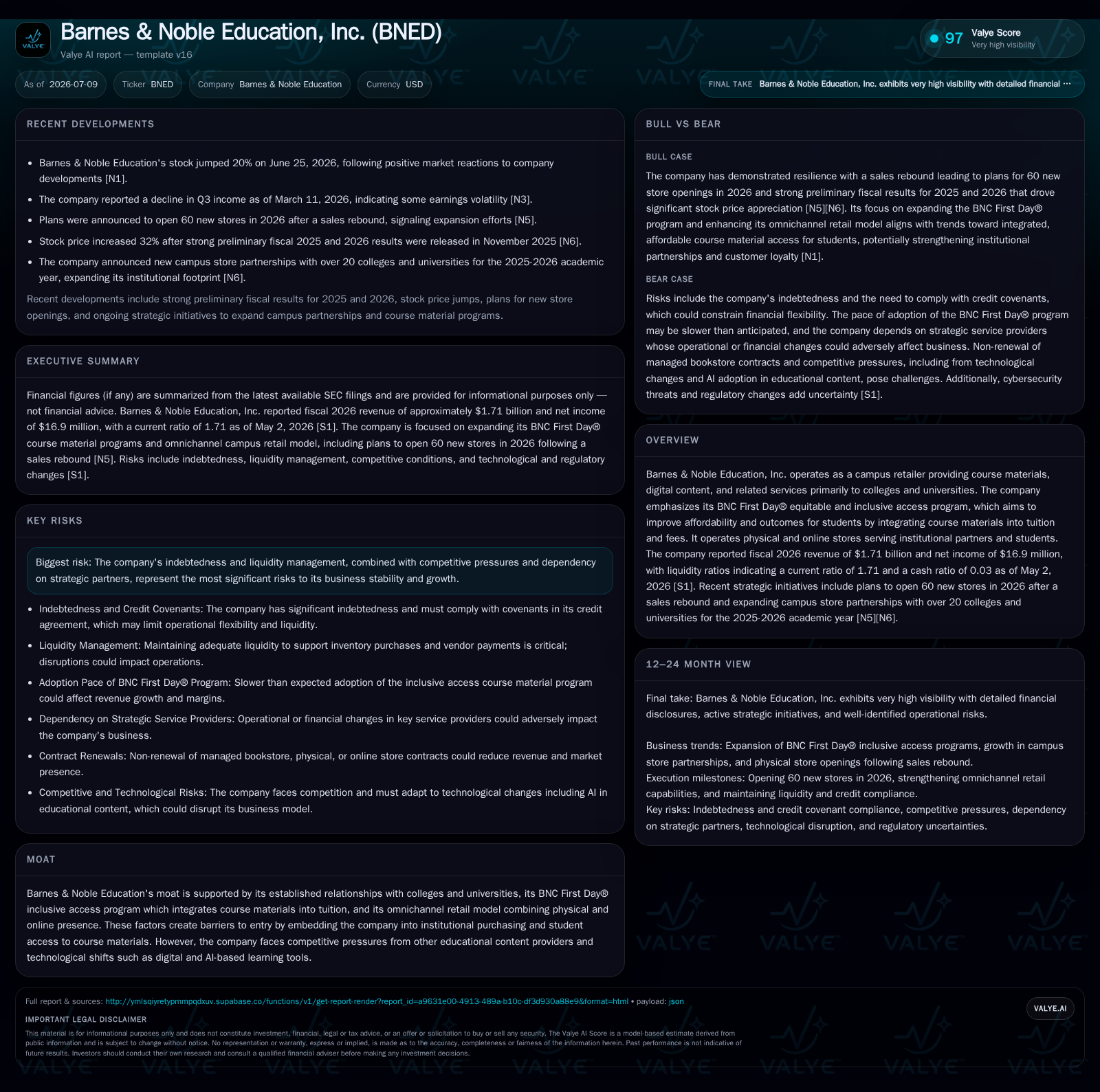
Barnes & Noble Education, Inc. (BNED) demonstrated resilience in fiscal 2026 by reporting $1.71 billion in revenue and net income of $16.9 million, fueled by growth in its signature inclusive access program that integrates course materials into tuition. The company leverages its deep institutional partnerships and an omnichannel retail approach encompassing physical campus bookstores and digital platforms. Strategic initiatives include opening 60 new stores in 2026 and expanding partnerships with over 20 colleges, signaling a renewed focus on physical presence amid digital transition pressures. Key risks stem from indebtedness, competitive challenges, and dependency on institutional contracts.
Recent Operating Update
Barnes & Noble Education, Inc. (BNED) reported fiscal 2026 revenue of $1.71 billion and net income of $16.9 million, reflecting a recovery driven by its inclusive access initiatives and strategic store expansion plans [F1][S1]. The company’s latest quarterly disclosures highlight ongoing momentum in its BNC First Day® program, which integrates course materials costs directly into tuition and fees, enhancing student affordability and boosting institutional content adoption rates [N6][S2]. This program remains a core driver of recurring revenue, supported by BNED’s deep institutional partnerships and omnichannel retail model combining physical campus bookstores with a robust e-commerce platform [S1].
Business Model Overview
BNED operates primarily as a campus retailer serving colleges and universities by providing a comprehensive range of course materials, including physical textbooks and increasingly digital content, alongside ancillary student services such as textbook rentals, branded merchandise, and technology rentals (e.g., laptops and tablets) [S1]. The company monetizes through contractual arrangements with educational institutions, which adopt BNED’s inclusive access solutions like the BNC First Day® program. This program bundles course material costs into tuition and fees, shifting payment mechanics from individual student purchases to institutional billing cycles, thereby improving student affordability and securing higher content adoption rates [N6]. These contracts create switching costs for universities due to integration with academic systems and billing processes, anchoring BNED’s recurring revenue streams.
The company’s omnichannel approach leverages physical campus bookstores to maintain on-campus presence and engagement, while its e-commerce platform caters to evolving student preferences for convenience and digital access. This hybrid model supports customer retention and drives average revenue per student, balancing traditional retail with digital transformation [S1]
Industry Structure and Competitive Position
The education retail and campus services industry operates at the downstream end of the educational content value chain, sourcing materials from publishers and digital content providers and delivering them to students via campus stores and online channels. BNED competes with other campus bookstore operators such as Follett Corporation, as well as digital-first learning platforms and textbook rental services like Chegg and VitalSource Technologies.
Competitive pressures include the sector-wide shift toward digital content adoption, direct-to-student publisher sales that bypass intermediaries, and emerging AI-enabled adaptive learning tools that may reduce reliance on traditional textbooks [S4][S6]. Enrollment trends also impact demand for campus retail services, while margin compression arises from increased price transparency and competition on e-commerce platforms.
BNED’s competitive moat is built on its entrenched institutional partnerships and managed bookstore contracts, which embed the company into university course material logistics and tuition frameworks. The BNC First Day® inclusive access program further strengthens this position by integrating course material costs into institutional billing, creating switching costs and recurring revenue visibility [S1][S4]. However, maintaining technological parity through investments in IT infrastructure and digital content delivery platforms remains critical to counter competitive threats and evolving customer expectations
Growth Drivers
The expansion of BNED’s BNC First Day® equitable access program is a central growth driver, reflecting increased demand from institutions seeking to improve student affordability and guarantee course material adoption rates [S3][N6]. By embedding course material costs into tuition, BNED secures recurring revenue streams aligned with academic budgeting cycles, enhancing revenue predictability.
Additional growth initiatives include the planned opening of approximately 60 new stores in fiscal 2026, aimed at deepening on-campus engagement and capturing enrollment rebounds at select institutions [N5]. Concurrently, BNED is increasing digital content penetration, aligning with sector trends favoring e-materials that offer improved margin profiles due to lower inventory risk and enhanced scalability.
The company is also diversifying revenue through ancillary student products and services, which typically carry higher margins compared to commodity course materials [S1]. Integration of physical and digital channels through its omnichannel retail model supports improved customer retention and cross-selling opportunities, contributing to average revenue per student growth
Sustaining these growth drivers depends on successful renewal and expansion of institutional partnerships, which govern managed bookstore operations and inclusive access contracts.
Risks and Watchpoints
BNED faces several key risks that could impact its operational and financial performance:
- Leverage and Liquidity: As of May 2, 2026, BNED reported net debt of approximately $95 million, with cash and equivalents of $8.4 million and a current ratio of 1.71, indicating reasonable short-term liquidity but necessitating disciplined cash flow management, especially around inventory funding aligned with academic cycles [F1].
- Contractual Dependency: The company’s revenue is heavily reliant on renewing managed bookstore and inclusive access contracts with educational institutions. Non-renewal or unfavorable renegotiations could materially affect sales volumes and recurring revenue stability [S6].
- Enrollment Trends: Declining college enrollment or reductions in student financial aid could reduce demand for course materials and campus retail services, pressuring revenue, particularly in physical textbook sales [S6].
- Competitive Disruption: Accelerated adoption of direct digital distribution by publishers and AI-driven learning tools pose substitution risks that may erode BNED’s intermediary role and margins [S4][S6].
- Technological and Cybersecurity Risks: Disruptions to IT systems, including order processing and payment platforms, due to cyber-attacks or technical failures could impair service delivery and damage customer trust [S4].
- Regulatory Changes: Shifts in education funding policies or data privacy regulations may require costly operational adjustments, impacting margins [S6].
Proactive management of these risks, particularly through contract renewals and technology investments, will be essential for BNED’s sustained execution.
What To Watch Next
Key operational and financial indicators to monitor include:
- Adoption rates and revenue contribution from newly onboarded BNC First Day® programs in fiscal 2027, which are critical for top-line growth sustainability.
- Progress and timing of planned store openings, with attention to capacity utilization and same-store sales growth as measures of organic expansion quality.
- The evolving sales mix between digital content and physical course materials, with digital penetration trends indicating margin improvement and scalability.
- Institutional partnership renewal announcements ahead of contract expirations, providing visibility into recurring revenue base stability.
- Liquidity and refinancing activities that could affect financial flexibility amid seasonality-driven working capital demands.
- Quarterly operating results reflecting cost control effectiveness and interest expense management in light of existing indebtedness.
Financial Profile Discussion
Barnes & Noble Education’s fiscal 2026 balance sheet as of May 2, 2026, shows current assets of approximately $484 million against current liabilities of about $284 million, yielding a current ratio of 1.71, which indicates adequate short-term liquidity to meet operational needs [F1]. Cash and equivalents stood at $8.4 million, while total debt was approximately $103 million, resulting in net debt near $95 million [F1]. This leverage level underscores the importance of disciplined cash flow management, particularly during peak inventory purchasing periods aligned with academic calendars.
The company initiated a regular quarterly dividend of $0.08 per share starting in fiscal Q4 FY26, signaling board confidence in cash flow generation; however, future dividend payments remain contingent on capital adequacy and compliance with credit agreement covenants [S9][S16]
Overall, BNED’s financial position reflects a business in recovery, balancing reinvestment in growth initiatives with prudent leverage management.
Conclusion
Barnes & Noble Education is navigating the evolving education retail landscape by leveraging its scalable inclusive access program embedded within institutional tuition billing frameworks, combined with an omnichannel retail approach spanning physical campus stores and digital platforms. Fiscal 2026 results demonstrate encouraging recovery momentum driven by these initiatives, further supported by planned store expansions targeting enhanced on-campus penetration amid recovering enrollment levels. Nonetheless, significant risks related to indebtedness, competitive disruption from digital-native players, contract renewal dependencies, and enrollment trends require focused mitigation.
Monitoring critical KPIs such as institutional partnership growth, course material adoption rates—particularly inclusive access penetration—same-store sales performance post-expansion, digital versus physical product mix evolution, and balance sheet health will provide vital insights into BNED’s capacity to sustain profitable growth going forward.
Disclaimer: This analysis reflects information available as of July 2026 gathered from SEC filings, company disclosures, news releases, and sector knowledge without extending predictive judgments beyond supported evidence.
Disclaimer: This is research-only, informational analysis and not investment advice. It may include AI-generated interpretation and general industry context. Always verify important details using primary sources.

Comments