
Jefferies Financial Group Strengthens Capital Base Amid Volatile Market Environment
Jefferies Financial Group reported a capital markets-focused quarter featuring debt issuance and steady liquidity, navigating cyclical pressures in investment banking and asset management.
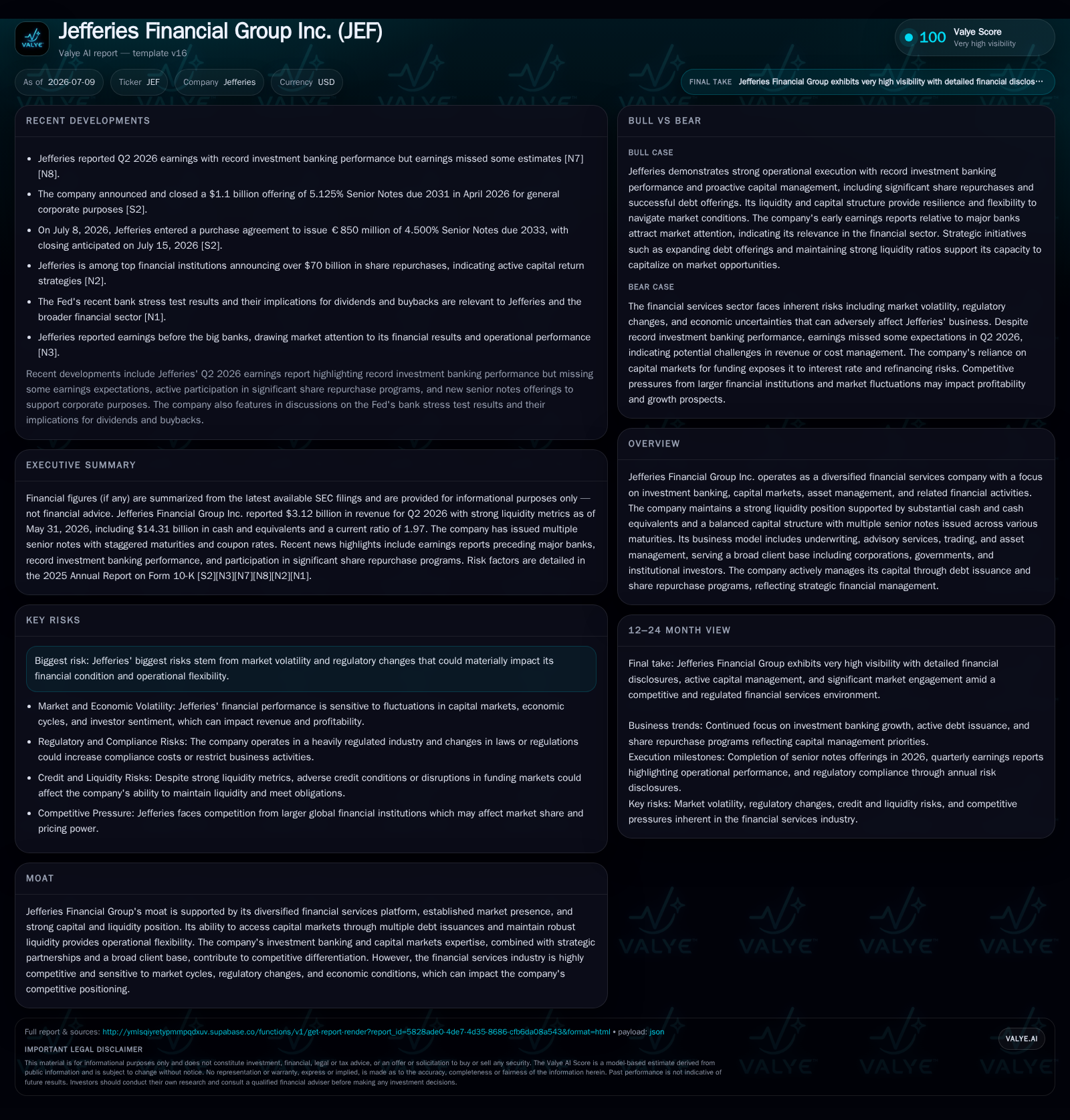
Jefferies Financial Group’s latest quarterly filing reveals proactive balance sheet management highlighted by a €850 million senior notes offering and robust liquidity alongside challenges inherent to market volatility. Its diversified platform leverages investment banking fees, trading profits, and asset management fees to serve institutional clients globally. Industry dynamics including regulatory oversight and macro cycles remain key risks, although the company’s execution in capital markets and strategic debt initiatives support operational flexibility. Monitoring KPIs like underwriting volumes, AUM growth, and liquidity ratios will be critical going forward.
Recent Operating Update: Strengthening Capital with New Senior Notes
Jefferies Financial Group’s latest quarterly filing dated July 9, 2026, highlights a strategic capital markets initiative with the pricing of €850 million of 4.5% senior notes due 2033, expected to close mid-July 2026 [S3]. This issuance complements Jefferies’ existing senior note maturities spanning 2027 to 2036, providing a staggered debt maturity profile that supports funding cost optimization and balance sheet flexibility amid volatile market conditions.
Liquidity metrics reinforce this prudent capital management approach. As of May 31, 2026, Jefferies held $14.3 billion in cash and cash equivalents against approximately $18.0 billion in total debt, resulting in a moderate net debt position near $3.7 billion [F1]. The firm’s current ratio of 1.97 indicates strong short-term liquidity coverage, a critical buffer for meeting obligations in the capital markets and broker-dealer environment [F1]. This liquidity position supports Jefferies’ ability to absorb episodic market volatility, which can impact underwriting volumes and trading revenue.
Recent analyst commentary on Q2 2026 earnings reflected a mixed operating performance: record investment banking fees driven by elevated underwriting and advisory activity were partially offset by softness in certain trading segments and fee pressures within asset management [N4][N6]. This segmentation illustrates the cyclical nature of investment banking revenues, which correlate closely with deal flow and capital market issuance, contrasted with the more stable but currently challenged fee-based asset management business.
Business Model: Integrated Investment Banking, Capital Markets, and Asset Management
Jefferies operates through two primary segments: Investment Banking and Capital Markets (IBCM) and Asset Management [S1]. The IBCM segment generates revenue from underwriting equity and debt securities, providing merger and acquisition advisory services, and executing capital markets transactions across the Americas, EMEA, and Asia-Pacific regions. Advisory fees are earned on announced transactions, while commissions and spread revenue derive from equity sales, fixed income trading, and derivatives activities.
The firm’s trading desks engage in market making and principal trading across equity derivatives, convertible bonds, fixed income instruments, commodities, and structured products. These activities expose Jefferies to market risk but also enable capture of bid-ask spreads and trading profits that diversify revenue beyond advisory fees [S1]. Given the daily mark-to-market accounting of trading inventories, effective market risk management and credit risk controls are essential operating variables.
Asset Management contributes primarily through fee income from credit and alternative investment strategies targeted at institutional investors seeking portfolio diversification beyond traditional equity and fixed income products. While asset management fees provide more predictable recurring revenue streams, their scale currently remains smaller relative to the IBCM segment. Management has signaled ambitions to grow this platform through new product launches and geographic expansion.
Jefferies’ business model monetizes client mandates by scaling underwriting volumes, advisory mandates, and trading activity. Key operating metrics include underwriting fees, client transaction volumes, assets under management (AUM) growth, and trading revenue. Profitability depends on balancing cyclical investment banking fees with recurring asset management income and managing market risk exposure in principal trading books.
Industry Structure and Competitive Positioning
The investment banking and asset management industry is highly competitive and regulated, with firms subject to capital adequacy requirements under Basel III/IV frameworks and trading restrictions such as the Volcker Rule in the U.S. Jefferies competes with global bulge bracket banks like Goldman Sachs and Morgan Stanley, as well as boutique advisory firms such as Lazard, particularly in M&A advisory.
Jefferies occupies a mid-sized niche combining full-service broker-dealer capabilities with targeted asset management offerings. Its prime brokerage services cater to hedge funds and other institutional clients, generating commission revenue but also introducing credit risk through margin lending and financing activities.
Compared to peers with larger fixed income franchises (e.g., UBS) or dominant passive asset management platforms (e.g., BlackRock), Jefferies emphasizes flexible underwriting and advisory services supplemented by active trading desks. This positioning allows the firm to capitalize on episodic market shifts and maintain diversified revenue streams.
Strategic geographic hubs in New York, London, and Hong Kong facilitate cross-border capital markets transactions and client coverage, enabling Jefferies to serve multinational corporations, governments, and institutional investors with localized expertise and global execution capabilities [S1].
Growth Drivers
Several structural factors support Jefferies’ medium-term growth prospects:
- Elevated capital market issuance activity, including IPOs and debt refinancing, drives underwriting fees and advisory mandates.
- Growing institutional investor demand for alternative credit and private credit products expands fee-bearing AUM.
- Expansion into emerging markets offers access to new deal flow and less saturated competitive landscapes.
- Innovation in electronic trading platforms enhances commission capture and operational efficiency amid industry-wide fee compression.
- Regulatory reforms may enable new lending or securitization opportunities previously constrained by compliance costs.
- Macroeconomic recovery phases stimulate corporate financing needs, increasing advisory and underwriting activity.
- Market volatility tends to increase trading volumes, benefiting spread revenue from active fixed income and derivatives desks.
Monitoring KPIs such as underwriting backlog, net new assets under management, client transaction volumes, margin lending balances, and net interest margins will provide insight into Jefferies’ business momentum and resilience.
Risks and Watchpoints
Jefferies faces several key risks typical of the investment banking and asset management sector:
- Market volatility can compress trading revenues and reduce deal flow, impacting quarterly earnings unpredictably [S1].
- Credit risk from counterparty defaults, particularly in margin lending and repo financing, poses potential loss exposure.
- Regulatory changes may increase compliance costs or restrict proprietary trading activities, affecting profitability.
- Liquidity risk arises if multiple debt maturities coincide without timely refinancing, stressing balance sheet flexibility.
- Operational risks include technology failures and cybersecurity threats that could disrupt trading and reporting systems.
- Concentration risk from large client exposures or sector-specific downturns may affect revenue stability.
Ongoing monitoring of capital adequacy ratios and liquidity coverage ratios will be critical as Basel IV regulations evolve globally [S1]. Current legal proceedings disclosed by the company are not expected to materially impact financials but warrant continued observation given reputational considerations
What to Watch Next
Key near-term developments include:
- Closing and integration of the €850 million senior notes issuance, influencing Jefferies’ debt maturity profile and refinancing costs [S3].
- Quarterly updates on underwriting volumes and IPO pipelines, which serve as leading indicators of investment banking fee trends.
- Trends in assets under management growth, signaling expansion or contraction of fee-based revenue streams.
- Regulatory developments affecting broker-dealer capital and trading book requirements.
- Earnings releases detailing segment revenue contributions and margin performance amid macroeconomic uncertainties.
- External market factors such as Federal Reserve stress test outcomes, which may impact dividend policies and investor sentiment [N1].
- Interest rate movements shaping net interest margins and credit demand in financing activities.
Financial Profile Discussion
As of May 31, 2026, Jefferies Financial Group held $14.3 billion in cash and cash equivalents against $18.0 billion in total debt, resulting in a net debt position of approximately $3.7 billion, reflecting moderate leverage balanced by strong liquidity reserves [F1]. The current ratio of 1.97 underscores the firm’s capacity to meet short-term liabilities comfortably, a competitive strength in the broker-dealer and capital markets environment [F1].
The company’s staggered senior note maturities from 2027 through 2036 enable effective management of refinancing risk and funding costs, supporting capital adequacy aligned with regulatory expectations [S3]. This financial flexibility underpins Jefferies’ ability to sustain underwriting and trading activities during periods of market stress.
Operational profitability remains influenced by the cyclical nature of investment banking fees, which fluctuate with deal activity, balanced against steadier asset management fee income [S1][N5]. Cost discipline and investment in electronic trading infrastructure are critical to maintaining competitive margins amid industry fee compression and regulatory compliance demands
In summary, Jefferies’ financial and operational positioning provides a foundation for resilient participation in global capital markets, leveraging a diversified revenue base and disciplined balance sheet management to navigate ongoing macroeconomic and regulatory challenges.
This analysis compiles information strictly from publicly available SEC filings dated through July 9, 2026 ([S1], [S2], [S3]), company facts data ([F1]), and relevant news reports ([N1], [N4], [N6], [N5]). It does not constitute investment advice but aims to provide an informed view on Jefferies Financial Group’s current operating profile within the investment banking and asset management industry.
Disclaimer: This is research-only, informational analysis and not investment advice. It may include AI-generated interpretation and general industry context. Always verify important details using primary sources.

Comments