
Sentinel Holdings Pursues Growth Amid Operating Losses and Litigation Risks in Private Security Sector
Sentinel Holdings focuses on California-based security services expansion with technology integration but faces profitability challenges and litigation headwinds.
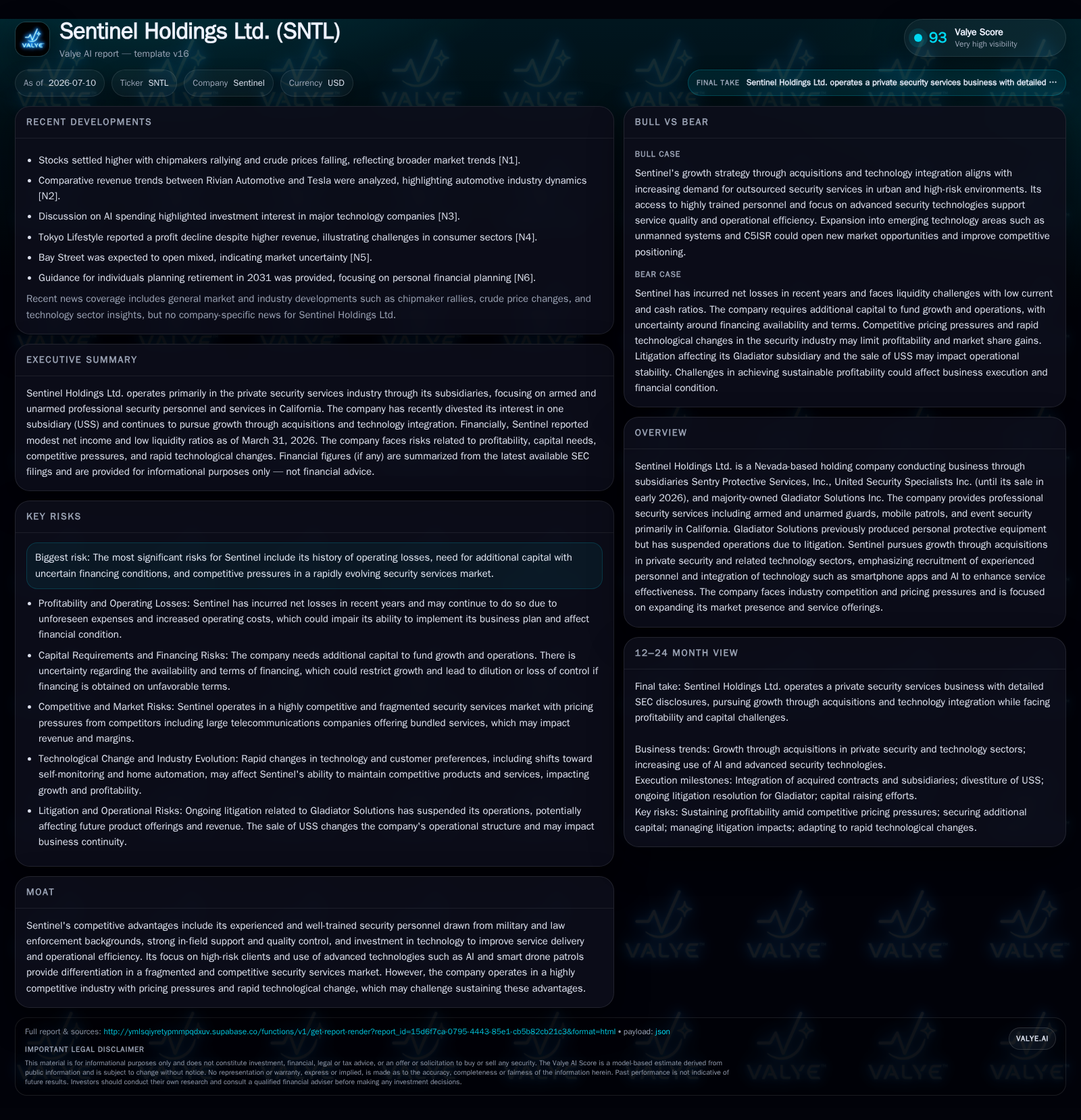
In its latest quarterly update, Sentinel Holdings Ltd. continues to operate through its security services subsidiaries primarily in California, having divested one unit early 2026. The company emphasizes growth via acquisitions and technology adoption, such as AI and smartphone apps, aiming to differentiate in a competitive and labor-intensive private security industry. However, Sentinel remains loss-making with sizable operating deficits, mounting legal exposures related to prior management actions, and liquidity constraints indicated by a weak current ratio. Future growth depends on successful integration of acquisitions, contract retention, and capital raises amid industry pricing pressures and regulatory demands.
Recent Operating Update
Sentinel Holdings Ltd.'s latest quarterly filing dated July 10, 2026 presents a mixed operational landscape dominated by restructuring actions and continued profitability challenges [S2]. Through its subsidiaries Sentry Protective Services Inc. and majority-owned Gladiator Solutions Inc., the company delivered professional armed and unarmed security personnel services primarily across California. Notably, Sentinel sold its equity interest in United Security Specialists (USS) in February 2026, consolidating operations with Sentry earlier in October 2025 following the acquisition of professional service contracts belonging to another California-based entity [S1][S5]. This consolidation reflects management’s effort to streamline operations under fewer legal entities.
Business Model Analysis
Sentinel operates as an integrated private security service provider delivering a portfolio that includes armed guards, unarmed guards, mobile patrols, and event security [S1]. Its monetization mechanics rely heavily on recurring client contracts structured around service volume (personnel deployment hours) and pricing per contract. Contracts often involve multi-year commitments but vary widely in duration and client risk profiles—from residential communities to high-risk venues such as schools or houses of worship where specialized armed personnel are required [S1][S17].
The company supplements traditional human-security offerings by embedding technology into its delivery model — notably through smartphone applications enabling guards real-time check-ins and incident reporting facilitated by SilverTrac software [S1][S17]. Additionally, Sentinel plans to expand AI-enabled solutions including smart drone patrols aimed at enhancing operational oversight while controlling labor costs—a key margin lever given the labor-intensive nature of the business [S1][S17]. Gladiator Solutions historically contributed through manufacturing personal protective equipment but has suspended operations during ongoing litigation disputes since mid-2023 [S1][S4].
Growth is pursued primarily via acquisitions—adding client contracts alongside incremental workforce recruitment—rather than organic expansion alone [S1][S5][S17]. Maintaining a pipeline of experienced military or law enforcement-trained personnel supports service quality especially for high-risk clients who demand reliability under potentially volatile conditions. Sentinel integrates new acquisitions operationally by merging logistics and support functions but faces risks tied to employee retention rates and contract attrition which materially impact recurring revenue streams [S17].
Industry Structure and Competitive Position
Operating within the highly fragmented U.S. private security services industry—dominated regionally by large players like ADT Inc., Allied Universal, G4S, and Securitas AB—Sentinel occupies a mid-sized regional niche focused on California markets. Large peers often leverage scale and technological ecosystems across diverse verticals including alarm monitoring and secure logistics; Sentinel's comparatively smaller size limits bargaining power with clients yet allows potential agility in specialized high-risk client segments.
Pricing pressure is endemic due to oversupply of contract security personnel providers competing on hourly rates [S1][S4]. The company’s emphasis on quality control via advanced technology integration aims to offset commoditization trends. However, rapid technological evolution necessitates continual capital investment to remain competitive against peers expanding AI surveillance capabilities or integrating unmanned systems broadly across their service footprint
Furthermore, labor market dynamics present both an opportunity and challenge: ability to recruit professionally trained guards from military or law enforcement backgrounds differentiates service quality but tight labor supply constrains growth scalability as wage inflation pressures operating costs [S12][S17]. Regulatory compliance adds complexity—licensing requirements vary state-by-state—with failure potentially leading to litigation or fines impacting reputation critically in a trust-sensitive service sector [S13].
Growth Drivers
Sentinel's growth strategy builds on three pillars: (1) geographic market penetration within California via expanded contract wins; (2) acquisition-driven scale targeting complementary regional companies or contract portfolios with limited liabilities; (3) technology adoption to enhance guard productivity and client satisfaction leveraging AI surveillance tools and mobile platforms [S1][S17]. Acquisition of client contracts from Opsec Specialized Protections in late 2025 exemplifies this approach with careful deal structuring linking earn-outs to contract revenue retention performance [S10].
The industry tailwinds include rising security concerns across public venues necessitating higher-risk services demand coupled with outsourcing trends where businesses favor external specialized providers over internal security teams for cost efficiency. Compliance environment tightening around cybersecurity standards also opens opportunities for firms capable of meeting certifications like Cyber Security Maturity Model Certification (CMMC), which Sentinel is targeting through acquisitions aligned with defense-sector technologies [S4].
Risks and Watchpoints
A significant legal risk arises from ongoing litigations specifically involving former Gladiator executive actions resulting in disputed loans unapproved by management, exposing Sentinel to litigation accrual uncertainties along with reputational damage risks within key client segments reliant on trustworthiness [S22][S29]. While some litigations appear dismissed or settled partially (e.g., labor-related claims), others involving cross-complaints reflect unresolved contingencies.
Market competition imposes persistent pricing pressure reducing margin improvement levers while dependence on recruiting experienced personnel from highly competitive labor pools constrains growth velocity. Regulatory compliance complexity across jurisdictions requires ongoing diligence especially as expansions into sectors with tighter licensing demands are contemplated.
What To Watch Next
Critical upcoming developments include monitoring the financial impact of USS’s divestiture completed early 2026 regarding realized proceeds versus prior valuation expectations [S2][S5], assessment of Gladiator-related litigations resolution which may unlock product relaunch potential or reduce contingent liabilities [S4][S22], quarterly operating results illustrating contract renewal rates post-acquisition integrations reflecting endurance of acquired revenue streams.
Capital raise announcements will be essential signals given stated need for supplementary funding channels to sustain scaling initiatives noted by management without dilution levels that impair shareholder value excessively [S19][S26]. Additionally, progress deploying AI-led technological enhancements correlating with utilization rate improvements among deployed personnel would signal successful strategic execution in a cost-pressured environment.
This analysis combines detailed company filings up to mid-2026 reflecting Sentinel Holdings Ltd.'s strategic repositioning within the private security services industry context characterized by intense competition, high regulatory demands, labor market complexities, growing importance of technology integration for differentiation, ongoing litigation risks affecting corporate stability, and persistent funding challenges critical for sustaining growth ambitions. Investors should watch carefully for demonstrated improvements in operational profitability metrics alongside managed resolution of legal exposures.
This article does not constitute investment advice nor research views regarding any securities mentioned herein.
Disclaimer: This is research-only, informational analysis and not investment advice. It may include AI-generated interpretation and general industry context. Always verify important details using primary sources.

Comments