
Expensify's Growth Paradox: Viral Momentum Meets Rising Losses
Examining how Expensify balances rapid platform adoption through viral user growth against increasing operating losses and the financial implications thereof.
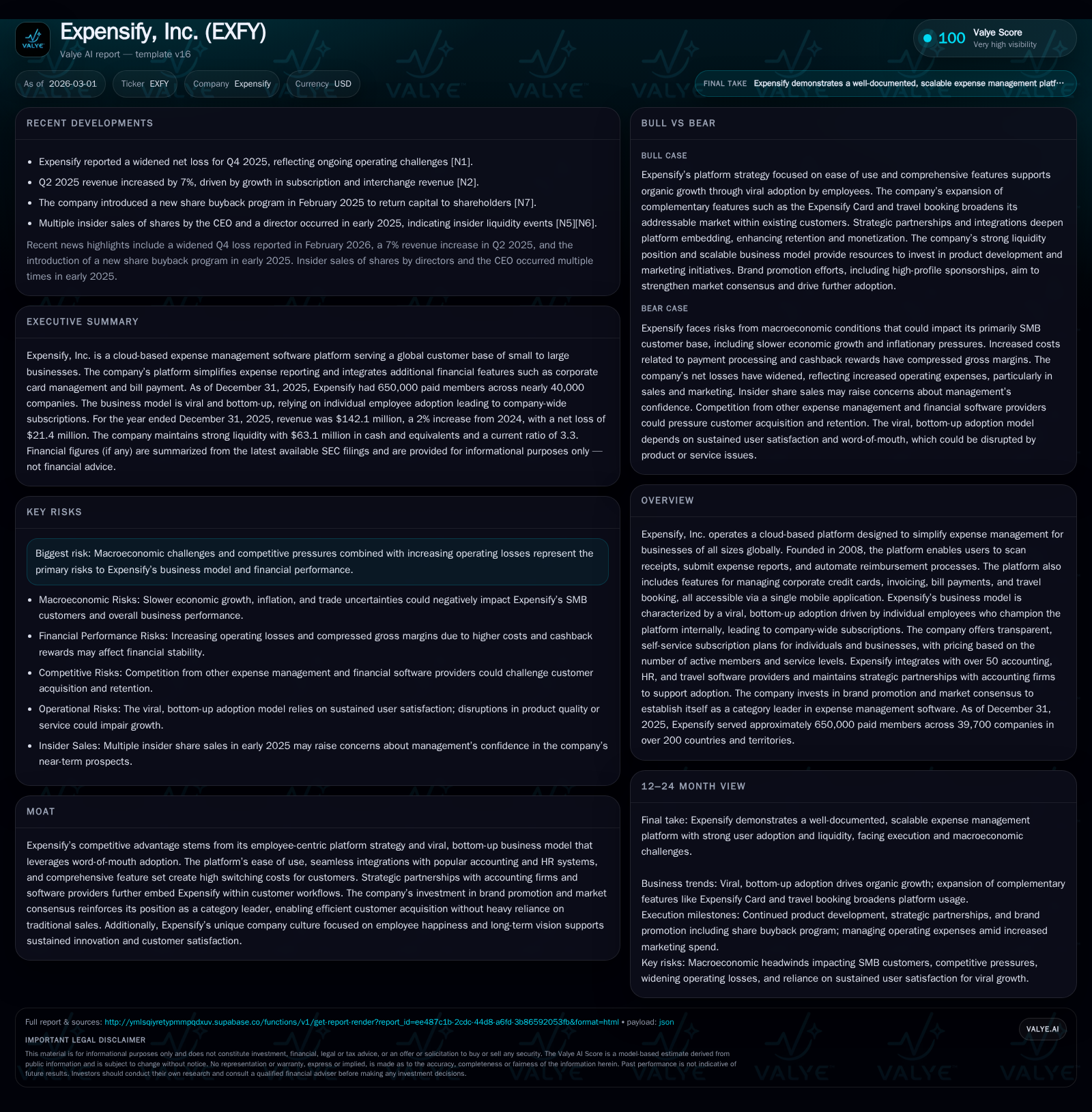
Expensify, Inc. has demonstrated robust user-driven growth characterized by a surge in paid members and transaction volumes totaling over 1.8 billion expense transactions by the end of 2025. This expansion is fueled by a unique employee-centric, viral bottom-up adoption model that minimizes sales expenses and leverages integrations with more than 50 third-party providers. However, this momentum contrasts sharply with widening operating losses, which reached $18 million in FY2025 despite positive operating cash flows driven by minimal capital expenditures. The company’s strategy to deepen platform functionality through complementary services such as the Expensify Card offers promising revenue levers, though macroeconomic headwinds and intensifying competitive pressures pose significant risks. Capital deployment includes steady share repurchases amid cautious liquidity management, underscoring the tension between growth investments and financial discipline.
User-Driven Growth: Examining Historical Expansion of Members and Transactions
Expensify's trajectory reflects sustained user-driven growth rooted in its unique employee-centric platform strategy. As of December 31, 2025, the platform had processed over 1.8 billion expense transactions cumulatively since inception [S1]. During FY2025, an average of approximately 650,000 paid members representing about 39,700 companies globally engaged with the platform monthly across more than 200 countries [S1]. This marks continued viral momentum compared to prior periods (642K average paid members for Q3 2025 [S2]).
This scale signals operational expansion into diverse geographies and industry segments. The bottom-up adoption approach—where individual employees independently deploy Expensify’s app before company-wide subscriptions are secured—drives organic penetration while minimizing costly sales efforts [S1], [S6]. This contrasts with traditional software procurement models relying heavily on top-down sales cycles.
The network effect is reinforced by Expensify’s integration ecosystem; its platform connects seamlessly with over fifty accounting, HR, ERP, and travel software providers [S18], embedding deeply into daily workflows and supporting high retention metrics [S21]. Viral ambassadors within organizations proliferate use cases beyond expense reports to corporate card management and travel bookings.
Product Innovation and Platform Extensions
Expensify aims to amplify revenue streams through product diversification. The Expensify Card launched in February 2024 has introduced interchange fee revenue alongside core subscription income [S1], [N1]. The company actively promotes this offering to cross-sell among its user base while expanding features around invoicing, bill payments, and travel booking functionalities within its mobile app [S1].
However, growth faces constraints from macroeconomic headwinds including inflationary pressures and recession risks that impact SMB discretionary spending such as corporate travel [S2]. Operating losses expanded amid these investments—highlighting tension between accelerated feature rollout and cost control.
The competitive landscape remains challenging as manual processes still dominate many SMBs but face disruption from horizontal platforms offering basic expense tools and incumbent corporate card providers [S9]. Expensify differentiates itself through patented SmartScan technology and comprehensive integration capabilities.
Historical Financial Performance Summary
Historical performance (annual)
| FY | Net ($mm) | CFO ($mm) | OpInc ($mm) | Capex ($) | Net YoY |
|---|---|---|---|---|---|
| 2025 | -21 | 20 | -18 | 17000 | -112.7% |
| 2024 | -10 | 24 | -1 | 0 | +75.7% |
| 2023 | -41 | 2 | -33 | 1384000 | -53.5% |
| 2022 | -27 | 33 | -15 | 585000 |
Source: SEC companyfacts cache [F1].
Capital returns and efficiency (annual)
| FY | Buybacks ($mm) | FCF ($mm) | ROE% |
|---|---|---|---|
| 2025 | 9 | 20 | -16.1 |
| 2024 | 2 | 24 | -7.8 |
| 2023 | 3 | 0 | -41.1 |
| 2022 | 6 | 32 | -27.8 |
Source: SEC companyfacts cache [F1].
Table: Historical Financial Performance Summary for Expensify (FY2022-FY2025) [F1]
Capital Allocation: Operating Losses Amid Positive Cash Flow and Share Repurchases
Operating income deteriorated significantly to a loss of $18.0 million in FY2025 compared with a loss of $0.8 million in FY2024—a reflection of aggressive investment in research & development and marketing designed to bolster product-led growth [F1], [S4]. Net income also declined further to -$21.4 million.
Despite net losses, free cash flow remained positive; operating cash flow was approximately $20.1 million against minimal capital expenditures ($17k), supporting operations without reliance on external financing [F1]. This capital-light model aligns with typical SaaS businesses emphasizing cloud services.
Management deployed nearly $9.1 million toward share repurchases during FY2025 under an authorized program extending through March 2028 [F1], [S16]. The company maintained healthy liquidity levels with cash & equivalents at roughly $63 million against current liabilities of about $46 million as of December 31, 2025—yielding a current ratio near 3.3x that signals strong short-term financial flexibility [F1], [S7].
Integration Moat: Embedding Within SMB Workflows
Expensify’s competitive moat rests on multi-layered integrations transforming expense management into an embedded SMB operational function. Partnerships with over fifty accounting systems plus HR platforms and travel providers like Uber and Lyft enable automated data flows that reduce manual reconciliation errors while increasing switching costs for customers [S6], [S21].
Such integrations support a bundled platform service delivery recognized under revenue accounting rules as a combined performance obligation—platform access plus customer support—provided concurrently fostering customer stickiness [S1]. This comprehensive approach strengthens resilience amid competition from single-function solutions.
Risks: Macroeconomic Headwinds and Legal Challenges
Key risks include macroeconomic volatility impacting SMB discretionary spending on technology and travel services critical to Expensify Travel monetization prospects [S2]. Competitive pressures from incumbents expanding digital offerings along with emerging AI-powered automated expense tools raise challenges to pricing power and innovation pace [S9].
Legal proceedings remain material; a securities class action related to IPO disclosures resulted in a $9.5 million settlement provision net of insurance recoveries recorded as liabilities at year-end 2025—management denies wrongdoing but acknowledges potential operational distractions or costs from litigation [S12].
Conclusion
Expensify exemplifies the complex balance SaaS companies face between rapid user-driven growth fueled by viral adoption models and persistent operating losses amid investments in innovation and market positioning. Its strong integration ecosystem embeds it deeply within SMB workflows where digitizing legacy processes remains nascent yet urgent.
Investors should monitor product feature uptake beyond core expenses—especially corporate cards—and assess how macroeconomic conditions influence member growth alongside evolving competitive dynamics.
Disclaimer: This analysis is informational only and does not constitute investment advice or recommendations regarding any securities mentioned herein.
Disclaimer: This is research-only, informational analysis and not investment advice. It may include AI-generated interpretation and general industry context. Always verify important details using primary sources.

Comments