
ARC Group Securities Acquisition I: SPAC Economics, Liquidity Constraints, and the Critical Path to a Deal
With minimal liquidity and no disclosed operations, ARC Group Securities Acquisition I embodies both the potential and the pitfalls of the SPAC structure. Its future hinges entirely on the successful identification and execution of a business combination, with current financials underscoring the urgency.
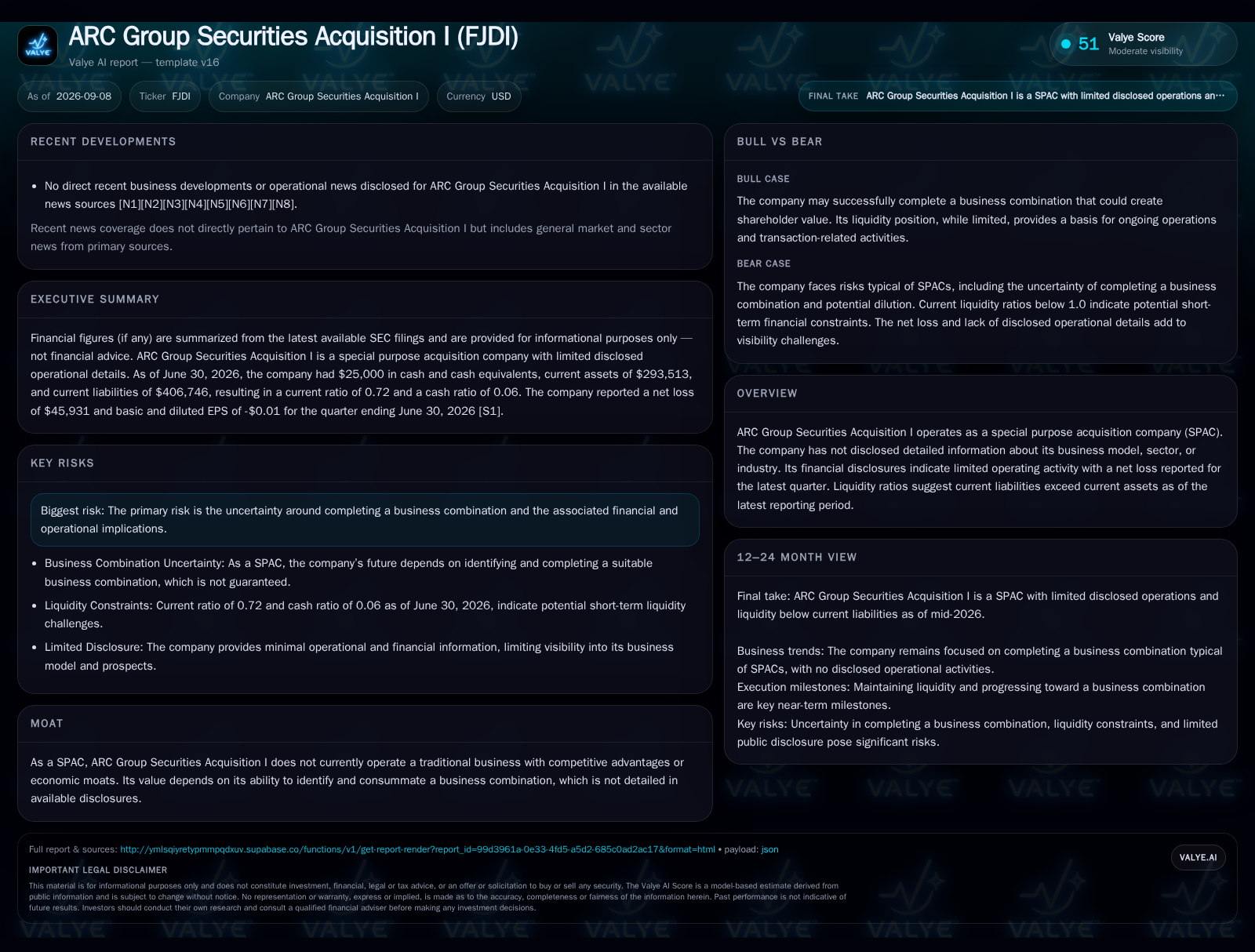
ARC Group Securities Acquisition I, a blank-check SPAC, currently reports no operating business and faces a current ratio of 0.72 with just $25,000 in cash as of June 30, 2026. Its only path to shareholder value is securing and closing a business combination. The company's limited liquidity and lack of operational disclosure highlight the execution risk and the importance of deal progress in the coming quarters. [S1]
ARC Group Securities Acquisition I typifies the high-stakes, high-uncertainty profile of late-stage SPACs that have yet to identify or close a business combination. With just $25,000 in cash and a current ratio well below 1.0 as of June 30, 2026, the company faces immediate liquidity pressure and no visible operating activities. Its entire value proposition rests on the ability to secure and execute a merger or acquisition, a process complicated by limited potential financial flexibility and minimal public disclosure. For investors, the core question is whether ARC Group Securities Acquisition I can navigate these constraints and deliver a viable deal before time and cash run out. [S1]
Liquidity Pressures and Absence of Operations Define the Present State
ARC Group Securities Acquisition I currently operates without an active business, reporting a net loss of $45,931 for the quarter ending June 30, 2026. The company’s cash and cash equivalents stand at just $25,000, with current assets totaling $293,513 and current liabilities at $406,746—yielding a current ratio of 0.72 and a cash ratio of 0.06. These figures highlight two urgent realities: first, the company’s liabilities exceed its assets, and second, it lacks the liquidity cushion typical of SPACs in earlier phases. The absence of a disclosed target or business combination as of the latest filing means that all forward-looking value is speculative and contingent on future deal-making. [S1]
SPAC Cash Burn, Dilution, and the Mechanics of Value Creation
As a special purpose acquisition company (SPAC), ARC Group Securities Acquisition I does not generate revenue or operate a business until a merger or acquisition is completed. Instead, its economics are driven by the capital raised during its IPO, which is typically held in trust (not reflected in the current cash figure, which may only cover operating expenses outside the trust). The company incurs ongoing administrative and legal costs, leading to persistent net losses until a business combination is closed or the SPAC is liquidated. Upon a successful merger, value for shareholders is created if the acquired business justifies the trust value plus any premium paid through share issuance.
Dilution risk is structurally embedded: sponsor shares and warrants can erode per-share value, especially if additional PIPE (private investment in public equity) financing is needed to close a deal. With the current cash position so low, ARC Group Securities Acquisition I may be forced to negotiate bridge financing or face unfavorable deal terms. If redemptions are high, the capital available for a combination shrinks further, compounding the challenge. The company’s limited liquidity also constrains its ability to conduct due diligence or compete aggressively for attractive targets.
SPAC Market Saturation and the Challenge of Standing Out
The competitive landscape for SPACs has shifted dramatically in recent years. While blank-check companies once enjoyed abundant capital and a wide pool of potential targets, the market is now crowded, and regulatory scrutiny has increased. ARC Group Securities Acquisition I faces competition from dozens of other SPACs seeking compelling acquisition targets, many with larger trust accounts or more prominent sponsor teams.
Potential advantages—such as sector expertise, sponsor reputation, or proprietary sourcing networks—are not disclosed for this company, making it difficult to assess whether ARC Group Securities Acquisition I can outcompete its peers. On the other hand, the lack of a sector or geographic focus may broaden the pool of eligible targets, but also dilutes the SPAC’s ability to differentiate itself in a seller’s market for high-quality private companies. The broader SPAC market is also contending with increased redemption rates, target scarcity, and skepticism from both PIPE investors and public market participants.
A High-Quality Business Combination Could Unlock Substantial Value
The optimal scenario for ARC Group Securities Acquisition I is the identification and successful closure of a business combination with an attractive private company—ideally one with strong growth prospects, credible management, and a clear path to public market acceptance. If such a deal is announced, positive market reaction could drive the share price above trust value, and sponsors could see meaningful upside.
Confirmation of this scenario would come from a definitive merger agreement with a well-regarded target, limited shareholder redemptions, and the ability to attract PIPE financing on favorable terms. Evidence against this path would be continued silence on deal progress, deal collapse, or excessive dilution to existing shareholders in order to close a transaction.
Stalled Deal Progress and Erosion of Value as Time Runs Down
The most likely near-term outcome, given the company’s low liquidity and lack of disclosed deal activity, is a protracted search for a target. Administrative costs will continue to erode the remaining cash, while the risk of forced liquidation rises as the SPAC approaches its deadline. In this scenario, ARC Group Securities Acquisition I may announce a deal under less favorable terms—potentially with a less attractive target, higher dilution, or a structure that relies heavily on sponsor concessions to address redemptions and capital shortfalls.
Evidence supporting this scenario would include ongoing net losses without an announced transaction, further deterioration of liquidity, or the emergence of a deal late in the SPAC’s life with high redemption rates. A reversal would require a credible, high-quality target and a clear capital solution.
Deal Failure or Liquidation: The Structural Risks of the SPAC Model
The adverse scenario is straightforward: ARC Group Securities Acquisition I fails to identify or close a business combination before its regulatory deadline. In this case, the SPAC would be forced to liquidate, returning any remaining trust proceeds to shareholders and leaving sponsors with losses on their at-risk capital. Given the current low cash balance and negative net working capital, there is also a risk that administrative expenses further erode the trust, reducing the amount available to public shareholders upon liquidation.
Confirmation of this scenario would come from missed deadlines, explicit liquidation announcements, or disclosures indicating the inability to secure a suitable target. Any news of sponsor loans or bridge financing to keep the SPAC operational could signal distress or an impending wind-down.
What Will Determine ARC Group Securities Acquisition I’s Outcome?
Announcement of a letter of intent or definitive agreement with a private company—this is the single most material event for the SPAC’s future.
Disclosure of additional financing, sponsor loans, or PIPE commitments, which would indicate deal progress or liquidity stress.
Public filings or press releases detailing redemption rates if and when a business combination is proposed; high redemptions would challenge deal viability.
Any changes to the company’s stated deadline for completing a business combination, including extensions or amendments to the trust agreement.
Quarterly cash burn and changes in current liabilities, as persistent net losses could accelerate the need for liquidation.
Sponsor or management team changes, which may affect deal sourcing capability and investor confidence.
If disclosed, the sector or geographic focus of any announced target, which would help assess competitive positioning and market appetite.
Disclaimer: This is research-only, informational analysis and not investment advice. It may include AI-generated interpretation and general industry context. Always verify important details using primary sources.

Comments