
General Dynamics’ Record Backlog and Earnings: The Leverage and Limits of Defense Demand
With record Q3 revenue, earnings, and backlog, General Dynamics demonstrates high operational momentum and financial visibility. Yet, its heavy reliance on government contracts, competitive industry pressures, and evolving defense priorities pose both opportunities and persistent risks.
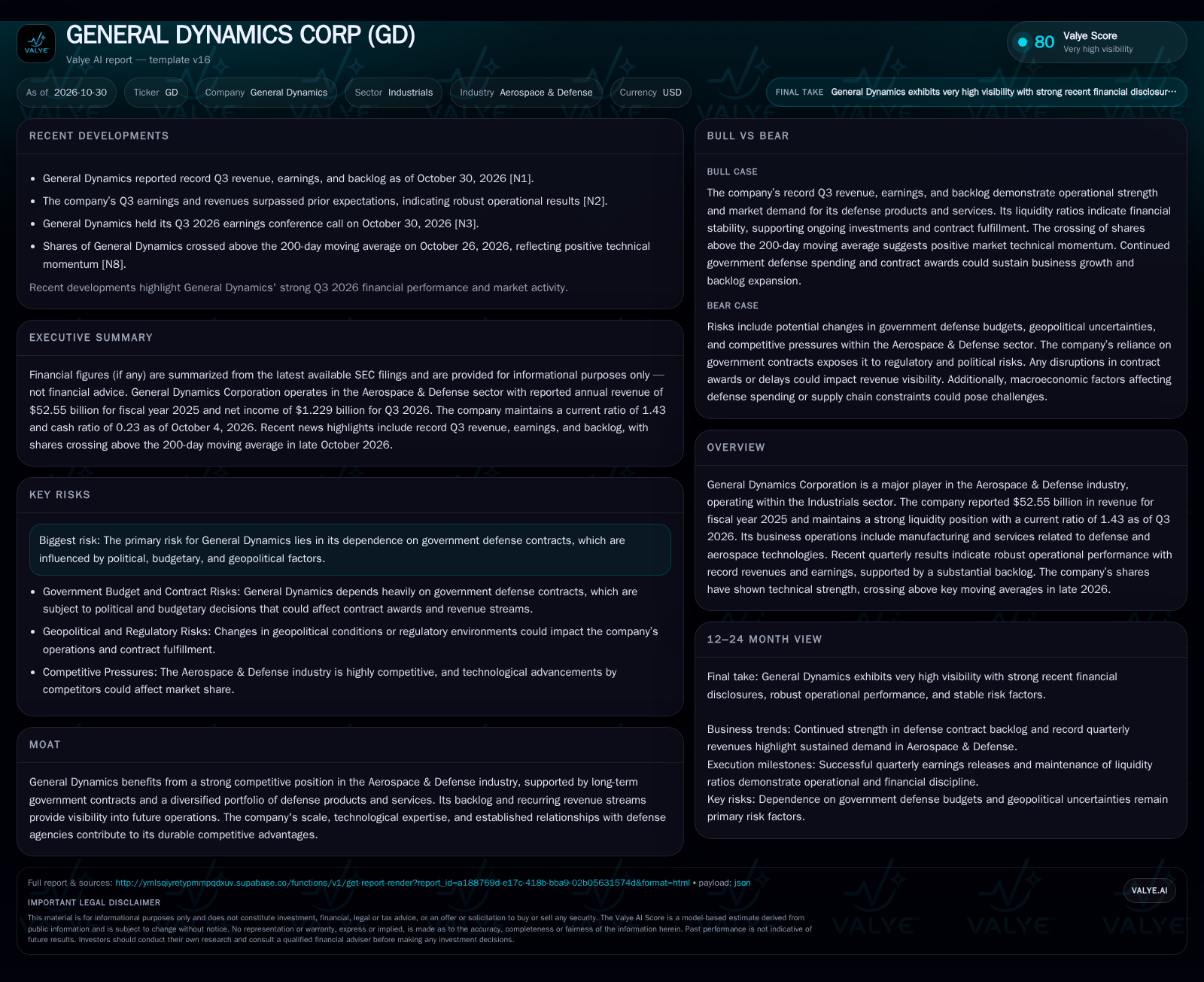
General Dynamics posted record Q3 revenue, earnings, and backlog, underscoring strong operational execution and robust demand for its defense offerings. The company’s liquidity ratios are stable, but its fortunes remain closely tied to government budget cycles and geopolitical factors. Sustained backlog growth could drive continued earnings momentum, though any shifts in defense spending or contract timing would quickly test the company’s resilience. Track contract wins, backlog trends, and government policy signals to gauge the durability of current performance.
General Dynamics’ latest results confirm its status as a bellwether in the Aerospace & Defense sector, with record quarterly revenue, earnings, and backlog propelling operational momentum into late 2026. The company’s scale and deep government relationships have translated into robust financials—annual revenue surpassed $52 billion for 2025, and Q3 2026 net income exceeded $1.2 billion. However, this performance is inextricably linked to the cyclical nature of government defense spending and the broader geopolitical landscape. As defense priorities shift and competition intensifies, the question is whether General Dynamics can continue translating backlog into durable earnings growth or if external headwinds will erode its current trajectory.
Record Backlog and Earnings Signal Robust Demand—But Also Heighten Exposure
General Dynamics reported record Q3 2026 revenue, earnings, and backlog, with quarterly net income reaching $1.229 billion and annual revenue for 2025 at $52.55 billion [S1] [S2] [N1] [N2]. These results exceeded expectations and were accompanied by a current ratio of 1.43 and cash ratio of 0.23 as of October 4, 2026 [S2]. The company’s shares also crossed above the 200-day moving average in late October 2026, reflecting positive technical sentiment [N8]. While these metrics indicate operational strength and liquidity, the record backlog underscores both the opportunity for forward revenue visibility and the risk of heightened reliance on continued government spending.
How General Dynamics Converts Backlog Into Profits—and the Levers That Matter
General Dynamics’ core economic engine is the conversion of long-term defense contracts and aerospace programs into sustained revenue and margin streams. The company’s business mix spans government contracts for military vehicles, naval vessels, aerospace systems, and IT/cybersecurity services. Typically, these contracts are structured as cost-plus or fixed-price agreements, with cost-plus offering margin stability but exposing the company to cost overrun risk, while fixed-price contracts can enhance upside if efficiently executed but penalize misestimation.
Operating leverage is significant: much of the company’s cost base—engineering, manufacturing facilities, and technical workforce—remains fixed over multi-year programs, enabling margin expansion if throughput rises. However, the capital intensity of shipbuilding and aerospace manufacturing can tie up working capital, and delays in contract execution or government payments can pressure cash conversion cycles. [S2]
Future margin expansion may depend on the company’s ability to mix higher-value engineering and technology services into its portfolio, as these segments typically carry higher margins and less capital intensity than traditional hardware manufacturing. Cost discipline, supply chain reliability, and successful program execution remain central levers for sustaining and improving operating economics.
Defensive Moats and Industry Headwinds: Where General Dynamics Stands
General Dynamics benefits from formidable competitive advantages rooted in scale, multi-decade customer relationships, and entrenched positions on mission-critical defense platforms. Its backlog provides multi-year revenue visibility, and the company’s ability to execute on complex, classified, and capital-intensive projects raises barriers to entry for new competitors.
However, the Aerospace & Defense sector is characterized by relentless competition among established peers for large government contracts, with rival primes and specialized technology providers vying for share. Technological change—particularly in autonomous systems, cyber, and space—creates both opportunity and risk, as legacy hardware could be displaced by new priorities or emerging competitors.
Switching costs for government customers are high due to the complexity and integration of defense systems, but budgetary pressures or shifts in defense strategy can quickly alter procurement patterns. General Dynamics’ position is further complicated by the rise of commercial technology firms seeking to penetrate defense markets, potentially eroding the traditional moat if the company does not keep pace with innovation.
Sustained Backlog Conversion Fuels Margin Expansion and Earnings Outperformance
If General Dynamics continues converting its record backlog into revenue at a steady or accelerating pace, while controlling costs and executing efficiently, the company could achieve sustained double-digit earnings growth. This scenario is most plausible if global geopolitical tensions persist, supporting robust defense budgets in the U.S. and allied nations, and if the company secures additional program wins—especially in higher-margin technology and services segments.
Evidence that would confirm this scenario includes continued sequential and year-over-year backlog growth, above-consensus earnings releases, and commentary from management or customers highlighting successful program execution and new contract awards. Margin expansion, particularly in technology-driven business lines, would further validate the thesis. Conversely, any signs of backlog attrition, cost overruns, or major program delays would challenge this upside pathway.
Backlog Stability Anchors Steady Performance Amid Shifting Priorities
The most plausible outcome is that General Dynamics leverages its backlog to deliver steady, mid-single-digit revenue and earnings growth over the next 12-24 months. This would be underpinned by continued, if moderate, defense spending in core markets, offset by routine contract timing fluctuations and ongoing competitive bids.
This scenario would be confirmed by consistent quarterly results in line with guidance, stable or gradually increasing backlog, and no major changes to risk disclosures or government budget trajectories. It would be challenged if new contract awards fall below replacement rate, if there are unexpected regulatory or geopolitical shocks, or if competitive pressures begin to erode margins or market share.
Budget Cuts or Contract Disruptions Test the Limits of Backlog Visibility
A negative scenario could unfold if there are significant reductions in U.S. or allied defense budgets, delays or cancellations in major programs, or geopolitical shifts that deprioritize General Dynamics’ core offerings. In such a case, backlog could prove less durable than expected—either through outright cancellations or delayed order conversion—leading to revenue declines, margin compression, and cash flow stress.
Indicators of this scenario would include declining backlog, missed earnings or revenue targets, adverse changes to government procurement strategies, or material updates to risk disclosures regarding contract timing or budgetary outlook. Supply chain disruptions or cost inflation could further exacerbate the downside, especially if the company is unable to flex its cost base quickly in response.
What Could Confirm or Challenge General Dynamics’ Visibility and Resilience?
Quarterly and annual changes in reported backlog; persistent growth would support the thesis, while any contraction or stagnation could signal future revenue pressure.
Breakdown of revenue and margin by business segment, if disclosed, to assess the shift toward higher-margin technology and services versus capital-intensive manufacturing.
New contract awards, especially for next-generation platforms, cyber, space, or autonomous systems, as indicators of competitive positioning and future growth.
Government budget announcements and defense policy updates, as these directly impact contract pipelines and backlog conversion.
Program execution metrics: cost overruns, delivery delays, or penalties would erode margins and backlog credibility.
Working capital trends and cash conversion cycle data, if disclosed, to monitor the efficiency of backlog-to-cash realization.
Any material changes to risk disclosures in SEC filings, signaling evolving exposures to contract, regulatory, or geopolitical risks.
Management guidance and commentary on supply chain stability, inflationary pressures, and investment in innovation—each could affect both near-term results and long-term positioning.
Disclaimer: This is research-only, informational analysis and not investment advice. It may include AI-generated interpretation and general industry context. Always verify important details using primary sources.

Comments