
Great Elm Group, Inc. (GEG) Equity Analysis: Navigating Real Estate Investment Dynamics Amid Financial Discipline
Great Elm Group operates in real estate investment and management, demonstrating improved cash flows and strategic acquisitions but faces profitability and financial covenant challenges. This analysis explores its business model, competitive moat, and plausible future trajectories.
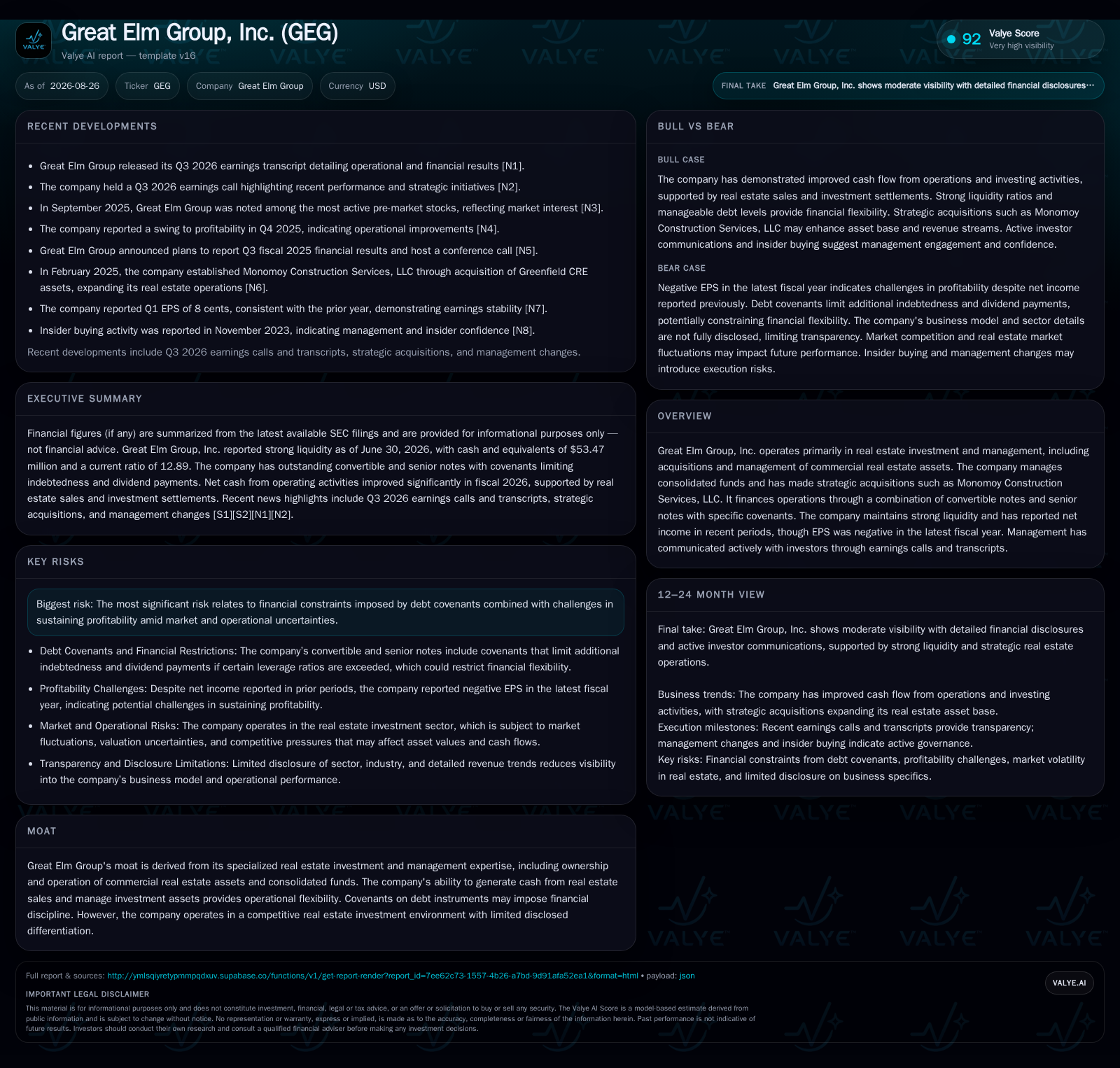
Great Elm Group’s liquidity strength and strategic real estate asset growth underpin moderate operational momentum; however, financial covenants and negative recent EPS highlight risks to profitability and flexibility in a competitive and opaque market environment.
Great Elm Group, Inc., a real estate investment and management company, displays a complex balance between reported liquidity position and operational improvements against constraints imposed by debt covenants and profitability pressures. With cash and equivalents exceeding $53 million and a robust current ratio, the company has maneuvered to improve net cash from operations significantly in fiscal 2026, aided by real estate sales and investment settlements. Strategic moves like acquiring Monomoy Construction Services signal an active approach to asset base expansion. Yet, negative earnings per share in the latest fiscal year underscore challenges in sustaining profitability, while restrictive debt covenants may limit future potential financial flexibility. Understanding how these factors interplay is essential in evaluating GEG’s future prospects and risks [S1][N6].
Latest Operating Snapshot
As of June 30, 2026, Great Elm Group reported cash and cash equivalents of $53.47 million and current assets of $99.63 million against current liabilities of only $7.73 million, yielding a strong current ratio of 12.89 and cash ratio of 6.92, underscoring substantial near-term liquidity [S1]. This liquidity cushion is critical in a capital-intensive real estate environment, providing the company with the capacity to meet obligations and seize acquisition opportunities without immediate financing pressure.
The company’s net cash from operating activities swung from a negative $9.0 million in fiscal 2025 to a positive $15.7 million in fiscal 2026, driven primarily by proceeds from real estate sales and changes in operating assets and liabilities [S1]. This improvement signals operational progress, potentially reflecting enhanced asset management or beneficial market timing in disposing of real estate holdings. However, despite this, the company reported a negative EPS of -$1.17 in fiscal 2026, contrasting with a prior net income of $12.89 million in 2025, indicating non-cash charges or dilution effects impacting reported earnings [S1].
Business Model and Unit Economics
Great Elm Group’s business model centers on acquiring, managing, and selectively disposing of commercial real estate assets, including operating consolidated funds and real estate-related services through subsidiaries such as Monomoy Construction Services, LLC, acquired in 2025 [N6]. Revenue streams likely derive from rental income, asset management fees, and capital gains on sales. The company’s ability to generate cash from sales and investments supports liquidity but also introduces variability, making earnings susceptible to market timing and asset valuation changes.
Capital intensity is significant given the nature of real estate acquisitions and development, requiring upfront investment and maintenance capital. Fixed costs may include asset management overhead and servicing of debt instruments. Variable components relate to property-level operating expenses and transactional gains or losses. Operating leverage could materialize if rental income scales faster than fixed expenses; however, large swings in asset sales may obscure underlying operating profitability. Debt covenants restricting leverage and dividends further complicate capital deployment, potentially forcing the company to prioritize cash conservation over growth investments [S1].
Moat, Competition and Counterforces
Great Elm Group’s moat primarily arises from its expertise in real estate investment and asset management, including consolidation of funds and operational control over commercial real estate assets. This specialization can provide advantages in sourcing deals, optimizing property performance, and timing disposals to capture value. The acquisition of Monomoy Construction Services adds operational depth potentially enabling vertical integration benefits, such as cost efficiencies in construction and property improvements [N6].
However, the real estate investment landscape is highly competitive, featuring institutional investors, REITs, private equity, and other specialized managers with extensive capital and scale. The company’s lack of detailed disclosure on sector and geographic focus limits clarity on differentiation. Financial covenant constraints may reduce agility compared to less encumbered peers. Furthermore, market volatility and regulatory shifts in real estate can erode asset values and cash flow stability, diluting any competitive advantage. Persistence of the moat will depend on the company’s ability to leverage its operational insights and balance sheet prudently.
Bull Case
In a favorable scenario, Great Elm Group capitalizes on its reported liquidity position and improved operating cash flows to strategically acquire and develop high-quality commercial real estate assets. The expansion via Monomoy Construction Services enhances operational control and cost management, leading to higher margins and stable recurring income streams. The company efficiently manages leverage within covenant limits, enabling prudent incremental investments while maintaining dividend capacity. Favorable real estate market conditions contribute to asset appreciation and profitable sales, translating into positive EPS and shareholder returns.
Confirming evidence would include sustained positive operating cash flows, stable or improving rental yields, successful integration and growth of Monomoy Construction’s operations, and adherence to debt covenants without breaches. Evidence falsifying this case would be persistent negative earnings despite cash flow improvements, covenant breaches forcing deleveraging or dividend suspensions, or failure to grow asset base meaningfully.
Base Case
The base case envisions Great Elm Group maintaining its current reported liquidity position position while managing through a competitive real estate market with moderate growth. Operating cash flows remain positive but volatile due to asset sales timing. The business continues to balance acquisition and disposition activity, leveraging Monomoy Construction to support property improvements but without dramatic margin expansion. Debt covenants restrict aggressive leverage growth, curtailing large-scale expansion but preserving financial discipline. EPS remains modestly negative or near breakeven as timing mismatches between cash gains and accounting charges persist.
This outcome assumes no significant covenant breaches, steady albeit competitive market conditions, and management’s continued focus on operational improvements. The company’s transparency through earnings calls and active investor communication support confidence in execution. Deviations include a material deterioration in real estate markets or unexpected operational disruptions that could pressure cash flow or asset valuations.
Bear Case
In a downside scenario, Great Elm Group faces prolonged profitability challenges with negative EPS persisting despite operational cash flow improvements. Debt covenants constrain potential financial flexibility by limiting additional indebtedness and dividend payments, forcing asset sales at suboptimal prices to meet obligations. Market volatility in commercial real estate depresses asset values and rental income, exacerbating cash flow instability. Integration challenges with Monomoy Construction or other subsidiaries impair operational efficiency, raising costs and reducing margins.
Confirming evidence would be covenant breaches necessitating restructuring, sustained negative operating cash flows, disappointing asset sale proceeds, or worsening liquidity ratios. Conversely, evidence falsifying this scenario includes covenant compliance with stable positive earnings, successful refinancing or covenant renegotiations, and steady or growing rental revenues.
What Matters Next
Key performance indicators to monitor include: (1) Operating cash flow trends, to assess core business health beyond accounting earnings; (2) Earnings per share trajectory, as a measure of profitability improvement or deterioration; (3) Debt covenant compliance metrics, including leverage ratios and interest coverage, which dictate potential financial flexibility; (4) Asset acquisition and disposition volumes and margins, signaling growth and capital recycling efficiency; (5) Performance and integration progress of Monomoy Construction Services, reflecting operational synergy potential; (6) Rental income stability and occupancy rates, critical for recurring revenue predictability; (7) Insider activity and management changes, providing insight into governance and strategic confidence; and (8) Market conditions in commercial real estate sectors and geographic focus areas, impacting asset valuations and cash flows.
Disclosure of these metrics or at least partial visibility through earnings call commentary would greatly enhance transparency. Investors should watch for material updates on covenant status and strategic capital allocation decisions, which will significantly influence the company’s trajectory.
Disclaimer: This is research-only, informational analysis and not investment advice. It may include AI-generated interpretation and general industry context. Always verify important details using primary sources.

Comments