
Structure Therapeutics Advances Oral GPCR Drug Pipeline with Aleniglipron Phase 3 Entry in 2026
The company leverages a proprietary structure-based platform to develop oral small molecule GPCR therapeutics, targeting significant chronic diseases with high unmet need.
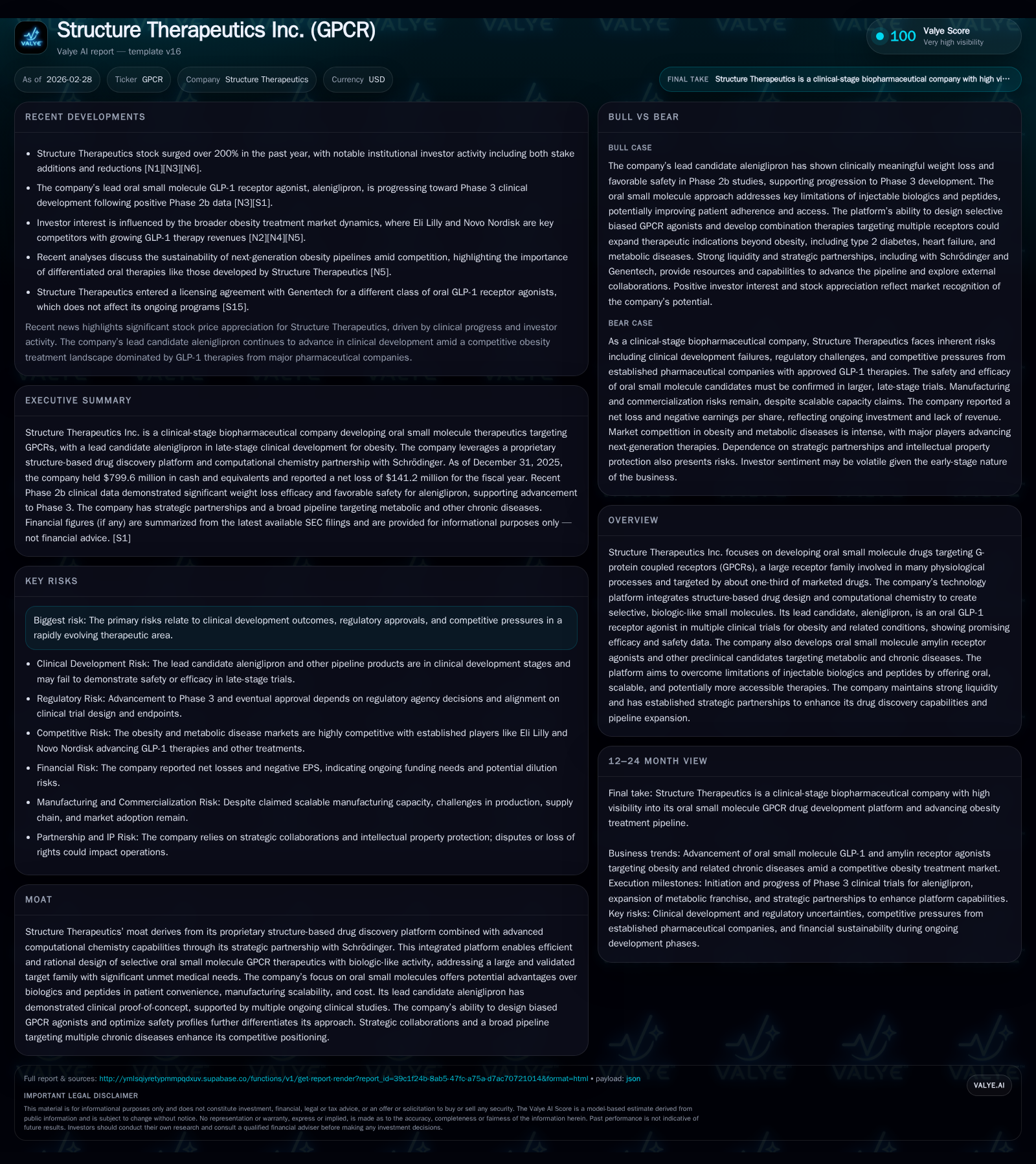
Structure Therapeutics Inc. focuses on developing oral small molecules against GPCR targets, aiming to overcome the limitations of injectable biologics. Its lead candidate, aleniglipron, an oral GLP-1 receptor agonist for obesity and related conditions, is advancing towards Phase 3 studies with encouraging Phase 2 data supporting differentiated efficacy and safety. The firm’s technology platform integrates advanced structural biology and computational chemistry, enabling selective drug design and pipeline expansion across metabolic and chronic indications. While operating losses continue as clinical development progresses, the company maintains robust liquidity and strategic collaborations to sustain growth and innovation.
Company Overview
Structure Therapeutics Inc. is a clinical-stage biopharmaceutical company pioneering oral small molecule drugs that target the large family of G-protein coupled receptors (GPCRs). GPCRs regulate diverse physiological processes and are targeted by about one-third of marketed drugs globally [S8]. The company’s integrated technology platform combines sophisticated structure-based drug discovery with computational chemistry capabilities—most notably via its strategic partnership with Schrödinger—to design highly selective oral small molecules that mimic biologic activity but circumvent the key limitations associated with injectable peptide or biologic therapies [S13][S16].
Historical Performance: Growth Drivers and Investment
Since inception, Structure Therapeutics has focused its R&D efforts on expanding therapeutic options for chronic metabolic diseases such as obesity and type 2 diabetes mellitus (T2DM). Revenue generation remains nascent given the pipeline stage; however, investment in clinical development has steadily increased operating losses.
Historical performance (annual)
| FY | Net ($mm) | CFO ($mm) | OpInc ($mm) | Capex ($mm) | Net YoY |
|---|---|---|---|---|---|
| 2025 | -141 | -222 | -177 | 4 | -15.2% |
| 2024 | -123 | -117 | -158 | 1 | -36.7% |
| 2023 | -90 | -79 | -103 | 2 |
Source: SEC companyfacts cache [F1].
Capital returns and efficiency (annual)
| FY | FCF ($mm) | ROE% |
|---|---|---|
| 2025 | -226 | -9.3 |
| 2024 | -118 | -14.2 |
| 2023 | -82 | -19.8 |
Source: SEC companyfacts cache [F1].
Operating income declined approximately 11.6% year-over-year in 2025 reflecting intensified clinical activities; negative net income expanded by approximately 15% versus prior year [F1]. Operating cash flow deteriorated sharply by more than 90%, driven by increased R&D expenditure; capital spending rose over 180% as manufacturing scale-up initiatives were undertaken to support commercial preparedness for aleniglipron [F1]. Equity nearly doubled over two years due to financing activities supporting development.
Technology Platform Differentiation
Structure Therapeutics’ competitive advantage rests on visualizing the three-dimensional structures of GPCRs combined with advanced physics-based computational methods that predict molecular binding affinities accurately [S16]. This capability facilitates rapid iteration cycles designing molecules that selectively engage target GPCRs while minimizing off-target effects—crucial given the close structural similarity among receptor subtypes that historically led to side effects such as bradycardia observed in earlier S1P receptor modulators [S13][S17].
The firm deploys "biased agonism" strategies, selectively activating G-protein signaling pathways while avoiding β-arrestin mediated receptor internalization pathways that can undermine efficacy or trigger adverse events [S16]. This precision engineering of signaling outcomes differentiates their oral small molecules from conventional approaches.
Lead Program: Aleniglipron
Aleniglipron (GSBR-1290) is an oral biased GLP-1 receptor agonist designed for the treatment of obesity and related metabolic conditions [S8][S24]. Distinct from injectable peptides like liraglutide or semaglutide which require self-injection, refrigeration, and complex administration protocols—aleniglipron is formulated as a once-daily oral tablet without dietary restrictions [S23][S29].
Clinical trials to date include multiple phase 1 and phase 2 studies:
- Phase 1 single ascending dose studies demonstrated dose-dependent pharmacokinetics with good tolerability.
- Phase 2a data showed statistically significant placebo-adjusted mean weight loss of approximately 6.2% at 12 weeks at doses up to 120 mg [S24],[S25]. An alternative tablet formulation showed improved PK leading to weight loss up to roughly 6.9%.
- Phase 2b ACCESS study enrolling ~230 patients reported dose-ranging results showing placebo-adjusted mean weight loss of about 11.3% at the highest tested dose (120 mg) after 36 weeks.
- ACCESS II exploratory trial extending dose titration to up to 240 mg achieved an even greater mean weight loss around 15.3% at week 36 without treatment discontinuations due to adverse events.
- Safety profile observed includes low incidence of gastrointestinal side effects typical of GLP-1 therapies—a noted advantage contributing to adherence potential [S24][S25].
Structure Therapeutics plans an End-of-Phase-2 FDA meeting in early-mid 2026 aiming at agreement on a pivotal Phase 3 program which is expected to start in H2 of the same year [S8]. The Phase 3 study design will evaluate multiple doses starting at low titration levels (e.g., beginning at ~2.5 mg daily).
Pipeline Beyond Aleniglipron
The metabolic franchise extends beyond GLP-1R:
- Two oral amylin receptor agonists are advancing — ACCG-2671 currently in Phase I and ACCG-3535 selected as a second development candidate [S14][S28]. Preclinical data highlight sub-nanomolar potency with significant weight reduction in diet-induced obese rat models.
- Programs targeting glucose-dependent insulinotropic polypeptide receptor (GIPR) and glucagon receptor (GCGR) are in preclinical stages aiming for monotherapy or fixed-dose combination products with GLP-1R or amylin agents for enhanced efficacy across obesity, T2DM, heart failure, sleep apnea, chronic kidney disease, osteoarthritis, MASH, neurodegenerative diseases including Parkinson’s and Alzheimer’s [S20][S8].
- Other non-metabolic targets like idiopathic pulmonary fibrosis (IPF) are explored through an LPA1 receptor antagonist candidate LTSE-2578 now positioned strategically after early clinical evaluation [S18].
Market Context
Obesity remains a chronic global epidemic affecting over one billion adults worldwide with concomitant high prevalence of T2DM and cardiovascular comorbidities generating an addressable market exceeding $100 billion annually [S29]. Existing GLP-1 peptide therapies lead sales growth but face challenges:
- High discontinuation rates due mainly to inconvenient administration routes,
- Supply shortages stemming from manufacturing complexity,
- Access limited by cost and storage requirements [N6][N10][S23].
Oral small molecules like aleniglipron potentially offer a paradigm shift by combining efficacy akin to peptides with superior patient convenience, ease of manufacturing scale-up (current capacity supports more than 120 million patients per year), lower production costs, no refrigeration requirements and fewer administration restrictions [S7][S23][N10].
Financial Position & Capital Deployment
Structure Therapeutics reported growing operating losses linked predominantly to accelerated clinical development efforts:
- Operating Income: -$176.6 million in FY2025 versus -$158.2 million prior year,
- Net Loss: expanded to -$141.2 million representing approximately -9.3% return on equity based on $1.52 billion equity at year-end [F1],
- Operating Cash Flow deteriorated markedly due to upfront investment ramp (-$222 million), driving free cash flow deeply negative (~-$226 million),
- Capital expenditure increased modestly supporting manufacturing readiness at ~$3.6 million annualized level.
The company maintains ample liquidity with $799.6 million cash & equivalents alongside a strong working capital position yielding a current ratio near 25x underpinning runway for advancing costly late-stage trials without immediate refinancing needs [F1]. Cash management prioritizes sustained R&D investment while retaining flexibility for strategic partnerships or business development deals.
Risks & Challenges
Key risk vectors include:
- Clinical risk inherent in late-stage trials particularly regulatory alignment on pivotal study design,
- Competitive landscape intensifying as major pharma companies lead obesity therapies spearheaded by Eli Lilly’s Mounjaro and Novo Nordisk’s Wegovy dominate the market [N1],[N9],
- Potential IP infringement challenges given complexity around patented GPCR ligands,
- Reliance on continued technological innovation within structure-based drug discovery incorporating AI that might not yield expected efficiencies or could increase operational risks including cybersecurity concerns,
- Need for successful commercialization execution post approval given novel modality competing against entrenched peptide injectables.
Outlook & What To Watch
Upcoming milestones critical for validation include:
- Timing and outcome of FDA End-of-Phase 2 meeting which will clarify pivotal trial protocol,
- Initiation of Phase 3 pivotal program for aleniglipron planned in second half of calendar year 2026,
- Readouts from Phase I studies of oral amylin agonists ACCG-2671 expected in second half of calendar year 2026 may reveal safety/PK profiles enabling next development phases,
- Further clinical data regarding combinatorial regimens involving GIPR/GCGR compounds broaden potential indication scope beyond obesity,
- Financial updates focusing on R&D spending trajectory, cash burn rate against liquidity reserves.
Meanwhile the company's collaboration strategy aims to augment platform competency leveraging external expertise in disease biology or geographic markets enhancing prospect breadth beyond metabolic diseases into areas such as fibrosis or CNS disorders.
In aggregate Structure Therapeutics sits at a confluence of technological advancement—harnessing cutting-edge structural biology aligned with machine learning-driven chemistry—to address enormous unmet chronic disease burden through transformative oral GPCR-targeted modalities. While financial losses persist reflecting investment phase dynamics typical in biotech pioneering new treatment modalities, the positive clinical trajectory of aleniglipron positions it alongside established injectable leaders yet promising differentiators important for long-term patient adherence and system scalability.
This analysis presents factual information derived from publicly available SEC filings dated through February 2026 supplemented by recent industry news sources. It does not constitute investment advice or recommendations but aims to provide an informed perspective on Structure Therapeutics’ corporate strategy, product progress, financial status, risks, and industry context based solely on verified disclosures.
Disclaimer: This is research-only, informational analysis and not investment advice. It may include AI-generated interpretation and general industry context. Always verify important details using primary sources.

Comments