
Home Federal Bancorp: Local Lending Dynamics and Risk Management in Regional Banking
Home Federal Bancorp, Inc. of Louisiana maintains a concentrated real estate loan portfolio in northwest Louisiana while navigating competitive local deposit markets and interest rate dynamics. Recent earnings growth and dividend continuity highlight operational stability, but regional concentration and evolving leadership present both opportunity and risk.
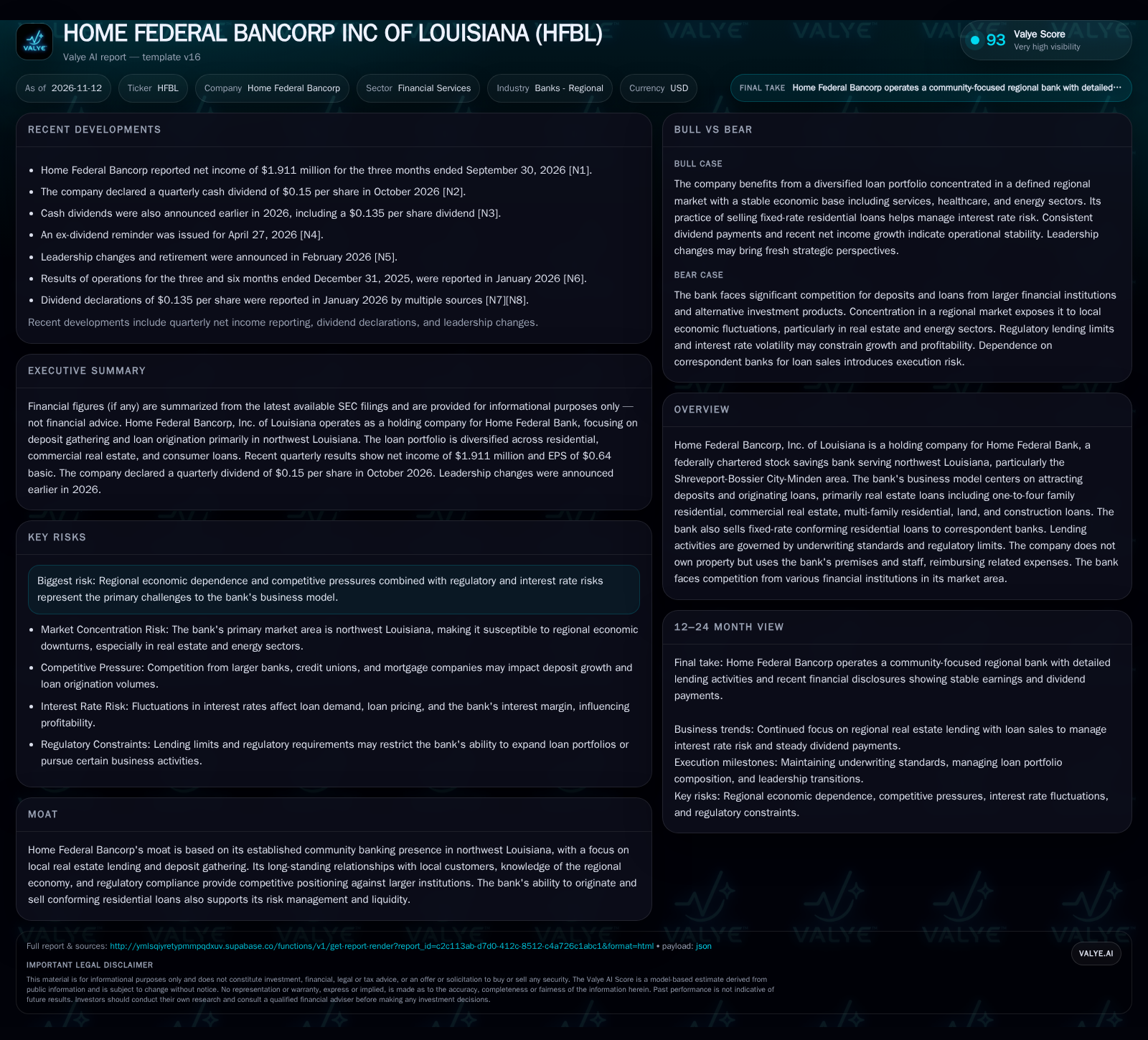
The company’s fortunes hinge on northwest Louisiana’s economic health, its ability to defend deposit share amid competition, and the effectiveness of recent leadership transitions. Interest rate risk and regulatory constraints remain prominent factors shaping future performance. [S1] [S2] [N1] [N2] [N5]
Home Federal Bancorp, Inc. of Louisiana exemplifies the classic regional bank: rooted in community lending, highly exposed to local economic patterns, and reliant on prudent risk management to balance profitability with stability. With nearly three-quarters of its assets in loans—primarily real estate—and a practice of selling fixed-rate residential mortgages to manage interest rate risk, the company’s recent net income growth and dividend continuity reflect operational steadiness. Yet, with leadership in transition and competition for deposits intensifying, Home Federal’s future will depend on its ability to navigate both external shocks and internal strategic shifts. [S1] [S2] [N1] [N2] [N5]
Loan Growth and Consistent Dividends Shape Recent Results
As of June 30, 2026, Home Federal Bancorp reported a net loan portfolio of $475.5 million, representing approximately 73.91% of total assets and underlining its focus on real estate lending in northwest Louisiana. For the quarter ended September 30, 2026, the company posted $1.911 million in net income, with basic earnings per share of $0.64 and a quarterly dividend of $0.15 per share declared in October 2026. The company originated $50.9 million in fixed-rate residential loans in fiscal 2026 and sold $30 million of these to correspondent banks, demonstrating active balance sheet management. Leadership changes and a retirement were announced in early 2026, signaling a period of potential strategic transition. [S1] [S2] [N1] [N2] [N5]
These facts matter because they reflect the company’s ability to sustain earnings and shareholder returns while navigating local competitive dynamics and the operational implications of management changes.
Returns Fueled by Deposit Growth and Loan Origination
Home Federal Bancorp’s business model is built on attracting local deposits and redeploying them into a diversified loan portfolio, with a pronounced tilt toward real estate lending. The core economics depend on net interest margin—the spread between interest earned on loans and paid on deposits—augmented by fee income from loan sales. The sale of fixed-rate conforming residential loans to correspondent banks helps manage interest rate exposure and provides a source of non-interest income, though the scale of these gains is typically limited in community banks of this size.
Operating leverage is modest due to the people- and branch-intensive nature of community banking. Fixed costs—primarily personnel and occupancy—are significant, but the company does not own property, instead reimbursing the bank for facilities and staff, which may afford some flexibility in cost structure. Funding needs are generally predictable, though liquidity must be carefully managed given the concentration in loans and relatively modest cash and short-term investments ($4.756 million and $72.045 million, respectively, as of September 30, 2026). [S2]
Loan growth and mix have a direct impact on earnings, but asset quality and credit costs can quickly erode profitability if local economic conditions deteriorate. The company’s ability to originate, underwrite, and, when appropriate, sell loans is central to both risk management and revenue generation.
Maintaining Market Position Amid Regional Banking Competition
Home Federal Bancorp operates in a highly competitive deposit and lending environment. Its main competitors include larger national and regional banks, credit unions, and mortgage banking companies, all vying for both deposits and lending opportunities in northwest Louisiana. The company’s long-standing local presence, customer relationships, and regional knowledge provide some insulation against pure price competition, but larger players can often outbid on rates or offer broader digital services.
Switching costs for depositors are generally low unless the bank has cultivated strong personal relationships or offers unique community engagement. On the lending side, underwriting expertise and local market knowledge can differentiate the bank, especially in assessing real estate risk. However, digital and non-bank entrants are increasingly targeting community bank customers with streamlined offerings, potentially eroding traditional loyalty.
The sale of conforming residential loans gives Home Federal some flexibility in balance sheet management relative to peers that retain all originations. Regulatory compliance and a reputation for conservative underwriting are sources of trust, but do not confer a structural moat against disruptive competition or shifts in customer expectations. The company’s regional concentration leaves it vulnerable to local economic downturns and competitor encroachment.
Robust Local Lending Conditions Could Enhance Margins
A favorable scenario would see northwest Louisiana’s economy remain stable or improve, supporting both deposit inflows and sustained demand for real estate and commercial loans. In this context, Home Federal could continue originating high-quality loans, maintaining or even expanding net interest margins if deposit costs remain contained and credit quality holds.
Effective leadership transition could introduce operational efficiencies or strategic initiatives—such as enhanced digital offerings or targeted loan growth segments—that further bolster returns. Continued active management of interest rate risk via loan sales would help protect the bank’s margin profile.
Conversely, any marked deterioration in credit quality or deposit outflows would undermine this outcome.
Stable Economy Underpins Consistent but Limited Growth
The most plausible outcome is that Home Federal Bancorp continues to deliver moderate earnings, with stable dividends and a loan portfolio that tracks the general health of the northwest Louisiana economy. Loan origination and sales activities remain consistent, and the bank manages interest rate risk through a mix of retained and sold loans.
Competitive pressure from larger banks and digital entrants gradually increases, but the company retains core customer relationships and manages to replace maturing loans with new originations. The leadership transition is executed without major disruption, sustaining current underwriting standards and operational discipline.
Confirmation of this scenario would come from steady quarterly earnings, a consistent dividend, loan growth in line with regional benchmarks, and limited volatility in credit costs. Disruption in any of these areas—especially a sharp decline in deposit growth or a spike in provisioning—would challenge the base case.
Economic Downturn or Deposit Losses May Weaken Earnings
Should northwest Louisiana experience an economic downturn—particularly in real estate or energy sectors—Home Federal could see a rise in loan delinquencies, compressing margins and forcing higher credit loss provisions. Simultaneously, intensifying competition or shifting depositor behavior (e.g., toward higher-yield alternatives) could trigger deposit outflows, raising funding costs or constraining lending capacity.
Leadership transition risk could be realized if new management fails to maintain underwriting discipline or mismanages balance sheet risks, leading to asset quality deterioration or regulatory scrutiny. The company’s relatively small cash and short-term investment position would limit its ability to absorb severe shocks without external funding.
This scenario would be confirmed by a rising nonperforming loan ratio, declining net interest margin, flattening or negative loan growth, dividend reductions, or asset sales to maintain liquidity. Regulatory actions or ratings downgrades would further validate downside risks.
Factors Influencing Home Federal Bancorp’s Financial Strength and Expansion
Quarterly net interest margin trends: Sustained or expanding NIM would signal pricing discipline and funding cost control; compression would suggest rising deposit or credit costs.
Loan portfolio growth and mix: Monitoring changes in the balance between residential, commercial, and construction lending will indicate risk appetite and market opportunity.
Nonperforming asset and charge-off rates (if disclosed): Deterioration would point to emerging credit issues tied to local economic conditions.
Deposit growth and retention: Tracking deposit inflows/outflows, especially relative to local competitors, will be crucial as competition for funding intensifies.
Volume and gain-on-sale of conforming loan sales: Increased sales or improved margins on these transactions would support both liquidity and fee income.
Leadership execution on strategic and operational changes: Evidence of process improvements, digital initiatives, or new growth areas would help gauge the impact of management transitions.
Regional economic indicators: Trends in northwest Louisiana’s employment, real estate values, and energy sector performance will be leading indicators for loan demand and asset quality.
Disclaimer: This is research-only, informational analysis and not investment advice. It may include AI-generated interpretation and general industry context. Always verify important details using primary sources.

Comments