
Health In Tech’s AI-Driven Underwriting Accelerates Access for Underserved Employers
HIT's latest quarter highlights faster AI underwriting and a growing broker network, underpinning scalable platform adoption in healthcare insurtech.
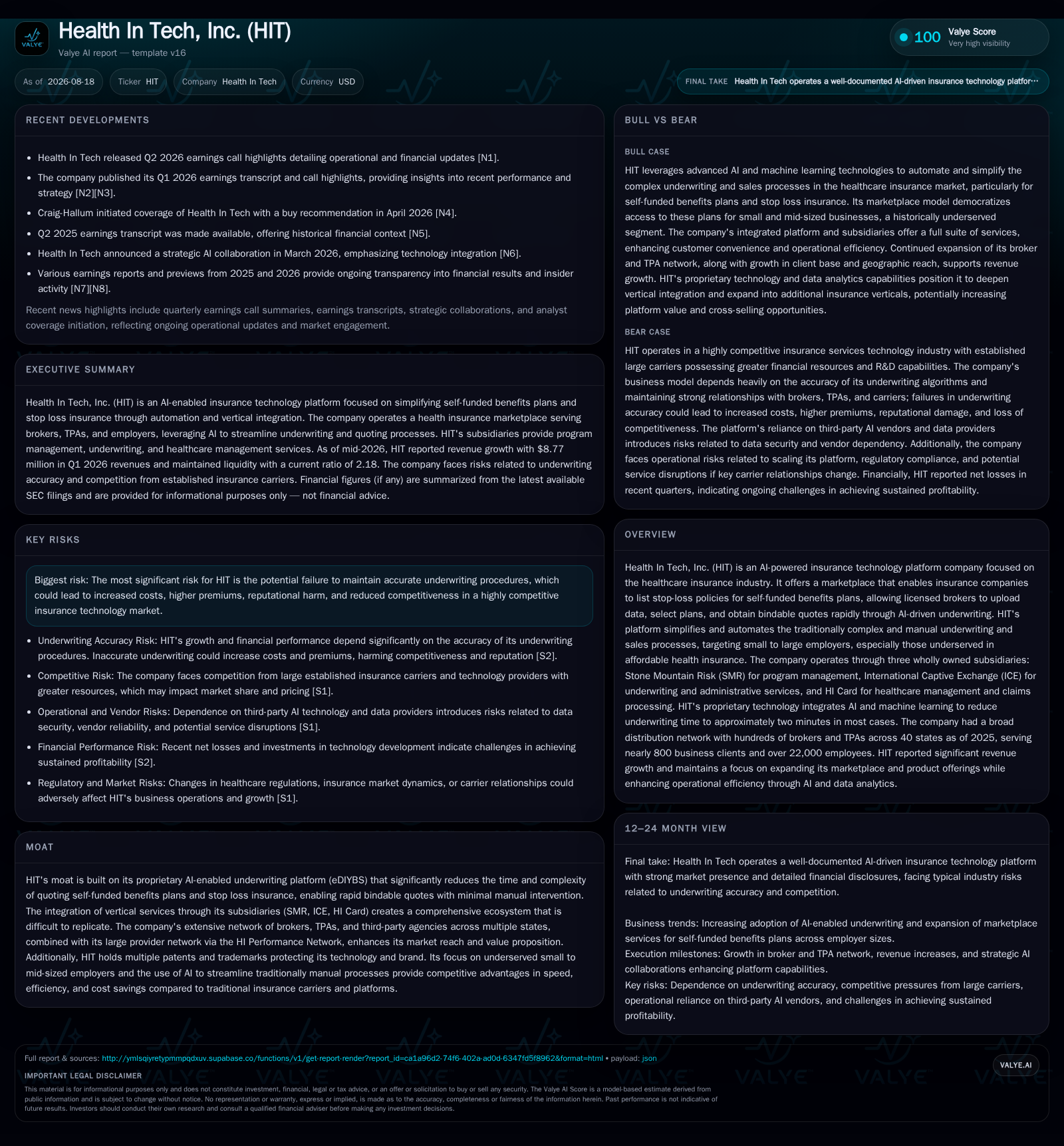
In its August 2026 quarterly filing, Health In Tech (HIT) reported meaningful acceleration in AI-driven underwriting turnaround times to approximately two minutes, enabling rapid delivery of bindable stop-loss insurance quotes. The company’s expanding network of over 580 licensed brokers, 12 TPAs, and hundreds of agencies across 40 states strengthens its distribution moat. Revenue increasingly derives from fee-based services via its vertically integrated subsidiaries Stone Mountain Risk (SMR) and International Captive Exchange (ICE), reflecting a shift toward higher-margin program management and underwriting offerings. While HIT benefits from proprietary AI automation and broker scale, it faces execution risks related to underwriting accuracy amid regulatory scrutiny. Key metrics to monitor include quote volume, broker retention, and policy issuance rates. Financially, HIT maintains solid liquidity with $6.5 million in cash and a current ratio above 2.0 as of June 2026, supporting ongoing R&D investment [S2][S1][F1].
Quarterly Acceleration in AI Underwriting Simplifies Market Access
Health In Tech’s August 2026 quarterly report reveals that its proprietary eDIYBS AI underwriting platform now produces bindable stop-loss insurance quotes within about two minutes—a substantial improvement over previous cycles [S2]. This acceleration addresses longstanding inefficiencies in the traditionally slow underwriting process for self-funded employer health plans. By enabling brokers to quickly upload employer data and receive instant pricing with customization options, HIT significantly reduces friction in closing sales.
This operational enhancement is critical for small to mid-sized employers who require swift quotations to align with budgetary cycles. The ability to automate complex actuarial assessments translates into higher throughput without proportional increases in manual staff costs.
Expanding Broker Network Strengthens Distribution Moat
Supporting this technology-driven efficiency is HIT’s broad intermediary ecosystem: over 580 licensed brokers alongside 12 third-party administrators (TPAs) and more than 260 agencies across 40 states actively use the platform [S1]. This extensive network not only amplifies reach but also creates embedded switching costs that protect HIT’s market position.
Brokers play a pivotal role as trusted advisors navigating the complexities of self-funded benefits plans. High engagement levels drive recurring fee revenues while improving data quality feeds back into refining automated underwriting algorithms.
Vertically Integrated Platform Model Drives Fee-Based Revenue Growth
HIT operates through three wholly owned subsidiaries delivering complementary services: Stone Mountain Risk (SMR) focuses on program management; International Captive Exchange (ICE) provides AI-driven underwriting modeling; HI Card offers claims processing and administrative tools [S1].
For fiscal year ending December 31, 2025, SMR accounted for nearly 79% of revenues primarily from fee-based program services, while ICE contributed approximately 21% from underwriting fees [S1]. The absence of HI Card revenue suggests strategic consolidation or margin pressures on claims-related offerings.
This vertical integration contrasts with insurtech peers specializing narrowly in either underwriting or brokerage software. By controlling multiple points along the insurance value chain, HIT enhances customer retention through seamless end-to-end solutions.
Execution Risks Around Underwriting Accuracy Amid Scale
A newly emphasized risk factor centers on sustaining precise actuarial rigor within rapidly scaling automated underwriting workflows [S2]. Model miscalibrations or data inaccuracies could inflate premiums or lead to underestimated loss exposures.
Such errors threaten financial performance and erode trust among brokers and carriers relying on HIT’s eDIYBS platform—a key intangible competitive asset. Regulatory attention on fairness and transparency in AI insurance applications further heightens compliance demands.
Mitigating these risks requires continuous algorithm validation combined with expert human oversight—a resource-intensive necessity that may pressure near-term margins.
Growth Catalysts Supported by Market Demand Trends
HIT benefits from macro trends favoring self-funded health plans among small-to-mid size employers seeking cost control amid rising healthcare expenses [S1]. These employers have historically faced barriers accessing affordable stop-loss coverage due to administrative complexity.
Regulatory encouragement of digital insurance marketplaces enhances receptivity to platforms like HIT’s that simplify quoting and policy customization processes for all stakeholders including carriers.
Advances in AI improve risk stratification precision allowing competitive pricing tailored to individual employer risk profiles—further expanding addressable markets.
Key Metrics To Monitor Going Forward
Investors should focus on quantitative indicators such as monthly active licensed brokers issuing bindable quotes, total volume of quotes generated post-quarterly updates, average underwriting turnaround time trends, and conversion rates from quotes to finalized policies [N1][S2]
Monitoring broker/TPA churn rates will be important as any erosion could signal weakening network effects undermining future growth potential.
Additionally, sustained improvements in loss ratios once disclosed will demonstrate robustness of HIT’s risk models critical for long-term profitability.
Financial Profile Discussion
As of June 30, 2026, Health In Tech reported cash and cash equivalents totaling $6.5 million against current liabilities near $10 million, yielding a current ratio of approximately 2.18—indicative of solid short-term liquidity coverage supporting ongoing operations and R&D investments [F1]
Though total debt stands modestly at $1.65 million based on prior disclosures (end-2023), the company’s net debt position is strongly negative given available cash balances [F1]
Annual revenue reached approximately $33 million as of December 2025 with gross margins around 63%, reflecting continued reinvestment in scalable automated processes rather than labor-intensive expansion [S1]. Sales and marketing expense ratios have improved relative to revenue growth signaling enhanced capital efficiency while research spending remains consistent with platform development priorities.
Overall financial health supports HIT’s strategy to deepen AI-powered automation capabilities essential for maintaining competitive advantage while balancing execution risks inherent in rapid scaling.
Disclaimer: This is research-only, informational analysis and not investment advice. It may include AI-generated interpretation and general industry context. Always verify important details using primary sources.

Comments