
Kosmos Energy's Leverage and Production Challenges Restrict Near-Term Cash Flow Recovery
Kosmos Energy’s 2025 marked by production declines, elevated leverage, and capital structure refinements amid a diversified deepwater portfolio.
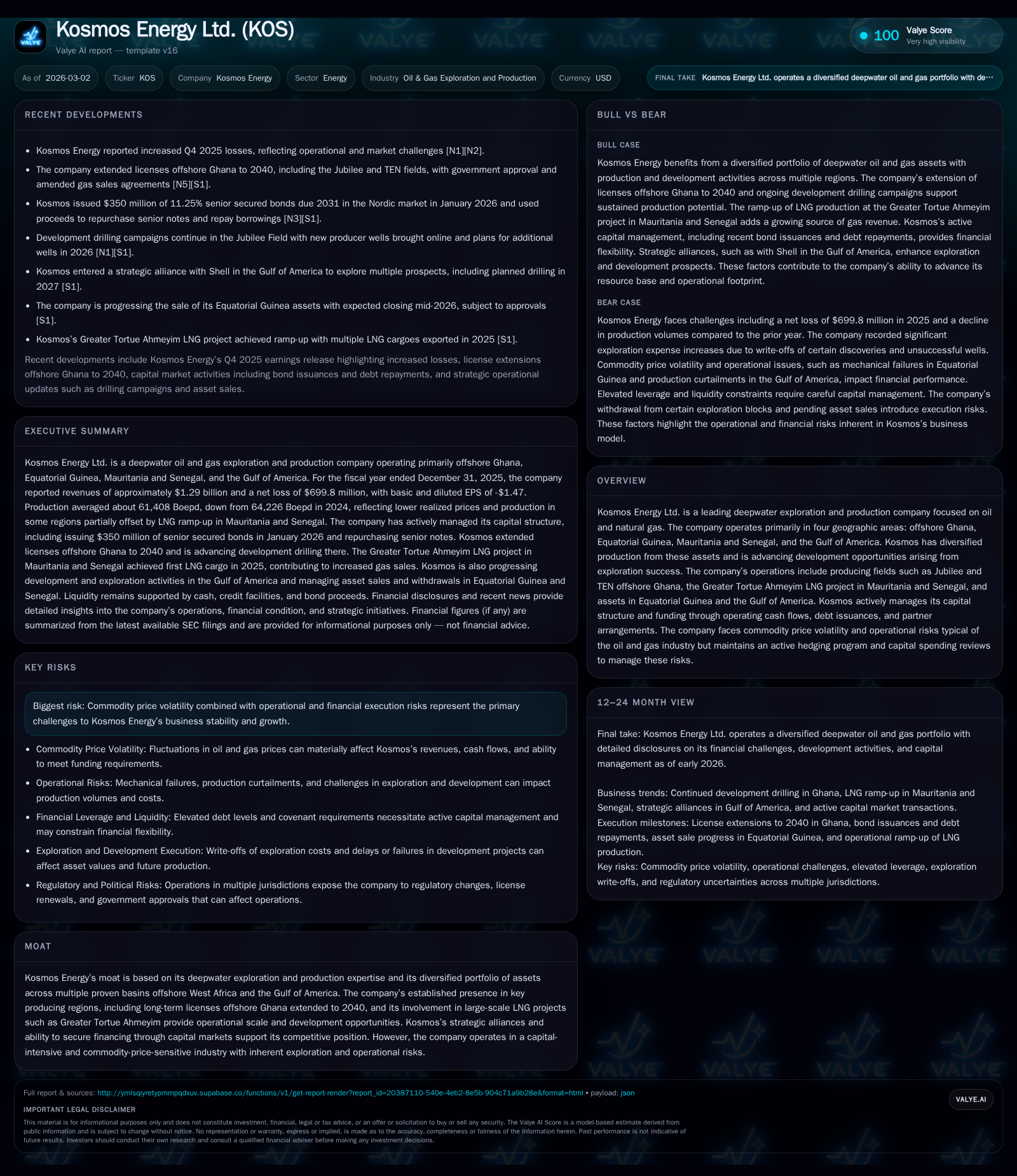
Kosmos Energy Ltd. operates primarily offshore West Africa and the Gulf of America with producing fields like Jubilee and TEN and development projects including the Greater Tortue Ahmeyim LNG project. In 2025, production activities advanced with new drilling offshore Ghana following license extensions through 2040, yet revenue declined to $1.29 billion from $1.68 billion in 2024 due to lower realized prices and volumes. Elevated leverage from ramp-up costs and subdued oil prices pressured results, leading to a net loss of $700 million and negative free cash flow. Capital markets actions including term loans and bond issuances helped refinance near-term maturities and extend debt profiles through 2031. The 2026 capital plan focuses on development drilling and maintenance across key assets but remains subject to commodity price variability, operational execution, and partner alignment.
Company Profile and Asset Portfolio
Kosmos Energy Ltd. is a deepwater exploration and production company focused on offshore West Africa—including Ghana, Equatorial Guinea, Mauritania/Senegal—and the Gulf of America. Its asset base includes producing fields such as Jubilee and TEN offshore Ghana alongside major infrastructure projects like the Greater Tortue Ahmeyim (GTA) LNG development spanning Mauritania and Senegal. The company also holds producing interests in Equatorial Guinea and Gulf of America operations, offering geographic diversification across proven basins.
Historical Financial Performance
Kosmos’s revenues have been volatile due to commodity price fluctuations and operational factors. In fiscal year 2025, total revenue declined approximately 23% year-over-year to about $1.29 billion from $1.68 billion in 2024 [F1]. This drop coincides with reduced production volumes—partly linked to ramp-up challenges at the GTA Phase 1 project—and lower realized oil prices amid macroeconomic headwinds [S1][S15].
The company swung from a net income of $190 million in 2024 to a net loss nearing $700 million in 2025 [F1], reflecting increased operating costs, impairments, and financing expenses during the period [S25]. Operating cash flow decreased sharply by about 80%, falling from $678 million to $134 million year-over-year, constrained by working capital demands related to project ramp-ups [F1][S11]. Capital expenditures moderated but remained substantial as Kosmos invested roughly $314 million across maintenance activities, infill wells, and development programs [F1].
Historical performance (annual)
| FY | Rev ($bn) | Net ($mm) | CFO ($mm) | Rev YoY | Net YoY |
|---|---|---|---|---|---|
| 2025 | 1.3 | -700 | 134 | -23.1% | -468.6% |
| 2024 | 1.7 | 190 | 678 | -1.5% | -11.1% |
| 2023 | 1.7 | 214 | 765 | -24.2% | -5.8% |
| 2022 | 2.2 | 227 | 1130 |
Source: SEC companyfacts cache [F1].
Capital returns and efficiency (annual)
| FY | ROE% |
|---|---|
| 2025 | -132.4 |
| 2024 | 15.8 |
| 2023 | 20.7 |
| 2022 | 28.8 |
Source: SEC companyfacts cache [F1].
Revenue predominantly derived from hydrocarbon sales across West African fields; decline driven by pricing environment and output reductions.
Capital Structure Developments
In late 2025, Kosmos secured a senior secured term loan facility totaling $250 million backed by its Gulf of America assets to refinance senior notes maturing in April 2026 [S7][S17]. The facility was funded in two tranches: an initial $150 million draw in October followed by an additional $100 million tranche funded in January 2026. Proceeds were used alongside cash on hand to redeem all outstanding balances of the company’s 7.125% Senior Notes due April 2026.
Additionally, Kosmos issued $350 million of senior secured bonds at an approximate coupon rate of 11.25% due January 2031 via the Nordic market [S10][S16]. Proceeds were applied towards repurchasing portions of higher-cost senior notes maturing in May 2027 and making voluntary principal repayments on existing credit facilities.
At year-end 2025, total long-term debt stood near $3.10 billion—up from about $2.8 billion the previous year—with approximately $1.2 billion drawn under a revolving credit facility whose borrowing base is reassessed semiannually based on net present values from producing assets including Jubilee/TEN offshore Ghana and Equatorial Guinea concessions [F1][S15].
Leverage increased as operating disruptions combined with lower hydrocarbon prices; accordingly, Kosmos negotiated amendments easing financial covenant requirements through mid-2026—including more lenient debt cover ratios—to maintain compliance during project ramp-ups [S6][S15]. The company’s next covenant test is scheduled for March quarter-end when it will be required unless waived to place around $50 million into restricted cash accounts supporting interest obligations.
Operational Progress Supporting Growth
In calendar year 2025, Kosmos advanced production notably offshore Ghana where average gross production approximated 93 thousand barrels of oil equivalent per day (boepd), equating to a net operator share near 31 thousand boepd after partner interests [S1]. Development drilling campaigns progressed with new wells brought online in Q3’25 and early Q1’26.
Critically, Ghana extended Petroleum Agreements covering Jubilee & TEN fields through mid-2040 with amendments allowing up to twenty additional wells post-2036; these long-term licenses underpin strategic investment visibility alongside revised gas sales agreements priced near $2.50/MMBtu reflecting current market conditions [N5][S1]. This extension supports sustained asset cash flow generation beyond historical plateau declines typical for deepwater fields.
In Mauritania/Senegal joint ventures—such as the GTA LNG development led by Kosmos Energy subsidiaries—infrastructure commissioning continues amidst efforts scaling natural gas exports mid-decade [S12]. Ongoing capex plans target phased developments aligned with global LNG demand growth but remain exposed to typical megaproject timing risks.
Operations in Equatorial Guinea emphasize facility integrity programs alongside appraisal well commitments required under license terms, providing reserve replacement optionality given mature producer profiles established through earlier investments [S18][N1].
Capital Expenditure Outlook for FY26
Kosmos budgeted approximately $350 million for capital expenditures during fiscal year ending December 31, 2026 excluding acquisitions or divestitures contingent on market conditions [S12]:
- Approximately $275 million allocated mainly toward maintenance capital prioritizing infill development drilling campaigns within Ghana/Jubilee assets plus Gulf of America leases along with final stages related to FPSO purchase payments for TEN field development;
- Around $60 million targeted at advancing phased developments across Mauritania/Senegal including project commissioning costs and pipeline integrity initiatives;
- Roughly $15 million dedicated to facilities integrity activities within Equatorial Guinea ensuring continuous production compliance.
Variations relative to this guidance will depend heavily on commodity price realizations affecting free cash flow capacity alongside operational execution success rates inherent in forward-looking drilling uncertainties plus partner capital alignment or broader corporate financing considerations.
Returns Profile & Cash Flow Dynamics
Kosmos posted a net loss approaching -$700 million reflecting impairments largely tied to asset revaluations along with elevated financing expenses compared with profitable periods averaging over +$200 million pre-pandemic (2019–22) levels [F1][S25].
Operating cash flows remained positive at roughly +$134 million but insufficient to cover investment requirements fully resulting in negative free cash flow estimated near -$478 million considering disclosed capex figures absent detailed reconciliation; this pattern reflects typical reinvestment intensity common among exploration-driven E&P firms investing through growth cycles or sustaining production post-peak years [F1][S16].
Equity contracted significantly from over $1.2 billion at end-2024 down below approximately $529 million at December ’25 close reflecting accumulated losses alongside redeployment pressures linked to capital market funding executed during refinancing aimed at extending maturity profiles while balancing cost-of-capital considerations pending operational normalization supported by sustained production plateau engineering afforded by license extensions.
Industry Context & Strategic Considerations
Deepwater exploration companies like Kosmos face high fixed costs making them sensitive not only to commodity price fluctuations but also operational volatilities such as platform uptime or reservoir performance impacting cash inflows timing which triggers frequent covenant recalibrations negotiated with lenders familiar with sector cyclicality paradigms. Long-dated financing instruments increasingly include flexible triggers referencing field-life coverage ratios or staged amortization schedules aligned with reserve life assumptions benchmarked against external price curves monitored closely for credit quality throughout asset life cycles.
Geopolitical risks associated with African offshore licensing regimes combined with growing ESG scrutiny around emissions intensity shape investor appetite driving diversified financing strategies incorporating sustainable finance instruments—though still nascent within deepwater E&P sectors reliant mainly on traditional capital markets augmented selectively by private equity attracted by technical acreage upside given Kosmos’s extensive operating history fostering durable alliances with local state enterprises mitigating sovereign risk premiums priced into yields demanded promoting stable partnerships.
Outlook & What To Watch
Key upcoming factors for Kosmos Energy include:
- Monitoring quarterly production reports for restoration momentum especially from Jubilee/TEN incremental wells critical for proving deliverability fundamentals;
- Tracking commodity price trends alongside hedging effectiveness influencing realized prices crucial for margin stability;
- Observing debt covenant tests approaching March/September assessment dates given recent easing but tighter thresholds thereafter;
- Following milestones related to Mauritania/Senegal GTA project progress indicating commercial ramp-up potential supplying LNG reliably;
- Assessing capital expenditure deployment efficiency versus budget guiding preservation or expansion scenarios shaping return-to-growth prospects post-current phase.
Kosmos’s deepwater expertise combined with multi-basin presence provides portfolio diversification mitigating basin-specific risks though cyclicality remains a dominant challenge manifesting as elevated leverage during low-price environments requiring prudent financial engineering balanced against active exploitation programs fostering cautious optimism contingent upon external factors chiefly commodity price stability plus geopolitical framework continuity assuring predictable regulatory support enabling stable long-term asset monetization.
Disclaimer: This analysis is based solely on data available from regulatory filings ([F1],[S#]) and recent news ([N#]). It does not constitute investment advice or recommendations regarding securities discussed herein.
Disclaimer: This is research-only, informational analysis and not investment advice. It may include AI-generated interpretation and general industry context. Always verify important details using primary sources.

Comments