
Loar Holdings’ Strategic Acquisition Drives Profitability and Elevates Leverage Profile in 2025
The acquisition of specialty manufacturer LMB significantly expanded Loar Holdings’ capabilities while impacting its financial leverage and integration risks.
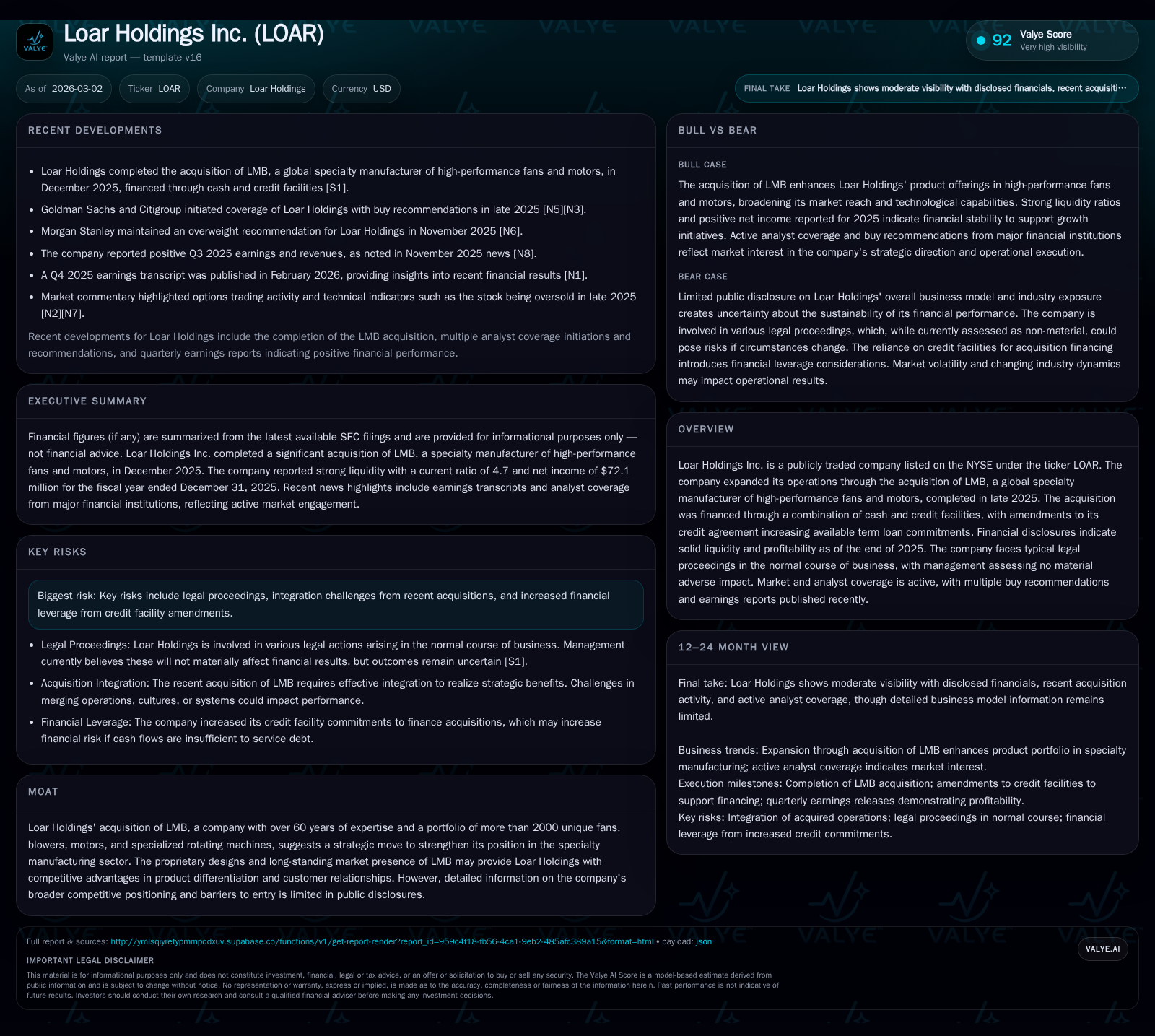
Loar Holdings Inc. executed a pivotal acquisition of LMB, a global specialty fan and motor manufacturer, in late 2025, funded by cash and increased debt capacity. This strategic move bolstered operating income and net margin substantially year-over-year, supported by enhanced product differentiation from LMB’s proprietary portfolio. However, the elevated leverage stemming from incremental term loans amplifies financial risk and renders operational integration critical for realizing expected synergies. Legal proceedings remain routine without material impact. Future performance will hinge on effective assimilation of LMB’s operations and managing leverage amid typical sector challenges.
Company Overview and Strategic Context
Loar Holdings Inc., listed on the NYSE under ticker LOAR, significantly reshaped its business profile with the late-2025 acquisition of LMB, a seasoned global player specializing in high-performance fans and motors [S13]. LMB's deep-rooted expertise spanning over 60 years complements Loar's existing capabilities by adding an extensive portfolio exceeding 2,000 unique products including specialized rotating machines [S13]. This acquisition underlines Loar Holdings' strategic commitment to establishing a foothold in the specialty manufacturing sector characterized by tailor-made solutions.
Historical Performance and Financial Drivers
Prior to LMB's integration, Loar reported steady profitability with operating income ascending from $87.6 million in FY2024 to $106.2 million in FY2025—an increase of approximately 21.2% [F1]. Most striking is the surge in net income which exploded by over 220%, reaching $72.1 million in FY2025 from $22.2 million the previous year [F1]. These improvements are attributable not only to organic growth but also to acquisition-driven revenue contributions coupled with improved operational efficiencies.
Operating cash flow painted a similarly bullish picture; it more than doubled to $112.3 million for FY2025 versus $54.9 million in FY2024 reflecting effective working capital management despite the scale increase [F1]. At year-end, liquidity stood firm with cash balances at $84.8 million and a robust current ratio near 4.7 indicating strong short-term financial health [F1]. Equity increased moderately supporting an approximate return-on-equity (ROE) of about 6%, reflective of underlying earnings gains against equity base expansion [F1].
Historical performance (annual)
| FY | Net ($mm) | CFO ($mm) | OpInc ($mm) | Net YoY |
|---|---|---|---|---|
| 2025 | 72 | 112 | 106 | +224.5% |
| 2024 | 22 | 55 | 88 |
Source: SEC companyfacts cache [F1].
Capital returns and efficiency (annual)
| FY | ROE% |
|---|---|
| 2025 | 6.1 |
| 2024 | 2.0 |
Source: SEC companyfacts cache [F1].
Note: Revenue figures are not explicitly disclosed; focus is on profitability and cash flow measures.
Capital Structure and Acquisition Financing
The transaction for acquiring LMB was valued at an aggregate cash consideration of $367 million plus assumption of net debt at closing [S13]. This substantial outlay was financed through a mix of existing cash on hand complemented by incremental borrowings facilitated via amendments to the company's credit agreement increasing term loan commitments by around $445 million [S9]. Prior amendments extended delayed draw term loan availability lifting total commitments to approximately $275 million ahead of the December deal closure [S10].
This layering of debt elevates financial leverage noticeably relative to pre-acquisition levels—an important factor heightening credit risk amidst integration uncertainty [S9]-[S11]. The credit facilities entail customary covenants typical in leveraged buyouts within industrial manufacturing contexts [N1].
Integration Challenges and Risk Factors
While the acquisition enhances Loar's product diversification via LMB’s proprietary technology suite, effective integration remains central to realizing anticipated synergies [N1]. Industry participants recognize that merging complex specialty production capabilities often involves aligning engineering workflows, consolidating supply chains, and harmonizing customer service infrastructures—all non-trivial undertakings with associated execution risks.
Additionally, the legal environment surrounding industrial manufacturers includes routine litigation arising from commercial disputes or compliance issues; Loar reports involvement in such actions but management views none as likely to cause material financial harm [S8]. The notable increase in leverage arising from financing arguably represents the most significant risk vector requiring focused monitoring.
Future Growth Outlook and Milestones
Growth prospects hinge on leveraging LMB’s established market presence built on differentiated designs catering to niche equipment needs across diversified end markets [S13]. Continuous innovation aligned with evolving industrial demands offers a runway for sustained revenue expansion.
However, future growth may be capped if integration hurdles impede operational contributions or if heightened interest burdens constrain reinvestments during cyclical downturns [N1]. Observers should watch quarterly earnings updates for trajectories in margin recovery post-acquisition costs along with management commentary on deleveraging strategies.
Crucial milestones over the coming quarters include delivering sales synergies through cross-selling initiatives as well as demonstrating stable free cash flow generation supporting orderly debt repayment schedules.
Capital Allocation and Return Profile
As of FY2025, Loar exhibits solid operational cash conversion with operating cash flows surpassing net income—an indicator of quality earnings supported by working capital efficiency improvements post-acquisition [F1]. There is no explicit detail on dividend policy or share repurchases in available filings suggesting capital prioritization toward debt reduction and strategic investments currently.
Approximate return on equity stands modestly at just above six percent given earnings gains relative to equity growth—the figure is consistent with manufacturers undergoing transformative acquisitions investing heavily for future leverage reduction [F1].
Summary
Loar Holdings’ transformational acquisition of LMB marks a decisive expansion into specialty manufacturing with promising enhancement of top-line potential through proprietary technologies combined with tangible bottom-line improvements evidenced in early results. The deal's financing strategy has shifted Loar’s balance sheet toward higher leverage raising creditor scrutiny although ample liquidity cushions mitigate immediate distress risk. Effective integration remains paramount alongside vigilant capital management to optimize returns amid cyclical industrial markets. Legal exposure continues as expected with no significant threat discerned. Overall, Loar stands at an inflection point where execution excellence will dictate whether current momentum translates into durable competitive positioning or exacerbates financial constraints.
Disclaimer: This analysis is intended solely for informational purposes reflecting information available as of early March 2026 and does not constitute investment advice or recommendations.
Disclaimer: This is research-only, informational analysis and not investment advice. It may include AI-generated interpretation and general industry context. Always verify important details using primary sources.

Comments