
MARA Holdings' Revenue Growth and Strategic Pivot Unveil New Industry Challenges
MARA's soaring bitcoin mining revenues contrast sharply with widening losses amid its ambitious shift into AI and HPC infrastructure.
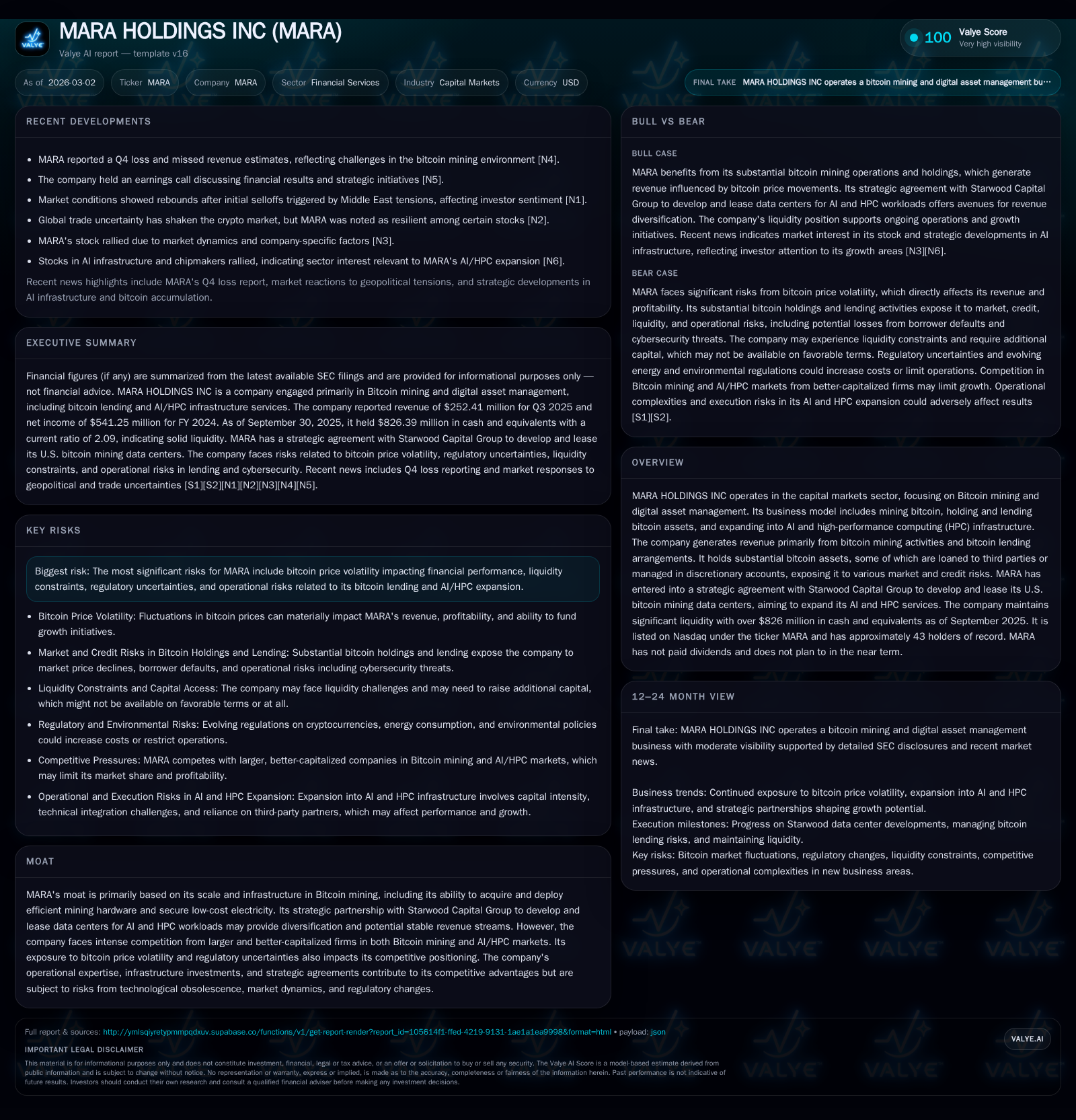
In 2025, MARA Holdings saw a near 38% increase in revenue driven chiefly by Bitcoin mining, reaching $907 million. Despite the top-line surge, operating income plunged to a $1.224 billion loss due to rising costs from bitcoin lending risks and ramped capital expenditures tied to strategic diversification into AI and HPC data centers. The company maintains substantial liquidity but faces ongoing pressures from market volatility, regulatory uncertainties, and execution risk around its new Starwood partnership for AI/HPC data center leasing. Monitoring milestone developments in leasing activity and industry regulation will be critical to assessing MARA’s path forward.
Explosive Revenue Growth: Bitcoin Mining’s Recent Surge
MARA Holdings witnessed robust revenue growth over the past three years, with total top-line increasing from $387.5 million in FY2023 to $656.4 million in FY2024—a nearly 70% growth—and further accelerating to approximately $907.1 million in FY2025, representing a solid 38.2% year-over-year expansion [F1]. This growth is predominantly attributable to increased Bitcoin mining operations supported by expanding hashrate capacity and monetization of mined digital assets. Within the capital markets sector focused on cryptocurrency mining, such scale expansion aligns with prevailing industry dynamics where growing operational footprint translates directly into greater Bitcoin rewards.
The company's ability to deploy updated mining hardware efficiently and secure low-cost electricity facilitated this upward revenue trajectory. However, as Bitcoin network difficulty dynamically adjusts upward with global hashrate increase, sustaining momentum requires continuous reinvestment and scaling efforts.
Historical performance (annual)
| FY | Rev ($mm) | Net ($mm) | CFO ($mm) | OpInc ($mm) | Rev YoY | Net YoY |
|---|---|---|---|---|---|---|
| 2025 | 907 | -1311 | -803 | -1224 | +38.2% | -342.3% |
| 2024 | 656 | 541 | -677 | 306 | +69.4% | +107.2% |
| 2023 | 388 | 261 | -316 | 221 | +166.5% | |
| 2022 | -393 | -176 | 0 |
Source: SEC companyfacts cache [F1].
Capital returns and efficiency (annual)
| FY | Buybacks ($mm) | FCF ($mm) | ROE% |
|---|---|---|---|
| 2025 | 47 | -1210 | -37.8 |
| 2024 | 35 | -928 | 13.1 |
| 2023 | -343 | 16.2 | |
| 2022 | -218 | -101.8 |
Source: SEC companyfacts cache [F1].
Operating Loss Drive: What Dented Profitability in 2025?
Despite impressive revenue gains through scaled Bitcoin mining output, MARA's profitability metrics reversed dramatically in FY2025. Operating income plummeted from a $306.1 million profit in FY2024 to a substantial operating loss of approximately $1.224 billion [F1]. Net income similarly declined into a $1.311 billion deficit—the sharpest deterioration across recent history.
Several intertwined factors underlie this adverse margin impact:
- Bitcoin Lending Risks: The company holds sizeable bitcoin assets loaned unsecured (~10,377 BTC per filings), subjecting it to counterparty default risk especially amid heightened market volatility [S1],[S2],[S13]. Loss reserves or impairments related to non-repayment contributed materially to costs.
- Operational Leverage & Rising Capex: Significantly higher capital expenditures deployed for infrastructure upgrades raised operational burden before corresponding revenue streams matured [F1],[S15],[S26].
- Strategic Diversification Costs: Expansion into AI and HPC services via acquisition (Exaion) and Starwood partnership introduced one-time expenses alongside ongoing development charges [S3],[S6].
- Market Volatility & Price Pressure: Fluctuating Bitcoin prices complicate forecasting realized asset values and may amplify impairments or necessitate writedowns [S1],[N1],[N2].
MARA's earnings call commentary emphasized these pressures alongside credit losses associated with lending counterparties that lack investment grade ratings and operate in nascent digital asset lending ecosystems [N2], reflecting sector-wide turbulences.
| FY | OpInc (USD) | OpInc YoY |
|---|---|---|
| 2023 | 220,911,000 | |
| 2024 | 306,111,000 | +38.6% |
| 2025 | -1,224,250,000 | -499.9% |
Capital Allocation Priorities: Capex, Buybacks, and Liquidity Management
Facing mounting losses yet pressing growth ambitions, MARA prioritized capital allocation heavily toward infrastructure investments while maintaining measured shareholder returns.
Capex surged by over 62% YoY—from about $251 million in FY2024 to $407 million in FY2025—underscoring brisk investment in both Bitcoin mining rigs upgrades and data center facilities poised for AI/HPC workloads per the Starwood strategic deal [F1],[S7],[S15]. Amid this outlay escalation:
- Share repurchases continued albeit at a reduced pace totaling roughly $47 million versus prior year’s $34.8 million [F1],[S7].
- Cash and equivalents stood at a robust $547 million end-2025 supporting liquidity cushions against market shocks [F1].
- Current ratio of approximately 1.27 signals adequate short-term asset coverage versus liabilities [F1].
Credit lines totaling up to $350 million secured against bitcoin collateral provide additional borrowing flexibility but expose MARA to margin call risks during price downturns—necessitating conservative liquidity management [S5],[S21],[S22]. This capital allocation reflects an intricate balancing act between fueling competitive hashrate scaling (capital intensive), ensuring liquidity resilience amidst digital asset market turmoil, and modest capital return policies.
| FY | CFO (USD) | Capex (USD) | Buybacks (USD) |
|---|---|---|---|
| 2023 | -315,651,000 | 27,611,000 | |
| 2024 | -677,022,000 | 250,825,000 | 34,857,000 |
| 2025 | -802,725,000 | 407,071,000 | 46,921,000 |
Bitcoin Asset Management: Lending Risks and Market Volatility Exposure
MARA’s substantial holdings of bitcoin lend complexity beyond mere mining activities. Approximately 10,377 BTC were loaned unsecured as of late 2025 [S2], exposing the company materially to credit default risks amplified by inherent volatility within the crypto lending market.
Unsecured lending entails subordinate claims compared to borrower’s restructuring creditors if insolvency occurs—raising recovery uncertainties [S13]. Operational risk factors encompass software or platform outages disrupting loan servicing plus cybersecurity vulnerabilities inherent in crypto custody models [S2],[S13],[S24]. Further:
- Managed accounts comprising nearly two thousand bitcoin introduce risks of trading missteps or external manager failure where MARA cedes day-to-day control over digital asset deployment [S2].
- Concentration of exposure within volatile instruments elevates liquidity risk especially amid stressed markets causing forced liquidations potentially below book values.
This constellation of credit risk combined with cryptocurrency price swings creates an uneven earnings foundation requiring vigilant risk monitoring.
Strategic Agreement With Starwood: Bridging Mining to AI and HPC
In February 2026 MARA inked a strategic accord with Starwood Capital Group targeting conversion of select U.S.-based bitcoin mining assets into leased data center capacity for AI and HPC customers—a clear pivot towards diversified infrastructure revenue streams beyond cryptocurrency reliance[S3],[S6],[S20],[S26].
The deal entails:
- Pre-development services including permitting and power arrangements undertaken primarily at MARA’s cost capped with Starwood maintaining right for funded continuation[S3].
- Trigger conditions centered on securing leases with creditworthy hyperscaler tenants initiate decision points on proceeding with full property redevelopment or otherwise relinquishing rights via sales[S20].
- Upon proceeding jointly formed ventures will manage operations where Starwood governs day-to-day management while MARA retains partial equity stakes[S20].
Though promising long-term stable leasing income potential aligned with burgeoning AI demand cycles[N5], execution risks abound: lease procurement timelines; power grid interconnections; supply-chain hurdles; plus integration complexities of Exaion acquisition expanding international footprint add layers of operational challenge[S6],[S23],[S26].
Competitive Terrain: Infrastructure Scale versus Regulatory and Market Headwinds
MARA operates within highly competitive environments for both Bitcoin mining hardware deployment/sourcing — where rivals benefit from larger scale or more favorable electricity contracts — as well as entering the nascent yet rapidly evolving AI/HPC colocation sector dominated by hyperscale cloud giants and specialized infrastructure providers[S6],[N9],[N10].
More broadly:
- Persistent regulatory ambiguity around digital assets prompts ongoing compliance cost uncertainties alongside potential operational constraints or licensing requirements[S4],[S8]-[S14].
- Supply chain disruptions for cryptographic hardware translate into delayed rig deliveries or increased unit costs undermining operating leverage advantages[S11].
- Energy policy shifts adding carbon/EHS constraints could impose further cost headwinds threatening margin structures across both core mining and new AI/HPC lines[S25],[S27].
These combined factors challenge MARA’s infrastructural moat derived from scale alone compelling careful navigation amid volatile policy landscapes.
What’s Next: Key Milestones and Potential Catalysts to Watch
Absent explicit forward guidance available publicly,[N4] anticipated catalysts forming investor watchlist include:
- Progress indicators around executing commercial leases at Starwood-managed properties heralding tangible step function revenues beyond volatile bitcoin cycles[S3],[N2].
- Continuous scaling milestones related to deployed hashrate growth counterbalancing network difficulty increments critical for core business competitiveness.[F1], [N2]
- Market signals influencing credit risk profiles of bitcoin lenders impacting impairment outlooks tied to loan portfolios.[S2]
- Regulatory developments shaping permissible operational scope for digital asset holders plus emerging ESG compliance costs which remain under legislative attention.[S4]-[S10]
- Supply chain normalization aiding modernization pace of miner fleet renewals potentially lifting efficiency curves.[N9]
Continuous scrutiny of these vectors will serve as barometers tracking MARA’s strategic transition efficacy.
Financial Health Snapshot: ROE, Cash Flow Challenges, and Capital Needs
Financial stewardship metrics underscore acute challenges during this transformation phase:
- Return on equity declined sharply reflecting net losses approximating -37.8% in FY2025 given equity base near $3.47 billion yet net income deficit exceeding $1.31 billion [F1].
- Operating cash flow remained deeply negative at roughly -$803 million while capex absorbed upwards of $407 million resulting in free cash flow deficit near -$1.21 billion denoting high cash burn rate integral to infrastructure buildout efforts[F1].
- Solid liquidity buffers evident through cash balances over half a billion dollars coupled with current ratio above one point two reflect prudent short-term financial positioning although sustained deficits imply capital raises may be needed going forward[S5][S16][N2].
- Buyback activity continues moderately suggesting cautious approach balancing shareholder value support within constrained earnings environment[F1][S7].
Overall capital intensity inherent in scaling Bitcoin mining alongside nascent AI/HPC investments presses firmly on cash generation capabilities demanding vigilant capital structure optimization strategies.
This analysis synthesizes publicly disclosed financial data alongside detailed SEC filings providing insight into MARA Holdings’ evolving operational paradigm marked by pronounced growth juxtaposed with emerging challenges inherent in strategic diversification efforts amid an uncertain regulatory environment. Readers should consider these factors carefully when contextualizing company performance absent direct investment advice.
Disclaimer: This is research-only, informational analysis and not investment advice. It may include AI-generated interpretation and general industry context. Always verify important details using primary sources.

Comments