
Malibu Boats, Inc. (MBUU) - Navigating Volume Pressures Amidst Cost Management and Strategic Flexibility
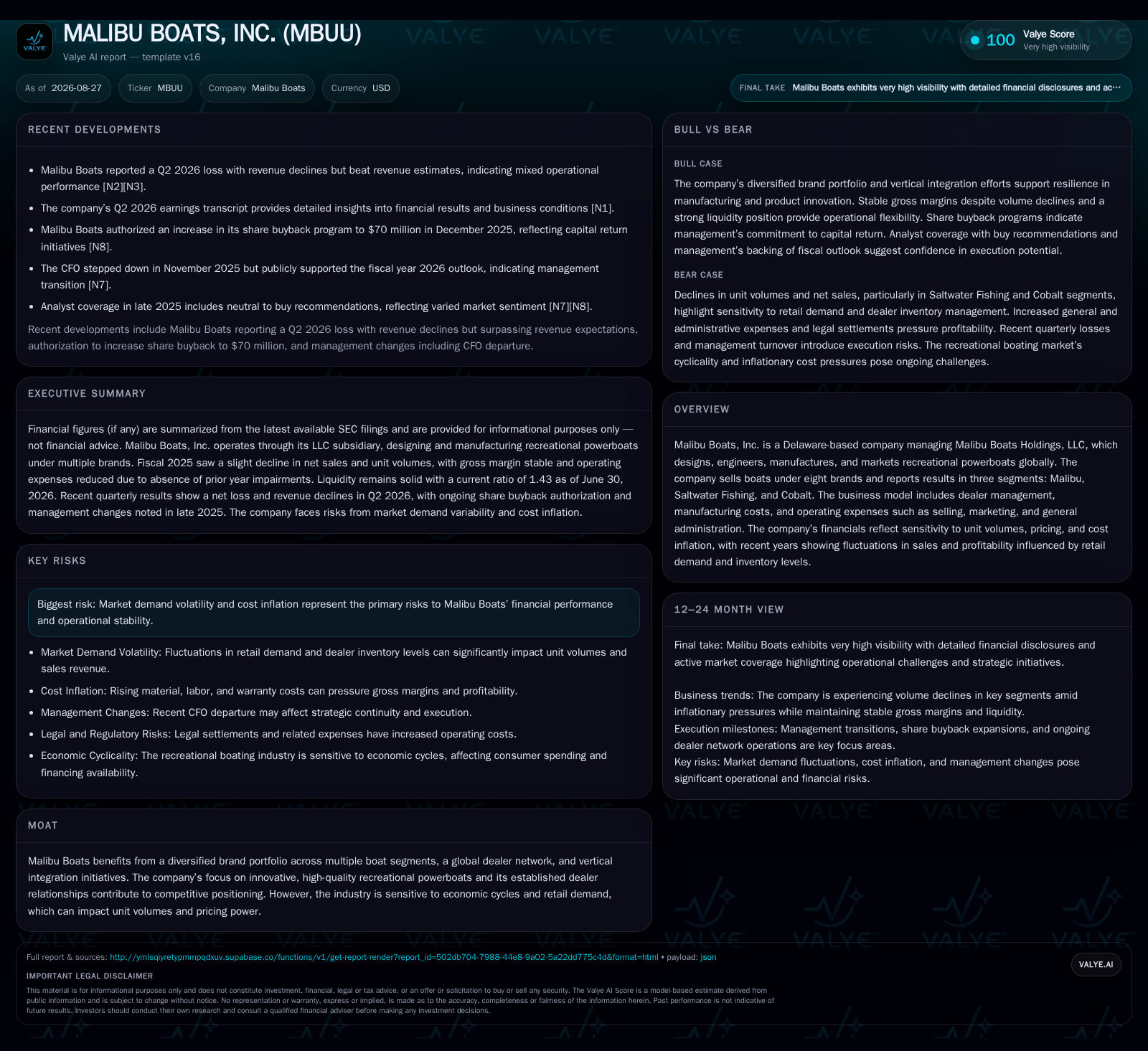
Malibu Boats faces a challenging recreational boating environment with declining unit volumes and revenue in key segments, yet maintains stable gross margins and liquidity. Its diversified brand portfolio and vertical integration offer operational resilience, but market cyclicality, cost inflation, and management shifts complicate near-term execution and profitability.
Malibu Boats reported lower unit volumes and revenue declines in fiscal 2025 and Q2 2026, particularly in Saltwater Fishing and Cobalt segments, while maintaining gross margin stability through cost management. Operating expense reductions from absent impairments contrast with rising general and administrative costs driven by legal settlements and compensation. The company’s diversified brand and dealer network provide strategic advantages, but demand volatility, inflationary pressures, and recent CFO turnover pose risks. Share buybacks and analyst optimism reflect confidence in long-term prospects despite short-term execution challenges.
Malibu Boats, Inc. confronts a complex market environment characterized by declining unit volumes and revenue softness in its recreational powerboat segments, especially Saltwater Fishing and Cobalt. Despite these headwinds, the company has maintained gross margin stability through tight cost control and preserved liquidity, reflected in a 1.43 current ratio and $74.4 million cash balance as of mid-2026 [S1][sec_financial_snapshot]. Its multi-brand strategy and dealer network lend operational resilience, yet rising legal and administrative costs, coupled with leadership changes, introduce execution risks. Share repurchases and continued analyst support suggest confidence in Malibu’s ability to navigate cyclical pressures and cost inflation while pursuing innovation and vertical integration.
Latest Operating Snapshot
In fiscal 2025, Malibu Boats reported net sales of $807.6 million, a 2.6% decline from the prior year, driven primarily by lower unit volumes which fell 9.0% to 4,898 units. The volume drop was concentrated in the Saltwater Fishing and Cobalt segments, partially offset by increased volumes and pricing in the Malibu segment reflecting inflationary adjustments [S1]. Gross profit margin remained stable at 17.8%, a slight increase from 17.7% in 2024, underscoring effective cost management despite top-line pressures [S1].
Operating expenses dropped significantly by 39.8% compared to 2024, largely because the company did not incur the $88.4 million impairment charges related to Maverick Boat Group recorded the prior year. However, general and administrative expenses rose 21.1%, driven by legal settlements, higher stock-based compensation, incentive pay, and salary costs [S1]. The liquidity position remains solid with a current ratio of 1.43 and cash of $74.4 million as of June 30, 2026 [sec_financial_snapshot]. Q2 2026 saw a net loss with revenue declines, yet the company beat revenue estimates, signaling operational challenges tempered by some positive momentum [N2][N3].
Business Model and Unit Economics
Malibu Boats’ business model centers on designing, engineering, manufacturing, and marketing recreational powerboats under eight distinct brands across three operating segments: Malibu, Saltwater Fishing, and Cobalt. Revenue is largely driven by unit volumes sold through a global dealer network, with pricing influenced by product mix, brand positioning, and inflationary pass-through. The company’s vertical integration efforts aim to control manufacturing costs and quality, encompassing raw materials, labor, overhead, and warranty expenses [S1].
Unit economics are sensitive to retail demand fluctuations and dealer inventory management, with fixed manufacturing overhead and R&D costs contributing to operating leverage when volumes rise. Cost inflation in materials and labor pressures gross margins, but disciplined cost controls can partly offset these effects. Operating leverage could emerge if pricing power strengthens or volumes recover, but margin stability amid declining sales suggests constrained leverage presently. Capital intensity is moderate, with investments needed in production capacity and innovation to sustain competitive positioning, while share buybacks indicate available free cash flow for capital return [S1][N8].
Moat, Competition and Counterforces
Malibu Boats enjoys a competitive advantage from its diversified brand portfolio spanning multiple recreational boating segments, enabling it to cater to varied customer preferences and mitigate dependence on any single market niche. Its global dealer network facilitates market reach and customer service, creating switching frictions that can support pricing resilience. Vertical integration initiatives provide partial insulation from supplier cost volatility and quality issues, enhancing operational control [S1].
Nonetheless, the recreational boating industry’s inherent cyclicality, driven by consumer discretionary spending and financing availability, weakens demand visibility and unit volume stability. Competition includes other established boat manufacturers, such as Brunswick’s brands, which may leverage scale and product breadth to exert pricing pressure. Inflationary cost pressures and rising warranty claims could erode margins if not tightly managed. Additionally, the absence of multi-year contracts or subscription revenues limits recurring revenue stability and switching costs, making Malibu’s competitive moat primarily related to brand reputation and dealer relationships rather than structural lock-in [S1][N5].
Bull Case
In a positive scenario, Malibu Boats leverages its diversified brand portfolio and vertical integration to sustain product innovation and manufacturing efficiencies, enabling stable or improving gross margins despite market headwinds. Continued pricing discipline combined with partial inflation pass-through could protect profitability even if unit volumes remain subdued. The company’s reported liquidity position and expanded share buyback program signal potential financial flexibility that supports investor confidence and reduces equity dilution risks. Dealer networks remain intact, facilitating market penetration and customer retention.
Confirming evidence would include sequential improvement in unit volumes or stabilization of the Saltwater Fishing and Cobalt segments, consistent gross margin expansion, and controlled operating expense growth excluding one-time legal costs. Analyst upgrades and upgrades in credit or equity ratings would also support this view. A falsification test would be a sustained deterioration in dealer inventory levels, margin contraction despite price increases, or recurring operational disruptions linked to supply chain or management instability.
Base Case
The base case envisions continued pressure on unit volumes in Saltwater Fishing and Cobalt segments, reflecting ongoing demand cyclicality and competitive dynamics. Malibu segment growth and pricing partially offset declines, resulting in overall flat to modestly declining net sales. Gross margins hold steady through cost control and selective price adjustments, while operating expenses normalize following prior impairments but remain elevated due to legal settlements and increased administrative costs. Liquidity remains sufficient, supporting ongoing operations and moderate capital returns.
Execution risks from management changes, particularly the CFO departure, introduce some uncertainty but do not derail strategic initiatives or dealer relationships. The company maintains a moderate share buyback pace, balancing capital returns with reinvestment needs. Market conditions remain challenging but stable, without significant deterioration in financing availability or consumer spending patterns. A falsification test would be a rapid recovery in unit volumes or margin expansion well above cost inflation, or conversely a sharp decline in gross margins or cash flow generation.
Bear Case
A downside scenario involves persistent declines in unit volumes driven by weakening retail demand and adverse dealer inventory dynamics, exacerbated by macroeconomic headwinds such as rising interest rates, inflation, or reduced discretionary spending. Cost inflation outpaces pricing power, compressing gross margins and profitability. Elevated general and administrative expenses, including legal settlements and compensation, further depress operating income. Management turnover, including the CFO’s exit, leads to strategic drift or execution gaps, undermining investor confidence and operational discipline.
Such a scenario could see cash flow constraints limiting reinvestment and share buybacks, while competitive pressures from larger or more diversified peers intensify. Market cyclicality and regulatory challenges could also reduce market size or increase compliance costs. Confirming evidence would be continued losses, deteriorating liquidity ratios, rising dealer inventory days, and downward analyst revisions. Falsification would be margin stabilization or recovery, successful management transition, or improved demand signals.
What Matters Next
Key performance indicators to monitor include unit volumes by segment, particularly Saltwater Fishing and Cobalt, as these drive the largest variability in revenue. Gross profit margin trends will reveal the company’s ability to manage cost inflation and pricing. Operating expense trajectory, especially general and administrative costs excluding one-time items, is critical for profitability analysis. Dealer inventory levels and order backlogs provide forward visibility on demand and supply chain health.
Liquidity metrics such as the current ratio and cash balances indicate potential financial flexibility amid cyclical pressures. Progress on share buyback execution reflects capital allocation priorities and confidence. Management stability, especially the CFO replacement and leadership communications, will affect strategic continuity. Finally, external factors like macroeconomic conditions influencing consumer discretionary spending and financing availability for boat purchases remain important external variables.
Disclaimer: This is research-only, informational analysis and not investment advice. It may include AI-generated interpretation and general industry context. Always verify important details using primary sources.

Comments