
Mediaco Holding Inc. Struggles with Network Affiliation Loss and Liquidity Constraints
The August 2026 quarterly filings reveal the financial and operational impact of the May 2025 termination of network affiliation agreements, compressing Mediaco’s key revenue streams amid tightening liquidity.
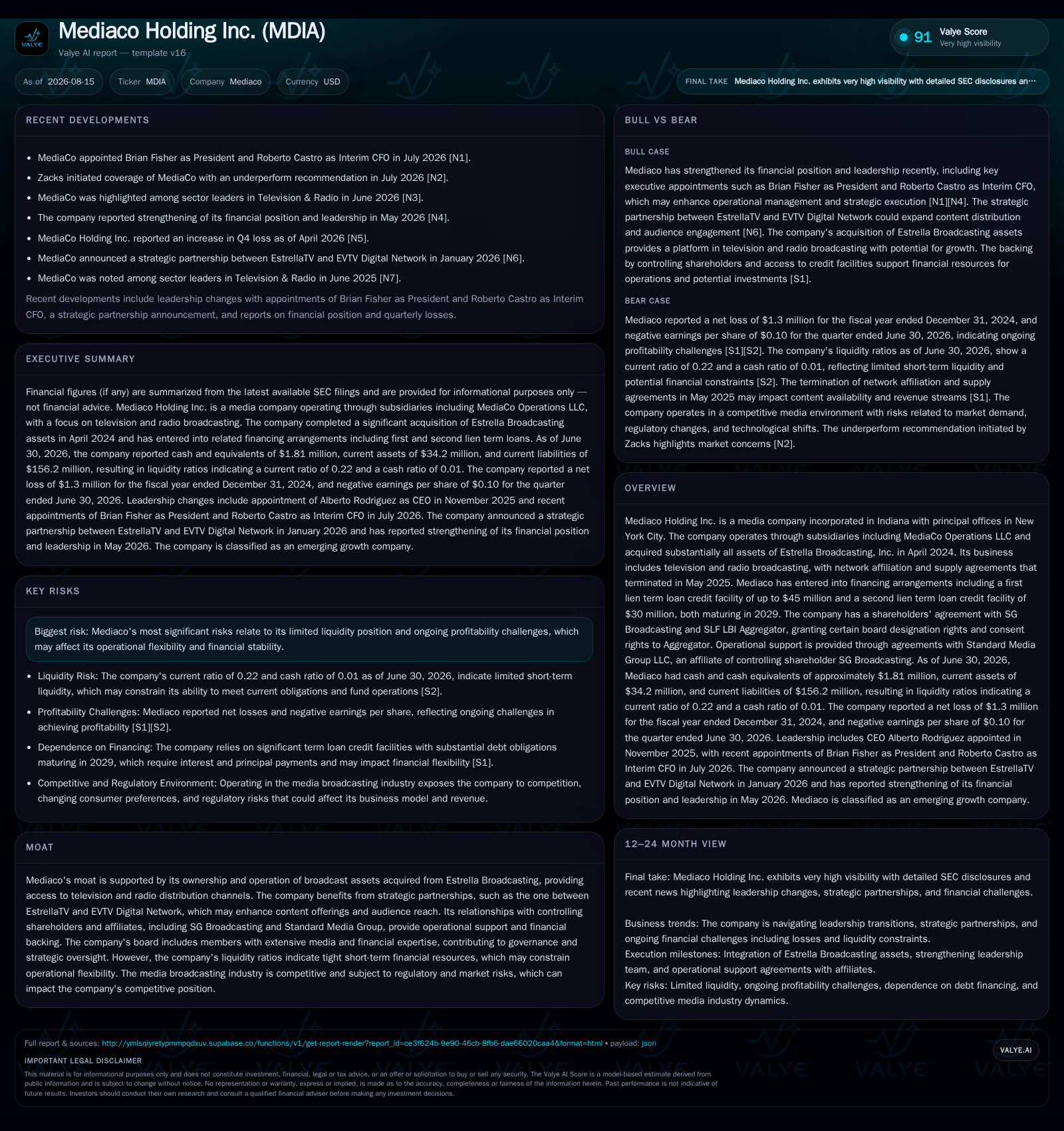
Mediaco Holding Inc.'s latest quarterly reports show significant challenges stemming from the expiration of crucial network affiliation and supply contracts in mid-2025, which severed critical retransmission fee and advertising revenue channels. The company’s broadcast asset base, anchored by its acquisition of Estrella Broadcasting in April 2024, remains a core strength, but tight liquidity evidenced by a current ratio of 0.22 and elevated net debt constrain reinvestment capacity. Strategic partnerships with SG Broadcasting and Standard Media Group support operations but may also limit flexibility under current financial pressures. Mediaco faces industry headwinds including audience fragmentation and digital competition, while growth opportunities via retransmission fees and content syndication remain constrained without improved operational leverage.
Contract Disruptions Reshape Revenue Base Amid Network Affiliations Termination
In its August 14, 2026 10-Q filing, Mediaco disclosed that all network affiliation and supply agreements related to Estrella Broadcasting terminated effective May 2025 [S2][S3]. This termination removed crucial contractual sources of retransmission fees and advertising revenue that had supported the company’s operating income. In broadcast media, network affiliation agreements often ensure steady programming content access alongside retransmission consent fees paid by cable/satellite providers—both key revenue catalysts. The loss thus materially impaired Mediaco’s core monetization streams.
The immediate financial fallout was a deteriorated operating income, evidenced by a -$24.8 million figure reported for full-year 2025, signaling ongoing operational distress linked to the disrupted revenue base [F1]. Margin compression reflects that alternative revenue or cost offset strategies have yet to emerge effectively. This change underscores a critical structural challenge rather than cyclical volatility given the contract cessation.
Broadcast Asset Footprint Anchored in Estrella Acquisition: Growth Levers and Limitations
Mediaco’s acquisition of substantially all assets of Estrella Broadcasting in April 2024 represented a strategic entry point into television and radio broadcasting markets with established local media outlets [S1]. Post-acquisition, the company gained regional market presence through transmission infrastructure and associated broadcast licenses—assets fundamental to securing advertising dollars driven by audience ratings.
However, the subsequent network affiliation terminations constrict growth levers tied to affiliate agreements that historically facilitated expanded audience reach through branded content networks. While owning broadcast spectrum and stations provides operational control over distribution channels, content exclusivity—and thus audience engagement—is jeopardized without robust affiliate alignment.
Peer regional broadcast groups typically retain longer-term affiliate deals anchoring local advertising potency; Mediaco's shorter contract duration hints at vulnerability relative to more entrenched competitors with diversified syndication or multichannel assets.
Capital Structure Constraints Heighten Operational Flexibility Risks
To finance the Estrella acquisition and related operations, Mediaco entered into a $45 million first lien term loan facility alongside a $30 million second lien credit facility with maturities set for April 2029 [S20]. These secured borrowings carry significant fixed servicing obligations including monthly principal amortization and interest payments pegged at SOFR plus approximately 6.0% interest rate.
Despite these arrangements, liquidity metrics are stark: cash reserves stood at only $1.8 million as of June 30, 2026, against current liabilities exceeding $156 million—translating into an acute current ratio of just 0.22 [F1]. Such imbalance highlights severe short-term funding pressures undermining capacity for needed capital expenditures on broadcast infrastructure or marketing investments necessary to revitalize viewership.
Net debt approximates $71 million well above cash levels emphasizing leverage risks usual for capital-intensive broadcasting firms but here exacerbated by profitability deficits. Typical media peers maintain lower leverage ratios or stronger cash buffers enabling more strategic latitude when confronting market disruptions.
Partnerships and Affiliations: Operational Synergies Versus Dependency Risks
A complex governance framework surrounds Mediaco owing to its relationships with controlling shareholder SG Broadcasting and affiliates like Standard Media Group LLC that provide operational support services [S1]. Under the shareholders' agreement executed alongside the Estrella acquisition closing, SG Broadcasting retains board designation rights contingent on maintaining certain equity thresholds.
Such arrangements can yield cost-saving synergies through shared service agreements enhancing operating efficiency across content production or distribution logistics. However, they may also curtail independent strategic decision-making should financial stresses intensify or if shareholder objectives diverge.
The operational dependency on affiliated entities reinforces potential bottlenecks or agency conflicts particularly as Mediaco pursues recovery strategies amid constrained resources.
Industry Context: Competitive Pressures from Digital Media Substitutes and Regional Peers
Mediaco operates within an industry facing accelerated disruption as consumer media consumption shifts toward streaming platforms offering on-demand video content often at lower cost or greater convenience than traditional broadcast TV or radio.
Such competitive dynamics impair audience ratings—the linchpin metric influencing advertiser spend—and correspondingly depress advertising revenue growth potential in legacy broadcast markets. Regional/local broadcast station groups with entrenched community ties often hold an advantage in localized content relevance but still confront similar structural pressures due to technological obsolescence risk.
Moreover, regulatory factors such as FCC oversight on station licenses impose operational compliance costs adding to fixed expense bases in an environment where cost containment becomes essential.
Growth Opportunities Constrained by Macroeconomic and Structural Challenges
Industry growth drivers include expanding retransmission consent fee negotiations with cable/satellite providers and leveraging digital simulcast capabilities expanding reach beyond traditional spectrum constraints. However, capital scarcity evidenced by Mediaco's liquidity metrics hampers investment needed to fully exploit these avenues.
Without incremental capital deployment capability—either for technology upgrades supporting hybrid distribution or marketing initiatives attracting advertisers—the pathway to free cash flow positive operations remains uncertain given ongoing operating losses (notably -$24.8 million in FY25) [F1]
Thus macroeconomic volatility coupled with structural shifts in media consumption dampens near-term expansion prospects absent balance sheet strengthening or new strategic alliances.
Financial Position Discussion: Liquidity Squeeze Marks Near-Term Operating Leverage Limits
Mediaco’s financial snapshot at Q2 2026 exposes critical liquidity stress points: $34.2 million in current assets versus $156.2 million in current liabilities translates into a dangerously low current ratio of approximately 0.22 signaling constrained short-term solvency [F1]. Additionally, cash balances cover only a fraction of upcoming obligations making working capital management a pivotal challenge.
The firm’s elevated net debt around $71 million limits flexibility for discretionary spending necessary for content acquisition or technical upgrades that could arrest revenue erosion from lost network affiliations [F1]. Operating income remains deeply negative underscoring difficulty in returning quickly to profitability absent cost rationalizations or new monetization models.
These tensions highlight refinancing needs or equity capital raises as possible future necessities to stabilize the capital structure against market uncertainties.
Key Risks Ahead: Regulatory Uncertainties, Contract Renewals, Audience Erosion
Risks articulated reflect longstanding industry headwinds compounded by specific company circumstances including potential FCC regulatory changes affecting broadcast spectrum allocations which could raise compliance costs or reduce license value [S2]. Another looming risk centers on renegotiation outcomes for any new affiliate agreements or content supply contracts given prior termination impacts.
Additionally, continued audience fragmentation away from traditional broadcasts toward digital platforms threatens core local advertising revenues undermining the sustainability of existing media markets.[S2]
Mediaco must actively manage these risks amid tight profit margins which leaves little buffer for adverse regulatory shifts or competitive losses.
Next Steps Monitoring: Milestone Indicators on Affiliate Renewal, Margin Stabilization, Capital Access
Critical near-term developments include any progress towards securing replacement affiliate agreements restoring retransmission fee streams or renewed supply contracts expanding content offerings beyond Estrella legacy assets [S3]. Additionally, stabilization or improvement in quarterly operating margins would signal initial success in cost management efforts addressing margin compression post-affiliation losses.[S3]
Access to refinancing alternatives or equity injections remains a key metric given present liquidity constraints—with recent executive leadership changes including Brian Fisher’s appointment as President an indicator of intended operational recalibration aimed at execution discipline improvements [N1]
Investor focus should track these milestones as proxies for recovery potential amid an environment marked by both structural industry challenges and company-specific disruptions.
Disclaimer: This analysis is based solely on publicly available information up to August 15, 2026. It does not constitute investment advice nor an endorsement of Mediaco Holding Inc.'s securities.
Disclaimer: This is research-only, informational analysis and not investment advice. It may include AI-generated interpretation and general industry context. Always verify important details using primary sources.

Comments