
MDWerks, Inc.: Navigating Innovation and Liquidity Challenges Amid Disruptive RF Technologies
MDWerks leverages patented radio frequency technology to transform spirits aging and industrial applications through its Spirits Rapid Aging System and molecular drying solutions. The company’s Whiskey-as-a-Service model aims to establish recurring revenue streams, yet ongoing liquidity constraints and operational risks pose significant hurdles to scaling and profitability.
MDWerks operates at the intersection of innovative radio frequency technologies and traditional spirits production, offering rapid aging solutions via patented RF systems. Its business model combines technology licensing and branded spirits production, providing diversified revenue potential. However, persistent net losses, liquidity shortages, and dependency on specialized personnel challenge its growth trajectory. Key to MDWerks’ success will be scaling deployments under its WaaS model, expanding industrial applications, and navigating regulatory and market acceptance hurdles.
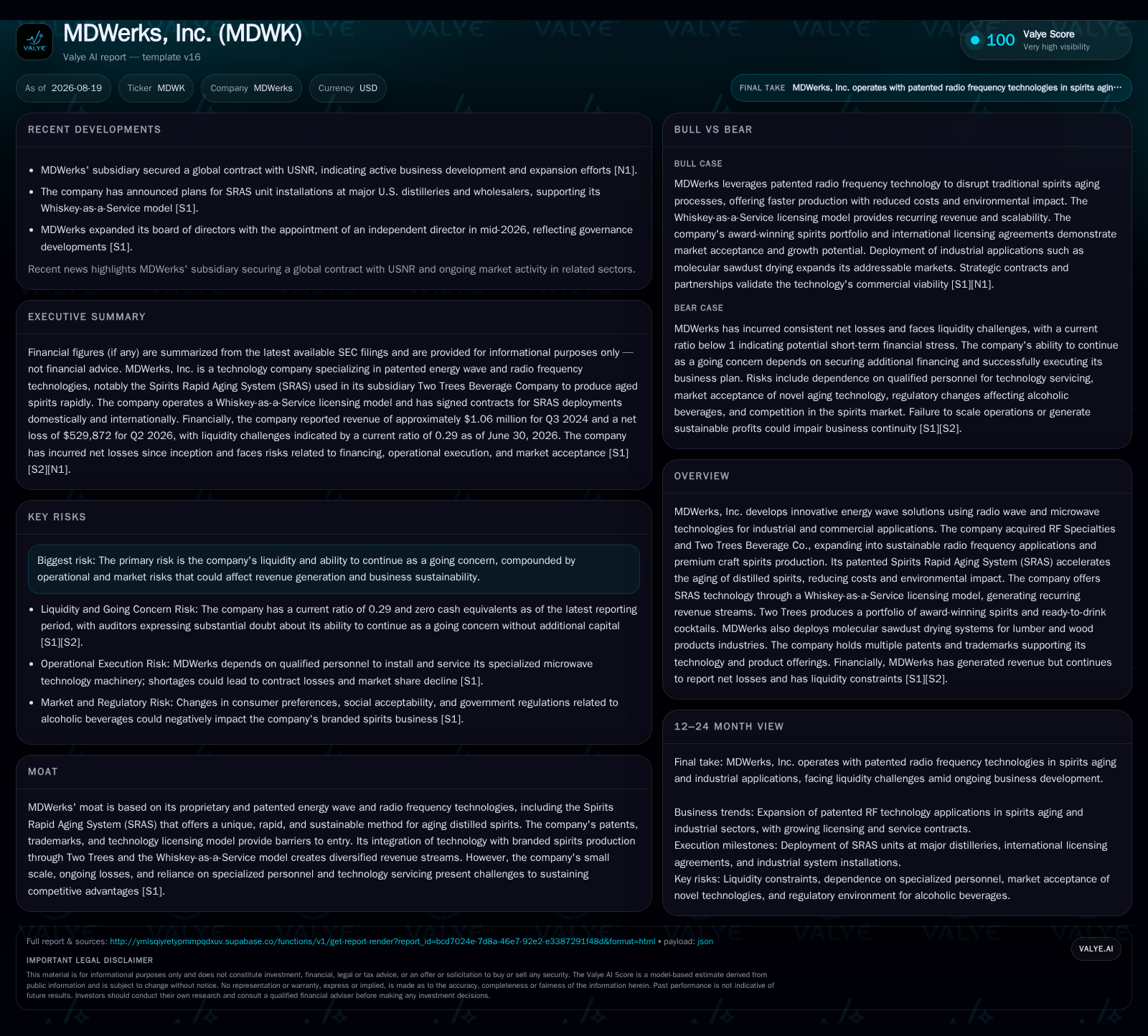
MDWerks, Inc. embodies a technologically innovative approach to traditional spirits aging and industrial processing through its patented Spirits Rapid Aging System and molecular drying technology. By integrating radio frequency and microwave solutions into both licensing and production via its Whiskey-as-a-Service model and Two Trees Beverage subsidiary, MDWerks targets a dual revenue stream strategy. Yet, despite promising technology and early commercial contracts, the company’s financials reveal persistent losses and acute liquidity challenges, underscoring the critical importance of execution and market adoption as it seeks to transition from a development-stage firm to a sustainable enterprise [S1][S2].
Latest Operating Snapshot
MDWerks has solidified its position in the spirits and industrial technology markets through recent strategic actions and contract awards. It acquired RF Specialties and Two Trees Beverage Co. in late 2023, integrating patented radio frequency (RF) applications into spirits aging and beverage production [S1]. The Spirits Rapid Aging System (SRAS) accelerates traditional aging processes, reducing costs and production time while offering environmental benefits. Notably, contracts for SRAS deployments at a major U.S. distillery and a leading wholesaler have been signed, with installations scheduled for 2026, evidencing initial commercial traction [S1].
Financially, MDWerks reported revenue of approximately $1.06 million in Q3 2024 but continues to operate at a net loss, with a $529,872 loss in Q2 2026 and an accumulated deficit exceeding $6 million by end-2025 [S2][S1]. The current ratio stands at a precarious 0.29, and cash equivalents were essentially nil as of mid-2026, raising substantial doubt about the company’s short-term liquidity and necessitating additional capital or operational improvements for sustainability [S2].
Business Model and Unit Economics
MDWerks generates revenue primarily through its Whiskey-as-a-Service (WaaS) model, which licenses its patented SRAS technology and provides on-site aging services to spirits producers. This creates a recurring revenue stream from licensing fees and maintenance contracts, theoretically offering scalability as deployments increase. Additionally, the Two Trees subsidiary produces and sells craft spirits leveraging SRAS, capturing margin on branded product sales. This dual approach combines technology licensing with manufacturing, diversifying income but also complicating operational focus.
Unit economics hinge on the cost-efficiency and throughput advantages of RF aging technology versus traditional barrel aging. By dramatically shortening aging cycles, SRAS reduces inventory carrying costs and accelerates cash conversion. However, capital intensity is nontrivial: specialized equipment manufacturing, installation, and servicing require skilled personnel, which may constrain margins and scalability if workforce supply is tight. Operating leverage could emerge as fixed costs for R&D and manufacturing spread over larger deployment volumes, but this depends critically on ramping recurring WaaS contracts and branded product sales. Failure to scale volume or control costs would limit margin expansion.
Moat, Competition and Counterforces
MDWerks’ competitive moat is rooted in its proprietary patents covering RF-based spirits aging technology, which expire as late as 2036, combined with trademarks protecting its branded spirits portfolio. The integration of technology licensing with direct spirits production via Two Trees creates diversified revenue sources that could reinforce customer stickiness and brand value. The WaaS model introduces recurring revenue and switching frictions by embedding SRAS units in customer facilities and providing ongoing service.
However, the moat faces significant counterforces. The spirits industry is traditionally conservative, with entrenched aging practices and regulatory frameworks that may slow adoption of novel RF aging. The company’s small scale and continued operating losses limit its ability to build distribution networks or scale production efficiently. Moreover, dependence on specialized technical personnel for installation and maintenance introduces operational risk. Competitors could emerge with alternative aging technologies or replicate aspects of MDWerks’ approach if patent enforcement proves challenging.
Bull Case
In the bull scenario, MDWerks successfully commercializes its Spirits Rapid Aging System at scale, driven by growing adoption from large distilleries and wholesalers under its Whiskey-as-a-Service licensing model. Recurring revenues expand steadily as SRAS units are deployed domestically and internationally, including under its exclusivity agreements. The accelerated aging process disrupts traditional distilling economics by drastically reducing time to market and lowering energy consumption, appealing to producers under margin pressure and environmental scrutiny. This drives rapid revenue growth, margin improvement through operating leverage, and cash flow generation.
Simultaneously, Two Trees’ award-winning craft spirits portfolio gains brand recognition, allowing MDWerks to capture premium pricing and higher margins on branded products. The company’s expansion into industrial applications like molecular sawdust drying establishes new revenue streams and diversifies risk. Confirming evidence would include sequential growth in WaaS licensing contracts, expanding international deployments, improved liquidity metrics, and profitability milestones. Falsification would occur if adoption stalls, recurring revenues fail to materialize, or regulatory barriers block market access [S1][N1].
Base Case
Under the base case, MDWerks achieves moderate commercial traction with its SRAS technology and WaaS business, securing incremental contracts with distilleries and wholesalers but at a slower pace than optimists expect. Revenue growth is steady but insufficient to offset ongoing operating losses in the near term. The company continues to rely on external financing to fund operations and development. Two Trees maintains a niche position with a limited but loyal customer base for its craft spirits products, generating modest margins but limited scale.
Industrial applications like molecular sawdust drying progress through pilot stages without immediate large-scale adoption. MDWerks maintains its patent protection and operational capabilities but faces continued challenges in scaling workforce and managing costs. Liquidity remains tight, requiring prudent cash management and incremental funding rounds. Confirming evidence would be gradual expansion of WaaS contracts, stable but negative EBITDA, and controlled cash burn. Falsification would be either rapid scaling surpassing expectations or failure to renew key contracts or raise capital.
Bear Case
In the bear case, MDWerks fails to gain meaningful market acceptance of its SRAS technology, hindered by entrenched industry practices, regulatory challenges, or inferior product performance relative to traditional aging. The Whiskey-as-a-Service model struggles to scale due to technical servicing bottlenecks or customer churn. Two Trees’ branded spirits face shifting consumer preferences or insufficient differentiation, limiting revenue growth. This leads to continued operating losses without a clear path to profitability.
Liquidity constraints become acute, with the company unable to secure necessary funding. Operational risks including personnel shortages impact contract fulfillment and damage reputation. Regulatory changes in alcoholic beverage standards or tariffs exacerbate challenges. The company may be forced to curtail R&D or asset sales, impairing future innovation and growth potential. Confirming evidence includes missed contract milestones, worsening liquidity ratios, and negative auditor opinions. Falsification would require unexpected financing, strategic partnerships, or breakthrough commercial wins [S1][S2].
What Matters Next
Key performance indicators and milestones for investors to monitor include: (1) Number and scale of SRAS units deployed under the WaaS model domestically and internationally; (2) Recurring revenue growth and continued-adoption indicators on licensing and maintenance contracts; (3) Progress and commercial adoption of molecular sawdust drying technology in industrial applications; (4) Quarterly operating margins and EBITDA trends to assess operating leverage; (5) Cash runway and liquidity metrics, including current ratio and cash reserves; (6) Ability to secure additional capital or strategic partnerships to fund growth; (7) Regulatory developments impacting spirits aging technologies and alcoholic beverage market access; and (8) Workforce stability and capacity to service specialized RF equipment.
Disclosure of unit economics per SRAS installation or service contract would be useful to assess scalability. Tracking Two Trees beverage sales volumes and award recognitions can provide qualitative signals of brand traction. Finally, monitoring contract renewal terms and exclusivity compliance in international licensing agreements will inform sustainability of recurring revenues and moat durability.
Disclaimer: This is research-only, informational analysis and not investment advice. It may include AI-generated interpretation and general industry context. Always verify important details using primary sources.

Comments