
MidCap Financial Investment Corp's Post-Merger Portfolio and Yield Dynamics
Examining how MFIC’s 2024 mergers reshaped its loan portfolio and impacted key yield, income, and cash flow metrics through 2025.
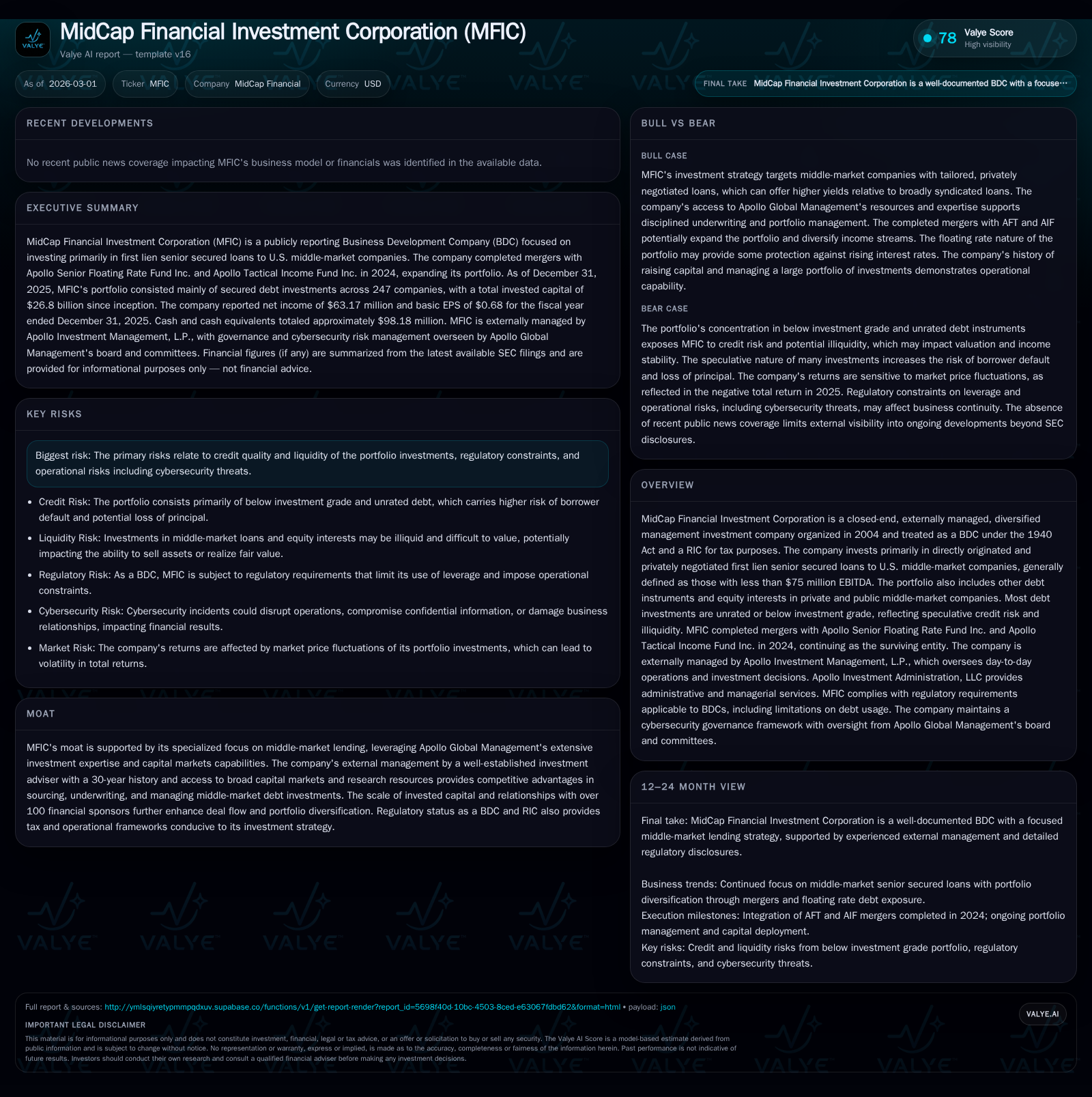
MidCap Financial Investment Corp completed transformative mergers with Apollo Senior Floating Rate Fund Inc. and Apollo Tactical Income Fund Inc. in mid-2024, significantly increasing portfolio scale and secured debt concentration. Despite growth in portfolio investments and maintained dividend payouts, the company faced a sharp decline in net income (-36.1%) and a substantial negative swing in operating cash flow (-421.9%) for fiscal year 2025 compared to 2024. The yield on its senior secured loans decreased amid credit risk considerations typical of middle-market speculative-grade lending, while liquidity and capital structure remain influenced by a predominance of floating-rate debt. MFIC's capital allocation favors dividends with moderated buybacks, supported by ROE around 4.8%. Cybersecurity governance under Apollo’s oversight and regulatory compliance as a BDC frame ongoing enterprise risks. Key future signals include cash flow stabilization and adherence to regulatory constraints.
2024-25: Merger Integration and Evolution of Portfolio Composition
In July 2024, MidCap Financial Investment Corporation (MFIC) completed two significant mergers with Apollo Senior Floating Rate Fund Inc. (AFT) and Apollo Tactical Income Fund Inc. (AIF), respectively [S1][S5][S6]. These transactions were pivotal, enlarging MFIC’s asset base and diversifying its portfolio composition appreciably. By year-end 2025, the combined entity managed investments across 247 portfolio companies, exhibiting a pronounced tilt toward first lien senior secured loans which composed over 95% of invested assets [S7]. This strategic positioning underscores MFIC’s focused commitment to middle-market lending — predominantly to U.S.-based companies often defined by EBITDA below $75 million — leveraging Apollo Global Management's robust deal sourcing and underwriting capabilities.
The post-merger portfolio reflects an evolved footprint: from approximately 233 companies pre-merger at end-2024 to 247 at end-2025, with incremental diversification into select preferred equity stakes (1%) and common equity/interests (4%) within the broader private and public middle-market universe [S7]. Notably, the composition reveals virtually no exposure to unsecured debt or structured products as of end-2025 — further emphasizing secured lending predominance.
Drivers Behind Historical Performance Shifts: Income and Operating Cash Flows
Financial performance through fiscal year ending December 31, 2025 illustrates contrasting dynamics accompanying the merger integration phase. While the mergers expanded asset scale and deal flow access, net income retreated substantially by 36.1%, declining from $98.8 million in FY2024 to $63.2 million in FY2025 [F1]. Operating cash flow contracted even more dramatically from a negative $9.5 million to negative $49.7 million over the same period [F1], signaling challenges related either to timing differences between accrual accounting for interest income recognition versus actual cash received or pressures from credit impairments or portfolio turnover.
Simultaneously, dividend disbursements were modestly increased to $141.6 million in FY2025, continuing MFIC’s characteristic policy aligned with Business Development Company (BDC) sector norms of distributing most earned income to shareholders [F1]. Share repurchases significantly diminished post-merger — falling to approximately $19.0 million in FY2025 from over $248 million in FY2024 — reflecting a strategic pause or reallocation of capital amid integration [F1]. These financial shifts underline a tension between earnings quality/conversion into cash flow versus shareholder distributions during a period of doubling portfolio complexity.
Historical performance (annual)
| FY | Net ($mm) | CFO ($mm) | Net YoY |
|---|---|---|---|
| 2025 | 63 | -50 | -36.1% |
| 2024 | 99 | -10 | +197.1% |
| 2023 | 33 | 196 | |
| 2022 | 158 |
Source: SEC companyfacts cache [F1].
Capital returns and efficiency (annual)
| FY | Div ($mm) | Buybacks ($mm) |
|---|---|---|
| 2025 | 142 | 19 |
| 2024 | 140 | 248 |
| 2023 | 123 | 2 |
| 2022 | 67 | 2 |
Source: SEC companyfacts cache [F1].
Yield Profile Trends and Credit Risk Considerations Within the Middle-Market Loan Portfolio
Yields on MFIC’s loan portfolio demonstrate nuanced shifts reflective of credit market conditions and portfolio repositioning following the M&A activity [S4][S7]. As of December 31, 2025, weighted average yields stood at approximately 9.7% on secured debt compared with a higher yield of roughly 10.8% at the prior year-end [S4]. This decline suggests marginal softening possibly due to repricing pressures or incremental exposures with lower rates.
Unsecured debt yields moved higher modestly—from about 9.5% up to around11.1%—though such instruments represent a minimal portion of total invested assets post-merger [S7]. The overall portfolio yield therefore experienced compression from about 9.5% to approximately 8.6%, which correlates with market-wide tightening credit spreads amid rising interest rates.
Credit quality remains firmly speculative grade; most loans are unrated or below investment grade given their bespoke structuring for smaller middle-market firms often unable to access broadly syndicated loans [S4]. This inherently speculative structure requires rigorous underwriting supported by Apollo's extensive experience but also increases potential illiquidity risk intrinsic to such portfolios.
Growth Opportunities and Structural Constraints Post-Merger
Scale advantages unlocked by integrating AFT and AIF underpin MFIC’s growth opportunities going forward [S1][S5][S13]. Leveraging Apollo Global Management’s expansive research capabilities and network facilitates continued access to proprietary deal flow within an otherwise fragmented middle-market lending ecosystem.
However, tangible growth prospects are balanced against structural constraints mandated under the BDC regulatory regime—principally leverage caps restricting excessive borrowing—which govern feasible deployment velocity without straining compliance limits [S13]. Moreover, illiquid positions in non-investment grade credits pose challenges for quick portfolio adjustments if adverse credit events arise.
Absent explicit forward guidance from management, monitoring how effectively MFIC navigates these boundaries while optimizing originations within upper leverage tolerance constitutes core analysis going forward (analysis).
Liquidity, Capital Structure, and Floating Rate Exposure Analysis
MFIC’s capital structure manifests a predominant reliance on floating-rate first lien senior secured loans constituting virtually100% of its direct origination portfolio measured both at fair value and cost basis as of December31,2025 [S7]. This positioning provides exposure aligned with current rising rate environments supporting interest revenue streams but also subjects earnings volatility linked directly to short-term benchmark rates fluctuations.
The broader capital mix includes corporate borrowings structured consistent with BDC guidelines alongside fixed income instruments such as corporate notes maturing in the medium term enhancing liability matching flexibility [S6][S10]. Post-merger asset scale has increased leverage capacity somewhat but within regulatory guardrails that prevent excessive risk-taking common across more traditional credit funds.
Capital Allocation Patterns: Dividends, Buybacks, and Return on Equity Trajectory
Capital returns remain tilted heavily toward dividends—a pillar feature for BDC investor appeal—with payouts rising modestly even as earnings declined sharply [F1]. Over $141 million was paid out during fiscal year 2025 versus roughly $139 million in the prior year reflecting commitment to consistent shareholder distributions.
Conversely, share repurchases slowed markedly post-mergers indicating possible conservatism during integration phases or prioritization of balance sheet fortification over aggressive buybacks [F1]. Return on equity approximating around4.8% offers insight into capital efficiency amidst increased asset base following merger consolidation—moderate by investment firm standards but typical given enlarged equity base diluting incremental income generation capacity.
Cybersecurity and Regulatory Framework as Enterprise Risk Dimensions
Non-financial risks incorporate cybersecurity vigilance embedded via Apollo Global Management’s layered governance architecture encompassing audit committee oversight through multiple specialized committees including a Cybersecurity Working Group chaired by experienced Chief Information Security Officers (CISOs) [S1][S9][S13][S14][S16]. Regular reporting cadence escalates cyber risk awareness from operational teams through enterprise risk forums ensuring continuous threat monitoring plus incident response readiness.
Regulatory oversight inherent under the Investment Company Act through BDC status imposes disciplined operational conduct including compliance audit protocols previously reviewed by independent directors which bolsters risk mitigation efforts consistent with sector best practice standards.
Key Monitoring Points: Market Signals and Portfolio Performance Metrics
Looking ahead (analysis), investors should focus on quarterly updates highlighting key parameters such as: stabilization or recovery trends in operating cash flows; further movements in net income aligned against expense absorption; detailed commentary addressing integration costs related to merger synergy realization; evolving yield spreads reflecting credit markets sentiments toward middle-market credits; changes in non-accrual loan ratios capturing credit deterioration signals; dividend sustainability metrics relative to underlying cash generation; liquidity position adjustments especially regarding cash reserves versus payable obligations; plus NAV fluctuations indicative of market valuation shifts.
Continuous attention to these variables will aid evaluation of whether MFIC can convert merger-driven scale into sustained financial returns without compromising asset quality or liquidity resilience.
This analysis is based exclusively on audited financial statements filed through February28,2026,[F1], company SEC disclosures pertaining primarily to fiscal years ending December31,, supplemented by sector contextual analysis without predictive or investment advice elements.
Disclaimer: This is research-only, informational analysis and not investment advice. It may include AI-generated interpretation and general industry context. Always verify important details using primary sources.

Comments