
MoneyHero Ltd Strengthens AI-Driven Financial Aggregation in Key Asian Markets
MoneyHero advances its strategic focus on higher-margin verticals leveraging AI technology to improve revenue quality and operational efficiency across Asia.
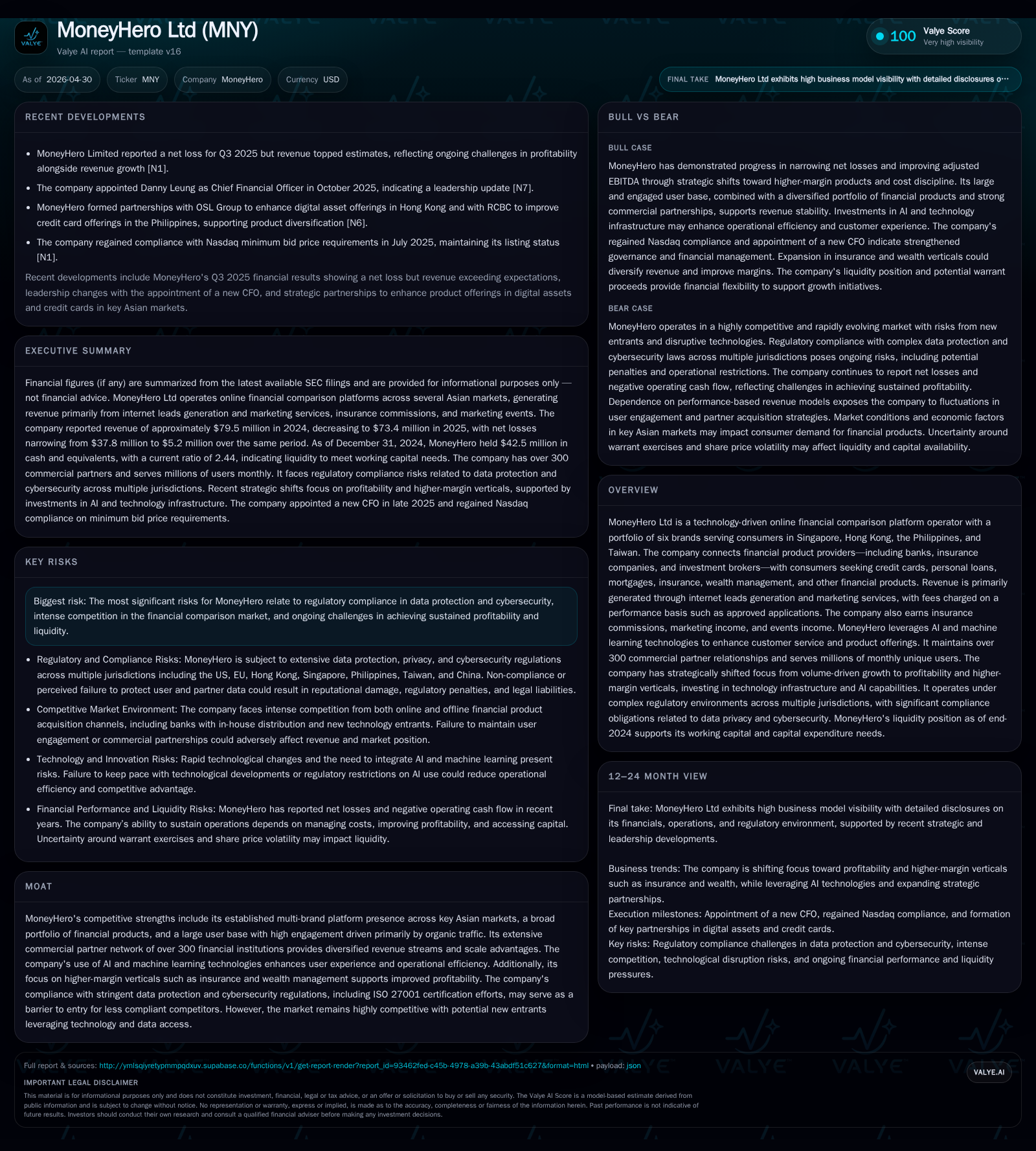
In its latest quarterly filing, MoneyHero Ltd demonstrated progress in shifting toward more profitable financial product verticals such as insurance and wealth management. This pivot has improved revenue quality and operational discipline, supporting a significant narrowing of Adjusted EBITDA losses. The company’s extensive multi-brand presence across Singapore, Hong Kong, the Philippines, and Taiwan, combined with AI-driven enhancements and a robust partner network of over 300 financial institutions, underpins its competitive position. Nevertheless, regulatory complexities and market competition remain material risks that could constrain growth momentum in the near term.
Latest Quarterly Operating Highlights: Strategic Execution and Market Reaction
MoneyHero Ltd's most recent quarterly disclosures as of April 30, 2026, underscore meaningful advancement in its business model evolution from volume-driven acquisition toward profitability-led growth. The company reported narrowing Adjusted EBITDA losses from negative $23.7 million in 2024 to negative $6.4 million in 2025 [S4]. This improvement was driven by scaling higher-margin verticals—particularly insurance and wealth management—while embedding tighter cost controls including marketing spend optimization and technology expense rationalization.
Notably, segment performance varied by geography: Hong Kong posted a segment profit of $1.6 million compared to a prior loss, aided by favorable product mix shifts; Singapore reduced its segment loss by over 99% due to aggressive expense restructuring [S16][S18]. In Taiwan, losses narrowed by 92% while the Philippines maintained stable losses amid provider headwinds but also benefited from substantial operational cost reductions. These variations reflect localized market dynamics but collectively support MoneyHero’s strategic repositioning toward unit-level economics enhancement.
Business Model and Revenue Streams: Performance-Based Leads and Brokerage
MoneyHero operates as a leading tech- and AI-powered online financial comparison platform across Singapore, Hong Kong, Taiwan, and the Philippines. Its portfolio includes six brands encompassing both B2C platforms like MoneyHero itself, SingSaver, Money101, Moneymax, Seedly as well as B2B offerings such as Creatory—a self-service portal enabling content creators to monetize traffic via commission or success-based fees [S1].
The core revenue mechanisms center on internet leads generation facilitated by performance-based fee models with commercial partners including banks, insurers, and investment brokers. Fees are commonly structured around approved applications (RPAA model), generating recurring commissions particularly in insurance brokerage lines where product renewals drive long-term visibility [S1]. Marketing service revenues and events form supplementary income streams.
The company's ability to generate millions of monthly unique visitors coupled with over 5.1 million group members underlines strong user engagement driven mainly by organic traffic bolstered by educational content offerings [S1]. AI integration enhances service personalization and operational workflows underpinning efficiency improvements that support scalable unit economics.
Industry Structure: Competitive Dynamics and Role of Technology Innovation
The financial comparison industry in Greater Southeast Asia is marked by fragmentation with entrenched incumbents operating traditional distribution channels alongside emerging digital platforms like MoneyHero. The company's broad multi-market footprint gives it scale advantages while its partnerships with more than 300 regional financial institutions diversify revenue sources effectively [S1].
Significant switching costs for consumers arise from platform usability complemented by rich educational content that assists decision-making in a complex personal finance landscape—reinforcing user retention. Integration of AI-powered customer service tools (e.g., conversational commerce bots for insurance) differentiates MoneyHero by improving customer conversion funnels while reducing costs [S1].
Regulatory compliance around data protection (including ISO 27001 certification efforts) establishes entry barriers given rising privacy legislation across jurisdictions such as Taiwan and Malaysia. These compliance capabilities are essential because failure risks reputational damage or penalties that would impair partner confidence.
Growth Drivers: AI Deployment, Multi-Brand Expansion, and Vertical Diversification
Investment in agentic AI technologies stands central to MoneyHero’s growth narrative—facilitating enhanced customer service responsiveness and internal automation that can boost margins despite spending constraints [S1]. Scaling higher-margin verticals like insurance commissions supports revenue quality improvements beyond credit card or personal loan leads which historically carry thinner margins.
Multi-brand strategies enable geographic diversification opportunities while Creatory empowers third-party content creators enhancing user demand acquisition through expanded digital channels. This platform innovation drives incremental revenue streams anchored on fixed or success-fee partner arrangements [S1].
User base scale (circa 5+ million monthly unique users) combined with steady application volumes—1.6 million applications leading to over 700k approvals in 2025—reflect healthy underlying KPIs aligned with margin expansion targets [S1]. Continued technology upgrades sustain frictionless user journeys aiding long-term retention.
Risks and Constraints: Regulatory Compliance, Competition, and Profitability Pressures
MoneyHero faces ongoing risks associated with cross-border data protection regulations requiring stringent security protocols to avoid breaches or regulatory sanctions—regulations vary widely among operating markets such as Taiwan’s additional requirements [S1]. Cybersecurity incidents pose structural risk given the volume of sensitive personal financial data processed.
Competition remains intense not only from other digital aggregators but also direct insurers’ internal brokerage arms wielding significant marketing budgets. This dynamic pressures customer acquisition costs (CAC) while compressing margins if spend efficiencies decline.
Profitability challenges persist given historical losses despite recent improvements; sustaining cost discipline without stalling growth is delicate particularly given necessary continued investments into technology infrastructure and talent acquisition [S1].
Outlook: Priorities for Demand Expansion and Operational Efficiency
Key focal points for near-term outlook involve leveraging AI rollouts fully across the customer journey to improve conversion rates while managing seasonal demand fluctuations typical in personal finance applications tied to tax seasons or holidays. Retention efforts for content/channel partners through innovations on the Creatory platform will guide extended reach into new audiences [S1].
Quarterly KPIs monitoring application volumes segmented by high-margin product verticals serve as critical demand indicators going forward. Maintaining disciplined marketing spending while expanding product offerings within wealth management remains central to margin trajectory ambitions.
Financial Snapshot: Current Liquidity, Cost Controls, and Profitability Trends
MoneyHero's current ratio stood at approximately 2.44 as of the end of 2024, indicating solid short-term liquidity coverage [F1]. The firm’s net loss narrowed substantially to $5.2 million for fiscal year 2025 from $37.8 million in 2024—a swing reflecting successful cost rationalizations including a nearly 20% reduction in advertising expenses alongside decreased technology costs stemming from amortization write-offs and vendor consolidations [S19][S20]. However, net cash used in operating activities remained at $10.2 million demonstrating ongoing cash burn tempered compared to prior periods [S10][S12].
Capital expenditures remain modest around $0.9 million focused mainly on technology platform development consistent with its scaling priorities [S23]. While no immediate refinancing needs are flagged explicitly in filings, management highlights potential future capital requirements dependent on growth execution success balanced against evolving macroeconomic conditions [S21][S26].
Disclaimer: This analysis is based solely on publicly available information disclosed through SEC filings up to April 30th, 2026. It does not constitute investment advice or recommendations but rather an independent assessment of MoneyHero Ltd’s business model dynamics and operating environment.
Disclaimer: This is research-only, informational analysis and not investment advice. It may include AI-generated interpretation and general industry context. Always verify important details using primary sources.

Comments