
Maravai LifeSciences Navigates Revenue Decline and Operating Loss Amid Strategic Restructuring
The company’s two segments showed mixed profitability in 2025, with restructuring efforts and market dynamics influencing near-term performance and outlook.
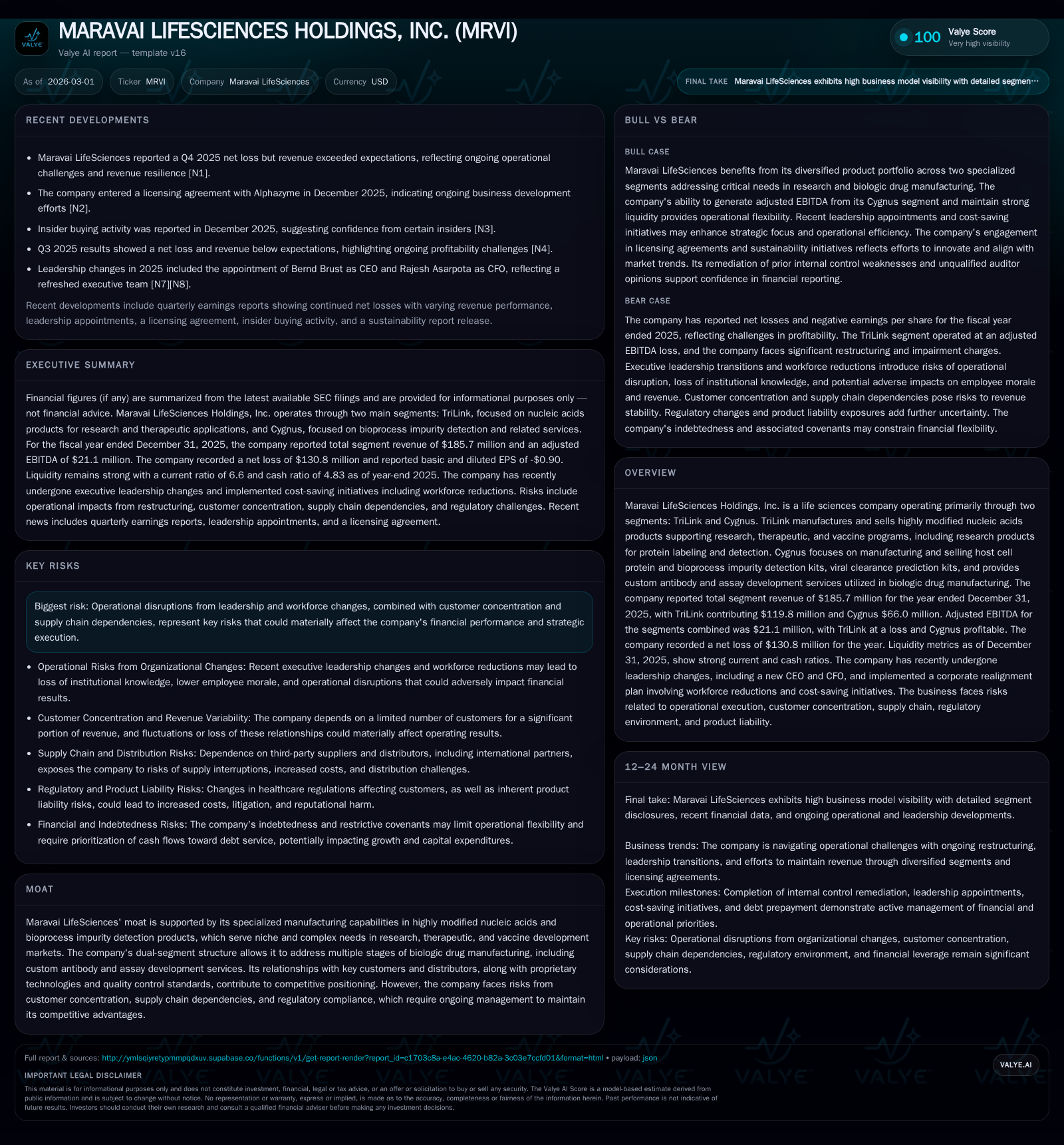
Maravai LifeSciences Holdings, Inc. reported total segment revenue of $185.7 million for 2025, down from $259.2 million in 2024, driven by a decline in TriLink's sales and modest growth in Cygnus. The company recorded an operating loss exceeding $215 million and a net loss of $130.8 million, reflecting restructuring costs, impairments, amortization, and integration expenses. While Cygnus delivered positive segment adjusted EBITDA, TriLink faced losses due to variable demand linked to vaccine and therapeutic markets. Leadership changes and workforce reductions were part of a strategic realignment focused on cost savings and long-term growth. Key risks include customer concentration, supply chain dependencies, regulatory challenges, and competitive pressures.
Company Overview
Maravai LifeSciences Holdings operates through two primary segments: TriLink and Cygnus [S1][S9]. TriLink manufactures highly modified nucleic acids products supporting research, therapeutic development, and vaccine programs. This segment also offers research-use products for protein labeling and detection [S1]. Cygnus provides host cell protein detection kits, bioprocess impurity testing solutions, viral clearance prediction kits, and custom antibody development services essential for biologic drug manufacturing [S1].
The dual-segment structure enables Maravai to serve complementary niches within the life sciences sector during growing demand for advanced therapies.
Historical Performance and Segment Revenue Trends
For fiscal year 2025, Maravai reported combined segment revenues of $185.7 million—a decline from $259.2 million in 2024 [F1][S1]. The TriLink segment’s revenue contracted sharply to $119.8 million from approximately $196.3 million the prior year, reflecting reduced demand following peak COVID-19 vaccine production cycles [F1][S1][N1]. Conversely, Cygnus increased revenue modestly to $66.0 million from $62.8 million [F1][S1].
Segment adjusted EBITDA showed divergence: Cygnus generated $44.2 million while TriLink incurred a loss of about $23.1 million [S1]. This reflects stable recurring demand for Cygnus’ impurity testing services versus more variable vaccine-related orders impacting TriLink [S1].
Despite positive combined segment adjusted EBITDA of approximately $21.1 million for 2025, substantial corporate expenses—$52.3 million—along with amortization ($27.9 million), depreciation ($23.6 million), interest expense ($27.0 million), stock-based compensation ($30.2 million), goodwill impairments ($68.7 million), and restructuring charges ($22.1 million) resulted in an operating loss exceeding $215 million [F1][S1].
Financial Summary Table
Historical performance (annual)
| FY | Net ($mm) | CFO ($mm) | OpInc ($mm) | Capex ($mm) | Net YoY |
|---|---|---|---|---|---|
| 2025 | -131 | -58 | -215 | 13 | +9.7% |
| 2024 | -145 | 7 | -236 | 30 | -21.7% |
| 2023 | -119 | 126 | -32 | 66 | -154.1% |
| 2022 | 220 | 536 | 574 | 17 |
Source: SEC companyfacts cache [F1].
Capital returns and efficiency (annual)
| FY | FCF ($mm) | ROE% |
|---|---|---|
| 2025 | -71 | -61.6 |
| 2024 | -22 | -44.5 |
| 2023 | 61 | -28.6 |
| 2022 | 519 | 40.4 |
Source: SEC companyfacts cache [F1].
Note: Revenues are total across all segments; net income excludes non-recurring tax agreement adjustments.
Capital Allocation and Liquidity
Capital expenditures declined by approximately 56% from $29.7 million in 2024 to $13.1 million in 2025 as part of cost realignment efforts [F1][S2]. Free cash flow remained negative due to operational losses combined with capital spending (-$70.7 million calculated as operating cash flow minus capex) indicating ongoing cash burn [F1].
Year-end cash and equivalents were nearly $217 million compared to current liabilities around $44.9 million—resulting in a strong current ratio near 6.6x that supports liquidity [F1]. However, total indebtedness stood at approximately $292 million largely comprising term loans per filings [S16], highlighting leverage considerations.
Goodwill impairments totaling about $68.7 million reflect downward revisions to acquired businesses’ expected performance [F1][S1]. Restructuring charges exceeding $22 million included severance related to workforce reductions affecting roughly one-quarter of employees as part of the August 2025 Corporate Realignment Plan aimed at reducing structural costs [S2][S3].
Strategic Shifts and Management Changes
In mid-2025 Maravai appointed new CEO and CFO leadership coinciding with organizational restructuring designed to enhance operational efficiency and concentrate resources on core growth areas [S2].
The August 2025 Corporate Realignment Plan involved terminating approximately 25% of the workforce alongside consolidating facilities aimed at annual labor cost savings consistent with sustainability objectives [S2]. Management noted potential risks including revenue impacts linked to knowledge loss or capacity constraints during the transition period [S2].
Additionally the company emphasized expanding e-commerce capabilities while selectively investing in projects aligned with long-term trends rather than short-term volume spikes—particularly relevant given post-pandemic volatility in mRNA vaccine supply chains [N1][S2].
Growth Prospects & Constraints
Growth Drivers:
- Continued expansion in bioprocess impurity detection (Cygnus) supported by global biologics manufacturing growth.
- Potential pipeline advancements tied to nucleic acid-based therapeutics supporting vaccine development cycles.
- Technology improvements including custom antibody development enhancing customer engagement.
- Geographic expansion leveraging distribution partnerships aligned with regulatory compliance.
Constraints:
- Demand volatility for TriLink products following pandemic-related sales peaks.
- Customer concentration risk with large pharmaceutical clients accounting for a high portion of revenues [S11].
- Supply chain vulnerabilities due to reliance on limited or sole suppliers for proprietary raw materials including specialized DNA reagents [S21].
- Regulatory scrutiny with evolving quality standards increasing compliance costs; FDA inspections pose business continuity risks given complex manufacturing processes [S4][S8][S10].
- Competitive pressure from larger life sciences companies capable of scale advantages leading to price compression or technology obsolescence risk [S12].
- Intellectual property litigation risks related to proprietary technologies central to product offerings with potential infringement claims or patent disputes [S14][S18].
Success depends on integrating acquisitions efficiently with organic innovation while managing cyclicality.
Outlook & Milestones
Management has not provided explicit financial guidance but highlights expected realization of cost savings from restructuring over upcoming quarters alongside cautious optimism for gradual recovery in nucleic acid reagent demand linked to emerging therapeutic modalities [N1][S2].
Investors should monitor segment adjusted EBITDA trends particularly improvements within TriLink; gross margin stabilization reflecting supply chain optimization; working capital shifts related to distributor inventories; as well as updates on regulatory inspections or litigation that could materially affect near-term prospects.
Risk Factors Summary From SEC Filings
- Operational disruption risks including leadership changes causing knowledge gaps during turnaround phase [S2].
- Customer concentration risk increasing exposure if key contracts are not renewed or volumes decline unexpectedly [S11].
- Supply chain reliance on limited vendors increases vulnerability to shortages or cost spikes [S21].
- Regulatory compliance risks heightened by potential reclassification or enforcement actions affecting research-use-only products possibly deemed diagnostic devices requiring approvals [S23][S24].
- Competitive threats potentially rendering technologies obsolete if rivals develop superior alternatives or leverage economies of scale unavailable to Maravai [S12].
- Product liability exposure from use of reagents in clinical trials possibly leading to lawsuits despite meeting standards [S6].
- Cybersecurity threats risking proprietary information compromise amid rising digital adoption [S8].
- Elevated indebtedness constraining capital investment flexibility while increasing refinancing risk under adverse conditions [S16][S19].
These factors underscore the importance of agile execution alongside robust compliance internationally.
Conclusion
Maravai LifeSciences faces a challenging environment marked by significant top-line contraction primarily driven by TriLink’s exposure to volatile vaccine/therapeutic markets partially offset by steady Cygnus growth linked to stable biologics impurity testing demand.
Substantial losses stem from amortization burdens plus goodwill impairments reflecting lowered acquisition expectations coupled with restructuring costs from rapid corporate realignment including major workforce reductions.
Strong cash reserves provide liquidity support; however operational disruption risks persist amid competitive pressures from larger global incumbents alongside dependence on key customers and suppliers.
Going forward success will require disciplined focus on core competencies such as nucleic acid technologies paired with niche analytical capabilities supported by prudent capital management aiming toward sustainable profitability.[F1][S1][N1]
Disclaimer: This report is based solely on publicly available information as of early 2026 and does not constitute investment advice.
Disclaimer: This is research-only, informational analysis and not investment advice. It may include AI-generated interpretation and general industry context. Always verify important details using primary sources.

Comments