
Match Group’s 2025 Growth Resilience Amid Subscription Model and Regulatory Hurdles
Match Group sustains revenue growth and capital returns in fiscal 2025 while navigating significant legal challenges and robust cybersecurity governance.
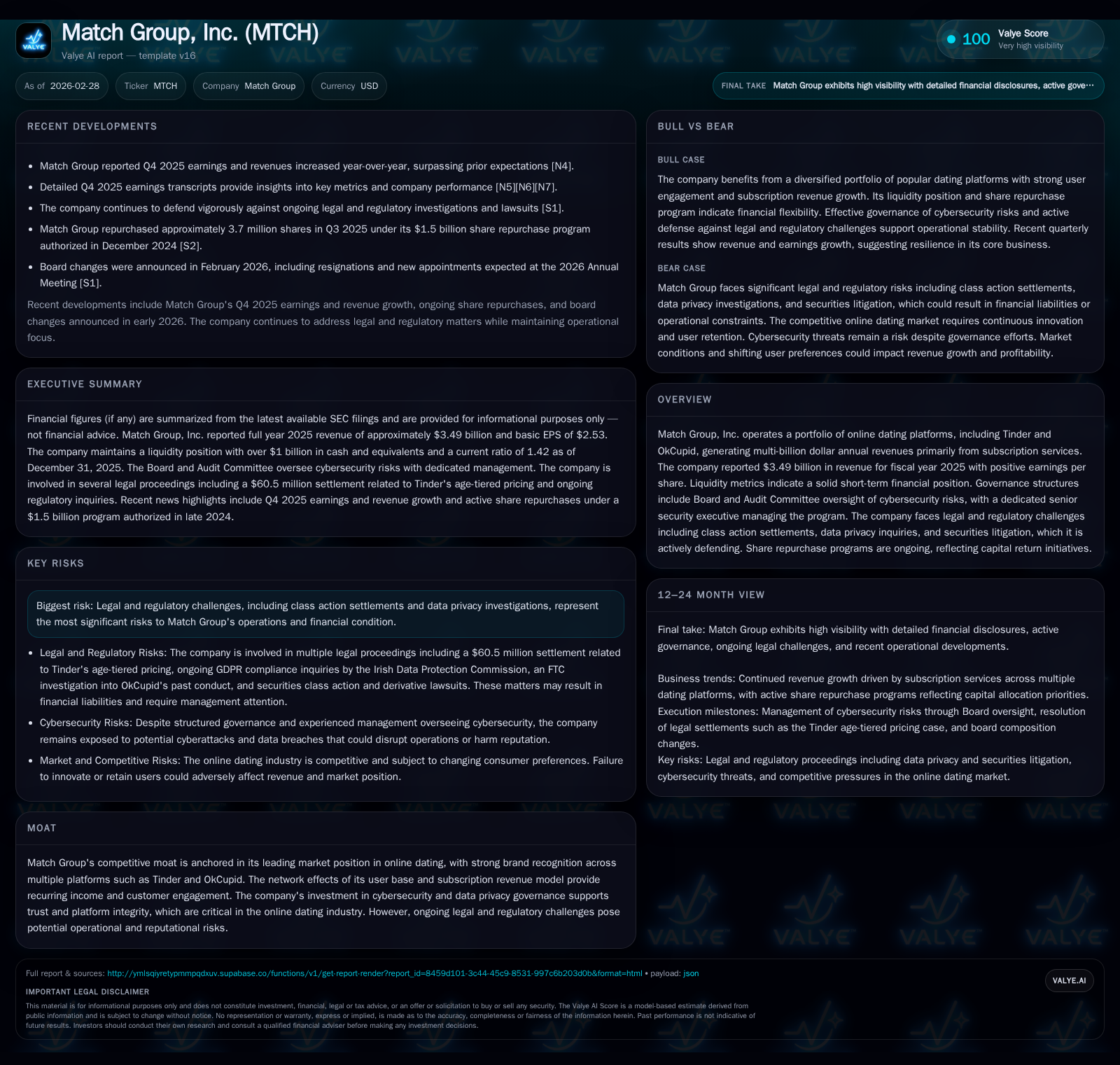
In 2025, Match Group posted moderate revenue growth driven by its subscription businesses like Tinder and OkCupid, alongside improved operating income. The company’s financial performance is supported by a recurring revenue model but shadowed by multiple legal actions and regulatory investigations, including a $60.5 million settlement over Tinder's age-tiered pricing and ongoing data privacy probes. Match Group’s governance framework includes active Board-level oversight of cybersecurity risks, a critical moat given the sensitivity of user data in online dating. Capital returns remain strong through share repurchases and dividends, underpinned by solid cash flow generation. Key upcoming catalysts include outcomes of legal proceedings and subscriber trends for core platforms.
Steady Revenue Expansion Driven by Subscription Scale
Match Group closed fiscal year 2025 with revenues touching approximately $3.49 billion, reflecting a restrained yet positive year-over-year growth rate of around 0.2% from the prior year’s $3.48 billion [F1]. This incremental revenue progression underscores the scale economics of its entrenched subscription model across marquee platforms such as Tinder and OkCupid, which form the backbone of the company’s recurring income stream. While macroeconomic headwinds have broadly pressured discretionary consumer spending across digital services, Match Group’s operational resilience derives from sustained subscriber engagement and monetization consistency within its online dating ecosystem.
Subscription revenue dynamics particularly benefit from network effects common in dating platforms: as user bases expand or stabilize, they reinforce both engagement value to customers and willingness to pay for premium tiers like Tinder Gold or Plus. The multi-platform portfolio approach also cushions the company against volatility on any single brand.
Historical performance (annual)
| FY | Rev ($bn) | CFO ($mm) | OpInc ($mm) | Capex ($mm) | Rev YoY |
|---|---|---|---|---|---|
| 2025 | 3.5 | 1080 | 873 | 57 | +0.2% |
| 2024 | 3.5 | 933 | 823 | 51 | +3.4% |
| 2023 | 3.4 | 897 | 917 | 67 | +5.5% |
| 2022 | 3.2 | 515 | 49 |
Source: SEC companyfacts cache [F1].
Capital returns and efficiency (annual)
| FY | Buybacks ($mm) | FCF ($mm) |
|---|---|---|
| 2025 | 789 | 1024 |
| 2024 | 753 | 882 |
| 2023 | 546 | 829 |
| 2022 | 482 |
Source: SEC companyfacts cache [F1].
Shows gradual revenue growth at scale; operating income rebound after dip in 2024; highlights net income volatility; depicts healthy CFO growing +15.8%; capex rise moderate representing ongoing investment.
Operating Margin Trends and Profitability Dynamics in FY2025
From an earnings perspective, operating income registered a healthy rebound to roughly $873 million in FY2025, marking an approximate increase of 6% compared to FY2024 [$823 million], which had experienced margin compression due to investments and competitive pricing pressures [F1]. This uptick reflects Match Group's ability to manage cost structures while selectively increasing spending on platform enhancements and marketing aimed at subscriber retention.
Notwithstanding steady operating profits, net income continues to exhibit volatility stemming from non-operating items such as litigation expenses and deferred tax impacts — documented elsewhere in the company's filings but not materially elaborated upon here due to data constraints [F1]. Given intense competition among digital social apps vying for user attention and willingness to pay, managing profitability at scale remains a core challenge. Still, these margin developments suggest effective stewardship within this dynamic marketplace.
Legal Battles and Regulatory Scrutiny: A Cloud Over Growth?
A prominent risk dimension for Match Group arises from ongoing litigations and regulatory actions centering on user privacy practices, subscription pricing strategies, and securities litigation claims [S4–S7]. A notable development is the class action settlement approved preliminarily in January 2026 concerning Tinder's age-tiered pricing scheme — settling for $60.5 million — based on allegations that older users faced higher subscription fees than younger cohorts in violation of California laws [S5].
Parallelly, Match Group confronts multiple privacy inquiries led by European authorities such as the Dutch Data Protection Commission focusing on GDPR compliance specifics related to user consent procedures on Tinder spanning back several years [S6]. The company asserts strong defenses in these matters but acknowledges the financial implications both from potential fines and remediation costs.
Additionally, derivative lawsuits accuse some executives of misrepresenting Tinder performance metrics impacting stockholder valuations; although dismissed or stayed so far, these claims underscore governance pressures linked with transparency disclosures [S4][S7]. These legal complexities pose reputational risks that require careful navigation without compromising operational vitality.
Cybersecurity Governance as a Competitive Shield
Amidst rising cyber threat landscapes for digital platforms reliant on sensitive personal data, Match Group has embedded rigorous cybersecurity protocols directly overseen at the Board level through its Audit Committee [S1][S8]. This governance architecture ensures regular assessments of security posture encompassing risk identification, threat detection capabilities, and escalation protocols when incidents arise.
Leadership responsibility rests with the SVP of Security Engineering—bringing over two decades of specialized cybersecurity experience who reports to the Chief Legal Officer—to coordinate cross-functional initiatives across IT infrastructure and user-facing platforms such as Tinder’s backend systems [S1]. Besides technical safeguards including encryption standards and vulnerability management programs, systematic reporting lines to senior management bolster transparency on emerging threats.
This well-structured cyber governance framework serves as an intangible competitive moat bolstering customer trust — increasingly vital given industry-wide scrutiny over data protection effectiveness.
Capital Redeployment: Share Repurchases, Dividends, and Cash Flow Strength
Financial discipline is evident through aggressive yet measured capital return policies aligned with free cash flow generation strength. Operating cash flow reached approximately $1.08 billion for FY2025—a significant +15.8% improvement year-over-year—while capital expenditures held at modest levels near $57 million as investments predominantly target platform scalability rather than heavy physical infrastructure expansion [F1].
Free cash flow thus approximates just over $1 billion ($1.02 billion), providing ample liquidity capacity for shareholder distributions.
Match Group prioritized share repurchases heavily during FY2025 with about $789 million expended against a $1.5 billion authorized buyback program initiated late-2024 [S9][S10]. Complementing buybacks were dividend payments totaling $186 million—a practice that only surfaced post-2020 reflecting shareholder value focus amid maturing business cash flows [F1].
Notably, despite persistent negative shareholder equity (around minus $254 million), roughly influenced by intangible asset adjustments or buyback accounting effects, ROE calculations indicate robust returns exceeding typical technology sector thresholds—signaling effective utilization of capital resources at current profit scales [F1].
What To Watch: User Growth, Regulatory Outcomes, and Innovation Pipeline (Analysis)
Looking forward beyond reported figures, three principal areas warrant close monitoring:
- User engagement trajectories: Especially monthly active users (MAUs) on flagship apps like Tinder which impact subscription renewals; recovery trends post recent pressures are critical for sustaining recurring revenue growth narratives [N3][N5].
- Legal resolution timelines: Final court approvals relating to pending settlements or regulatory inquiries will shape financial provisioning needs as well as public relations dynamics influencing user trust.
- Product innovation: Investments aimed at differentiating experience through AI-driven matching algorithms or new platform introductions could catalyze longer-term subscriber base expansion but remain unquantified explicitly in disclosures.
Absent explicit forward guidance details from management on these dimensions, investors and analysts should track quarterly subscriber metrics announcements alongside regulatory news flow closely to gauge trajectory shifts affecting valuation context.
This analysis synthesizes publicly available financial statements and regulatory filings supplemented by recent earnings commentary emphasizing Match Group’s interplay between steady operational execution and evolving litigation/regulatory challenges. It abstains from speculative forecasts or investment judgments respecting mandate constraints.
Disclaimer: This report is intended solely for informational purposes based on available data as of February 28, 2026. It does not constitute investment advice or recommendations.
Disclaimer: This is research-only, informational analysis and not investment advice. It may include AI-generated interpretation and general industry context. Always verify important details using primary sources.

Comments