
MasTec's Expanding Backlog and Self-Insurance Approach Shape Future Prospects
MasTec's robust revenue surge in 2025 dovetails with strategic risk management and capital deployment amidst industry complexities.
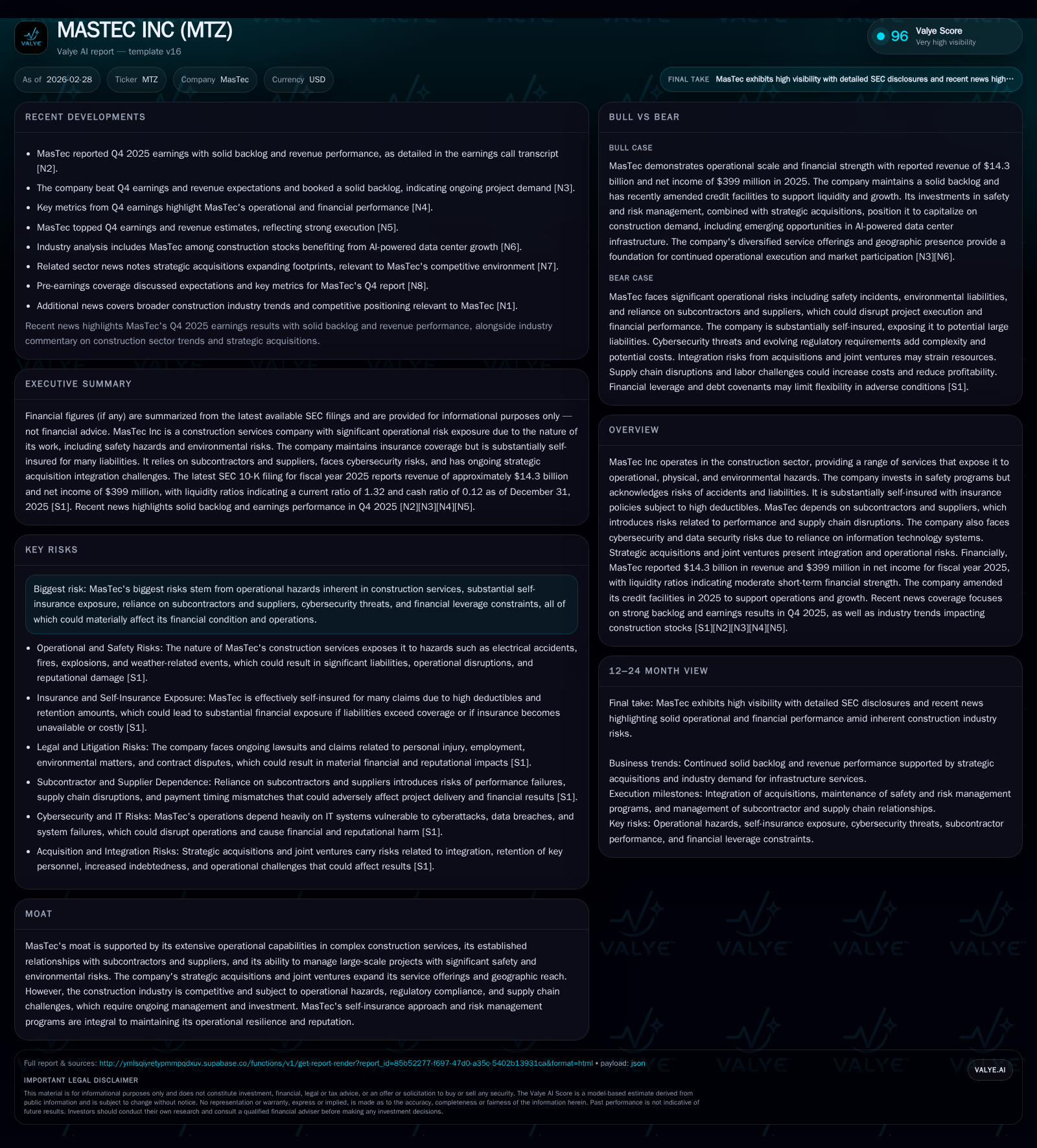
In fiscal year 2025, MasTec Inc achieved a notable 16.2% increase in revenue, reaching $14.3 billion, paired with a significant 145% surge in net income to $399 million. This performance reflects strong demand for complex construction services supported by a solid backlog and successful integration of acquisitions. Operational hazards inherent to construction, amplified by substantial self-insurance exposure due to high deductibles, remain pivotal risk factors. On the capital front, recent amendments to credit facilities provide liquidity flexibility amid moderate leverage, while cash flow dynamics reveal a substantial decline in operating cash flow year-over-year despite improved profitability. Forward-looking considerations include monitoring project execution amidst supply chain dependencies and regulatory landscapes that impact both risk management and growth trajectories.
Record 2025 Performance: Revenue Surge Amid Challenging Industry Dynamics
MasTec capped fiscal year 2025 with revenue totaling approximately $14.3 billion, representing a robust increase of 16.2% over the prior year’s $12.3 billion mark [F1]. This milestone emphasizes the company’s ability to scale its operations across diverse construction segments including energy infrastructure and telecommunications projects known for complexity and higher margins. Net income growth was even more pronounced, rising from $163 million in FY2024 to nearly $400 million, a 145% improvement fueled by operational efficiencies and favorable project execution timing [F1]. Management commentary during the Q4 earnings calls highlights backlog expansion as a key driver sustained by continued demand for broadband infrastructure rollouts and renewed energy sector investment, affirming sustained organic growth momentum balanced with accretive acquisitions [N3], [S1]. Such top-line acceleration against a backdrop of challenging labor markets and raw material inflation illustrates MasTec's adeptness in pricing discipline and delivery.
Historical performance (annual)
| FY | Rev ($bn) | Net ($mm) | CFO ($mm) | Rev YoY | Net YoY |
|---|---|---|---|---|---|
| 2025 | 14.3 | 399 | 546 | +16.2% | +145.1% |
| 2024 | 12.3 | 163 | 1122 | +2.6% | +425.9% |
| 2023 | 12.0 | -50 | 687 | +22.7% | -249.8% |
| 2022 | 9.8 | 33 | 352 |
Source: SEC companyfacts cache [F1].
Capital returns and efficiency (annual)
| FY | Buybacks ($mm) | ROE% |
|---|---|---|
| 2025 | 77 | 12.2 |
| 2024 | 0 | 5.6 |
| 2023 | 0 | -1.8 |
| 2022 | 81 | 1.2 |
Source: SEC companyfacts cache [F1].
(Note: Capital expenditures are referenced qualitatively in filings related to IT upgrades and acquisition integration efforts; precise figures are not disclosed.)
Risk Management in Construction: Balancing Self-Insurance and Operational Hazards
MasTec’s operations expose it continuously to risks from electrical installations, heavy equipment use, hazardous materials handling, adverse weather conditions, and work in densely populated areas — all heightening the potential for incidents involving property damage or personal injury [S1], [S5]. To manage these risks financially while controlling insurance costs, MasTec employs significant self-insured retention under high-deductible policies.
This approach means MasTec directly bears substantial claims costs up to policy limits, reflected as retained liabilities within financial statements. The company’s captive insurance subsidiary helps manage these exposures but considerable uncertainty remains around claim frequency and severity due to unpredictable factors such as wildfire prevalence or regulatory changes [S5], [S8].
Serious accidents or deteriorating safety records could increase future costs or limit contract opportunities due to regulatory scrutiny or customer concerns about health & safety compliance [S17]. Accordingly, MasTec invests continuously in occupational health & safety programs, incident investigations, and workforce management strategies aimed at sustaining operational resilience and reputation.
Backlog Strength and Market Drivers: Foundations for Growth
Entering Q4 2025, MasTec reported solid backlog growth across core business units driven by fiber optic network expansions supporting data center demands — trends linked to accelerating digital transformation initiatives widely observed industry-wide [N3], [N4]. Joint ventures enable broader geographic reach into emerging markets while leveraging technical expertise without proportionate fixed cost increases or balance sheet strain [S7], [N3].
Competitive pressures remain intense as peers also report order book expansions fueled by AI infrastructure investments; execution speed and supplier agility will be key differentiators amid ongoing supply chain challenges sector-wide [N10].
Capital Structure and Liquidity: Moderate Leverage with Flexible Credit Facilities
As of December 31, 2025, MasTec held current assets of approximately $4.33 billion versus current liabilities near $3.27 billion yielding a current ratio around 1.32 — indicative of moderate short-term liquidity coverage despite working capital pressures linked primarily to payables owed to subcontractors [F1].
The company’s amended credit facility from mid-2025 extended maturities out five years while removing certain restrictive covenants such as minimum interest coverage ratios but maintains a consolidated leverage covenant capped at roughly 3.5x adjusted EBITDA—temporarily increased up to about 4x following acquisitions exceeding $200 million (the “Acquisition Adjustment”) [S18], [S23].
Debt bears variable interest rates indexed predominantly to Term SOFR plus margins exposing MasTec to interest rate fluctuations amid Federal Reserve rate volatility despite recent easing trends during CY2025 [S4]. This underlines refinancing risk if market rates rise unexpectedly.
Capital Allocation Trends: Share Repurchases Amid Cash Flow Volatility
In FY2025, MasTec resumed share repurchases totaling about $77 million after no buybacks in the prior two years—reflecting confidence supported by improved earnings quality despite operating cash flow dropping over half from FY2024 levels ($546 million vs $1.12 billion), largely due to working capital timing differences typical for prime contractors where vendor payments precede customer receipts [F1], [N3].
This divergence between soaring net income (+145%) and declining operating cash flow (-51%) signals non-cash earnings elements or episodic accounts receivable build-ups warranting careful analysis when assessing free cash flow availability for deleveraging or reinvestment.
Dividend payouts remained stable though detailed payout ratios are not explicitly disclosed suggesting balanced priorities between shareholder returns and liquidity preservation mandated by debt agreements.
Future Outlook: Monitoring Execution Amid Market Uncertainties
Recent earnings commentary offers cautiously positive outlooks for Q1 and full-year FY2026 emphasizing backlog conversion visibility alongside selective bidding discipline amid macro uncertainties affecting raw material prices and labor availability—key variables influencing project timing given the company's exposure to complex service delivery profiles typical of the construction sector [N2], [N3].
Environmental regulations combined with insurer retrenchments increasing reliance on self-insurance layers introduce cost uncertainties that could temper margin expansion if claims escalate over medium term.
Sector-Specific Risks: Supply Chain Dependence and Partnership Liabilities
MasTec’s extensive subcontractor network is critical for timely project delivery; disputes over scope or payment terms can raise liquidity risks especially when subcontractor payments precede customer collections—a common dynamic in the sector impacting profit margins during payment delays or contract disputes [S20], analysis.
Joint ventures enhance capacity but also extend contingent liabilities through joint-and-several obligations should partners default or face regulatory penalties necessitating rigorous governance frameworks highlighted in recent filings underscoring these risks’ materiality within strategic alliance structures [S7], [S12].
Operational Resilience: Safety Programs Counter Physical and Cyber Threats
MasTec’s competitive positioning rests on sustained investment in occupational health & safety programs addressing frequent construction hazards including electrical shocks, falls, environmental exposures heightened by climate change risks such as wildfires documented extensively within regulatory disclosures crucial for maintaining contract eligibility especially under multi-agency oversight regimes ensuring workforce readiness through continuous training cycles [S1], [S8].
Concurrently, cybersecurity enhancements protect mission-critical financial systems and project management platforms vital for operational continuity amid increasing digitalization footprints subject to evolving data privacy regulations—an area receiving heightened focus aligned with enterprise risk management best practices outlined in SEC disclosures post-fiscal year-end filings earlier this year[S21].
This analysis is based solely on publicly available documents through February 28, 2026 including SEC annual reports consolidated by companyfacts snapshots alongside recent earnings call transcripts and authoritative market news sources without extrapolation beyond reported data or speculative forecasts outside official guidance ranges.
Disclaimer: This is research-only, informational analysis and not investment advice. It may include AI-generated interpretation and general industry context. Always verify important details using primary sources.

Comments