
Marzetti Company (MZTI) Equity Analysis: Specialty Foods with Strategic Growth and Operational Challenges
Marzetti Company leverages strong brand recognition and strategic acquisitions to grow within the US specialty food market, balancing operational restructuring with a long-standing dividend growth record amid competitive and liquidity pressures.
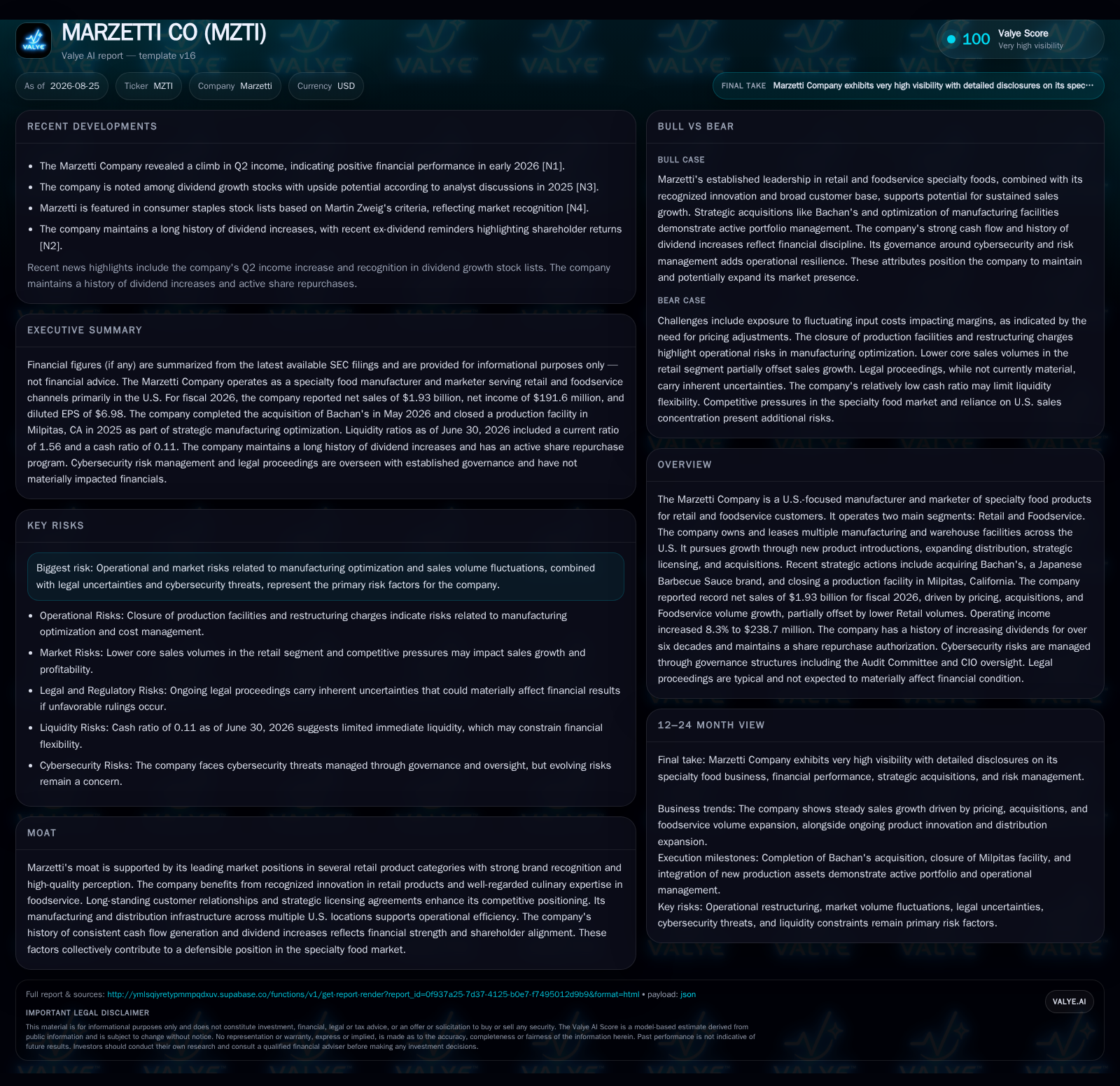
Marzetti operates a solid specialty food business split between retail and foodservice segments, showing modest sales growth driven by pricing, acquisitions, and foodservice volume expansion. Its business model benefits from brand strength and manufacturing scale, but margins and volume face pressure from input cost volatility and retail softness. The company’s moat rests on brand equity, product innovation, and a diversified manufacturing footprint, while risks include operational restructuring, legal uncertainties, and limited liquidity. Future performance hinges on successful integration of acquisitions, volume recovery in retail, and disciplined cost management.
The Marzetti Company (MZTI) is a US-based manufacturer and marketer of specialty food products serving retail and foodservice customers through two operating segments. In fiscal 2026, Marzetti reported $1.93 billion in net sales, a modest 1.1% increase supported by pricing strategies, strategic acquisitions like Bachan's Japanese Barbecue Sauce brand, and growth in foodservice volumes. However, retail volume softness partially offset these gains. The company’s operating income improved by 8.3%, reflecting some operating leverage despite rising SG&A costs linked to acquisitions and IT investments. Marzetti continues to execute operational restructuring, including facility closures and acquisitions, while maintaining a long history of dividend increases and managing risks such as cybersecurity and legal proceedings through structured governance. The company faces a mixed outlook balancing growth opportunities against operational and market headwinds.
Latest Operating Snapshot
Marzetti reported fiscal 2026 net sales of $1.93 billion, up 1.1% from the prior year, driven primarily by pricing actions, the acquisition of Bachan's in May 2026, and increased Foodservice volumes. Retail segment volumes declined, partially offsetting growth [S1]. Operating income grew 8.3% to $238.7 million with a 12.4% operating margin, signaling modest operating leverage despite a 10.6% rise in SG&A expenses attributed to acquisition-related costs and investments in IT and personnel [S1].
The company completed a strategic facility closure in Milpitas, California in August 2025, while acquiring a production facility in Atlanta, Georgia in February 2025, indicating active portfolio and manufacturing footprint optimization. Liquidity metrics as of June 30, 2026 include $25.1 million in cash and equivalents, a current ratio of 1.56, and a low cash ratio of 0.11, suggesting moderate short-term potential financial flexibility [S1]. Governance over cybersecurity risks is robust, with oversight by the Audit Committee and CIO, and the company maintains its 63-year streak of dividend increases, reflecting financial discipline and shareholder alignment [S1][N3].
Business Model and Unit Economics
Marzetti generates revenue primarily through the manufacture and marketing of specialty food products in two segments: Retail and Foodservice. pricing power could derive from brand strength and product innovation, particularly in specialty sauces, dressings, and condiments, where differentiated formulations and recognized culinary expertise can command premium pricing. Volume growth is driven by expanding distribution channels and new product introductions, while acquisitions add incremental sales and diversify the portfolio. The company’s U.S.-centric manufacturing footprint supports efficient supply chain management and responsiveness to customer needs.
Fixed costs are significant due to manufacturing facilities and SG&A infrastructure, while variable costs include raw materials and packaging, which are sensitive to commodity price fluctuations. Operating leverage emerges when sales volume increases outpace SG&A and manufacturing fixed costs, as seen in the 8.3% operating income growth despite only 1.1% revenue growth. However, this leverage can fail if volume declines persist or input cost inflation pressures margins without sufficient pricing pass-through. Capital expenditures focus on facility optimization and capacity management, as evidenced by recent plant closures and acquisitions. The low cash ratio signals limited liquidity buffer, potentially constraining discretionary investments or flexibility to weather operational shocks.
Moat, Competition and Counterforces
Marzetti’s competitive advantage centers on brand equity in specialty food categories with loyal retail and foodservice customers. Its portfolio includes established brands recognized for quality and innovation, providing some pricing power and customer stickiness. Long-term customer relationships and strategic licensing agreements bolster its market presence and create switching frictions. The company’s multi-location manufacturing and distribution network supports supply chain reliability and operational resilience, which are critical in food production.
Competitive pressures arise from both large food conglomerates and niche specialty brands innovating in the same segments. Private-label products pose a risk to pricing and volume, especially in retail. Market saturation and changing consumer preferences toward health and convenience foods require ongoing innovation and marketing investment. The company’s U.S.-centric sales expose it to regional economic and regulatory factors without international diversification benefits. Counterforces such as input cost volatility, channel mix shifts favoring foodservice over retail, and operational restructuring risks could erode margins and market position if not managed effectively.
Bull Case
In a favorable scenario, Marzetti leverages its strong brand portfolio and manufacturing footprint to sustain growth by successfully integrating acquisitions such as Bachan's, expanding into higher-growth foodservice channels, and innovating with new specialty products aligned to consumer trends. Pricing discipline combined with efficient cost management could improve margins further. The company’s history of dividend increases and share repurchases reinforce investor confidence, enabling it to attract long-term capital and maintain favorable financing terms.
Confirming evidence would include accelerating volume growth in both retail and foodservice, expanding market share versus competitors, further margin improvement beyond current gains, and successful execution of manufacturing optimization without additional restructuring charges. Falsification would arise if retail volume declines deepen, acquisition synergies fail to materialize, input cost inflation overwhelms pricing power, or liquidity constraints limit growth initiatives.
Base Case
Marzetti continues moderate revenue growth driven by pricing and foodservice volume gains offsetting retail softness, with stable operating margins reflecting balanced cost control and SG&A investments. The company incrementally expands distribution and launches new products that maintain customer interest without major market share shifts. Acquisitions like Bachan's integrate smoothly but do not materially accelerate growth beyond current trends. Dividend growth persists at a modest rate reflecting earnings stability.
This scenario assumes manageable input cost pressures with partial pass-through, steady but not accelerating volume trends, and no material operational disruptions. Cybersecurity and legal risks remain contained without material financial impact. Liquidity remains adequate for ongoing investments but limits large-scale capital projects. Evidence supporting this includes flat-to-modest volume trends, consistent margin profiles, and steady dividend increases. Signs challenging this view would be accelerating volume declines, margin compression, or unexpected restructuring costs.
Bear Case
Downside risks crystallize if retail volumes continue to decline sharply due to competitive pressures or changing consumer preferences, eroding top-line growth. Input cost inflation could outpace pricing, compressing margins and forcing operational cost cuts that impair service and innovation. Additional restructuring or facility closures may be required, resulting in charges and operational disruption. Liquidity constraints could limit the company's ability to invest in growth or absorb shocks. Legal proceedings could become material, and cybersecurity breaches could cause reputational damage or financial penalties.
Confirming evidence would be sustained volume declines, margin erosion despite pricing efforts, negative operating leverage, increased restructuring charges, or deterioration in liquidity ratios. Falsifying evidence would include volume stabilization or growth, margin recovery, successful cost control, and benign legal outcomes. The company's resilience depends on balancing these pressures while maintaining brand strength and customer relationships.
What Matters Next
Key metrics to monitor include segment volume trends in Retail and Foodservice to assess demand momentum and channel shifts. Margin progression, especially gross and operating margins, will indicate pricing power and cost control effectiveness amid input cost dynamics. Integration success of recent acquisitions, particularly Bachan's, should be evaluated through contribution to sales and operating income as well as synergy realization.
Liquidity and capital allocation decisions bear watching, given the low cash ratio and ongoing share repurchases. Tracking restructuring-related charges or announcements will shed light on operational optimization risks. Monitoring dividend announcements and share repurchase activity will provide insight into financial discipline and shareholder return priorities. Lastly, updates on cybersecurity incidents or legal proceedings could alter risk perceptions and financial outlooks.
Disclaimer: This is research-only, informational analysis and not investment advice. It may include AI-generated interpretation and general industry context. Always verify important details using primary sources.

Comments