
N-able's Subscription Growth and Debt Expansion Weigh on Profitability in 2025
N-able, Inc. reported strong recurring revenue growth with expanding partner footprint but saw a sharp decline in net income amid higher costs and debt servicing.
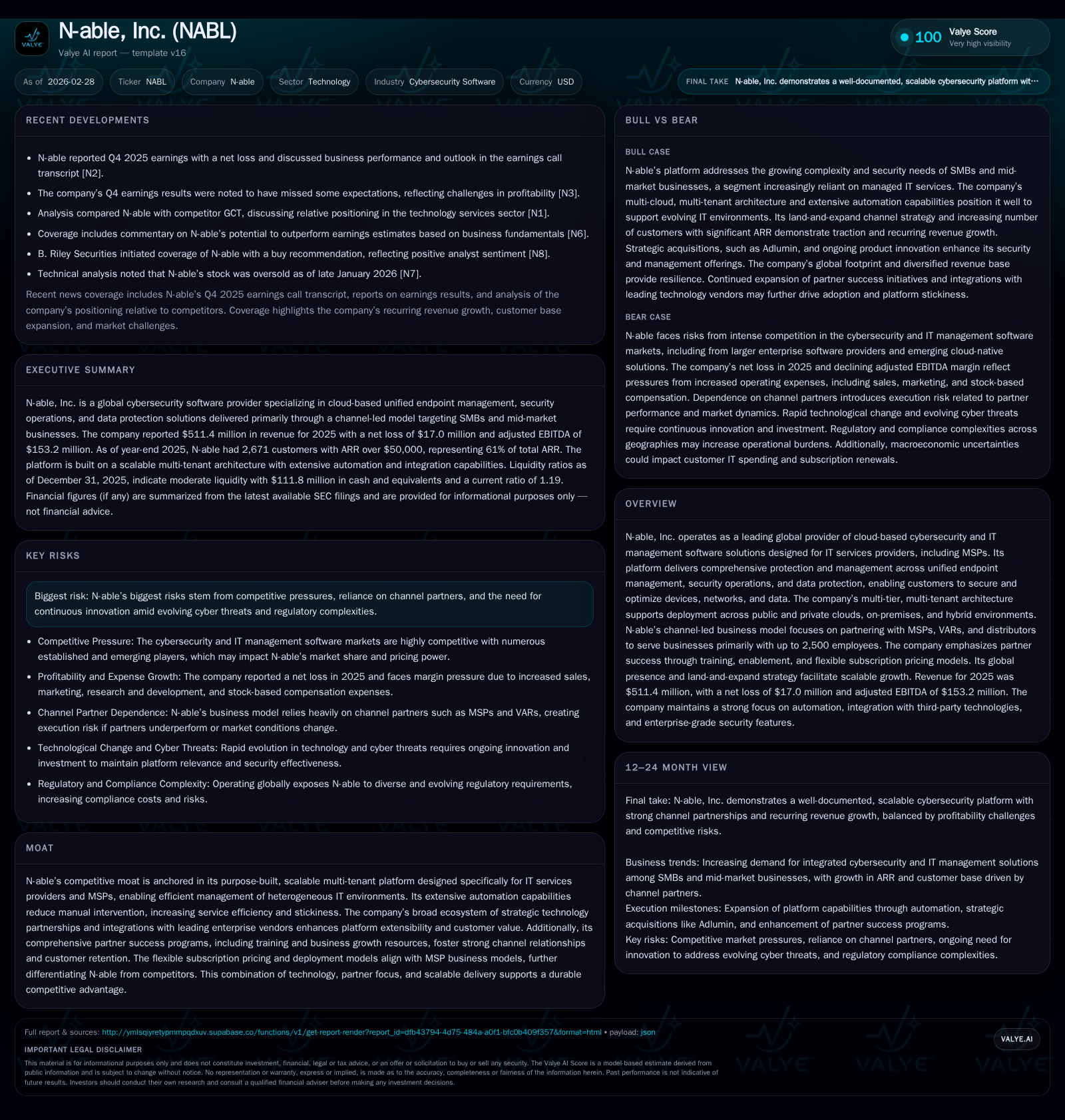
N-able, Inc. delivered 9.7% revenue growth in 2025 driven by subscription sales and expanded Annual Recurring Revenue, supported by its channel-led MSP business model and recent acquisitions. Despite robust revenue, net income swung to a loss of $17 million due to rising expenses, amortization from acquisitions, and interest costs linked to increased leverage. Operating cash flow remained healthy, underscoring solid core business cash generation. The company’s land-and-expand strategy targeting IT service providers for SMBs fuels future growth, balanced against competitive pressures and the need for ongoing innovation. Investors should monitor execution on long-term contracts and cost control as key milestones.
Overview
N-able, Inc., established as an independent public company through the spin-off from SolarWinds in mid-2021, operates as a global provider of cloud-native cybersecurity and IT management software tailored primarily for Managed Service Providers (MSPs) and IT service providers. Its platform integrates Unified Endpoint Management (UEM), Security Operations, and Data Protection modules into a scalable multi-tenant architecture capable of deployment across public clouds, private clouds, hybrid environments, or on-premises systems [S1][S4].
The company targets mainly SMBs and mid-market businesses with fewer than 2,500 employees through a channel-centric business model that includes MSPs, Value Added Resellers (VARs), distributors, and other partners [S4][S11]. This model enables efficient expansion by onboarding IT service providers who subsequently bring their end customers onto N-able’s platform.
Historical Financial Performance
N-able has sustained top-line momentum since its spin-off. For fiscal year (FY) 2025, total revenue hit $511.4 million—up 9.7% from $466.1 million in FY2024—primarily fueled by subscription sales growth (+10.3%) that now comprises virtually all revenue (99.0%) [F1][S1]. Other revenues like maintenance and professional services have declined slightly.
Annual Recurring Revenue (ARR), a critical SaaS metric indicating the health of subscription renewals and expansions, rose nearly 12% YoY to approximately $540 million at December 31, 2025 [S1]. The count of customers contributing more than $50K ARR increased about 14%, representing a growing base of larger accounts responsible for a greater share of recurring revenues [S1][S15].
Despite solid revenue gains, profitability deteriorated significantly during this period. Operating income fell sharply from about $82 million in FY2024 down to roughly $37 million in FY2025—a decline over 55% [F1]. More notably, net income swung from a positive $31 million to a loss of $17 million in FY2025 [F1]. Rising amortization expenses related to acquired technologies (including the November 2024 Adlumin acquisition), higher interest costs due to increased borrowing under Credit Agreement amendments, growing R&D spend aimed at innovation, and sales/marketing investments all weighed on earnings [S1][S19][S20].
Operating cash flow improved moderately from $79 million to over $93 million despite these challenges while capital expenditures rose modestly to approximately $18 million [F1], reflecting continued investment in platform enhancement.
The table below summarizes key financial results for FY2022 through FY2025:
Historical performance (annual)
| FY | Net ($mm) | CFO ($mm) | OpInc ($mm) | Capex ($mm) | Net YoY |
|---|---|---|---|---|---|
| 2025 | -17 | 93 | 37 | 18 | -155.0% |
| 2024 | 31 | 79 | 82 | 18 | +32.2% |
| 2023 | 23 | 90 | 70 | 14 | +40.1% |
| 2022 | 17 | 71 | 47 | 13 |
Source: SEC companyfacts cache [F1].
Capital returns and efficiency (annual)
| FY | FCF ($mm) | ROE% |
|---|---|---|
| 2025 | 75 | -2.1 |
| 2024 | 62 | 4.1 |
| 2023 | 76 | 3.3 |
| 2022 | 59 | 2.6 |
Source: SEC companyfacts cache [F1].
*Note: The unusually high revenue growth in FY2024 incorporates the transition following the spin-off combined with continuing organic growth trends.
Business Model and Industry Context
The accelerating complexity of IT environments—driven by hybrid infrastructures, multi-cloud strategies, exponential data growth, emergent SaaS applications, and AI integrations—is intensifying demand for unified management solutions among SMBs lacking deep internal IT expertise [S4]. N-able's comprehensive platform addresses these needs through unified endpoint management combined with security operations capabilities and data protection services.
Its multi-tiered multi-tenant architecture is purpose-built to support MSPs managing diverse client estates efficiently — enabling automation of routine tasks which enhances operational leverage for these partners [S28]. This technical advantage bolsters N-able’s competitive moat alongside strategic alliances with leading technology vendors such as Microsoft Intune integration and Meraki network support that extend device coverage breadth [S15].
Moreover, N-able's channel-led model expands its market footprint efficiently without proportionally increasing direct sales expenditures by leveraging partner networks—including VARs and distributors—for customer acquisition and technical service delivery [S4][S11]. This structure aligns well with MSP economics where recurring subscription revenues compound through multi-layer expansions within end customer environments.
Partner success initiatives—comprising extensive training programs such as Head Nerds expert consultations and community events like the annual Empower conference—drive loyalty and support partners’ business expansion efforts [S11][S13]. This ecosystem approach contributes not only to high retention but also greater consumption per account as MSPs roll out additional solutions powered by N-able.
Pricing flexibility offers further differentiation; customers may elect pay-as-you-go monthly terms or commit to multi-year volume agreements with corresponding pricing rationalizations—affecting revenue recognition timing but enhancing contractual visibility into future cash flows [S20][S25].
Growth Prospects and Strategic Priorities
Looking ahead, N-able aims to capitalize on substantial market opportunities via:
- Expanding Customer Footprint: Continuing acquisition of new MSP partners who onboard their client bases onto N-able’s platform.
- Facilitating MSP Growth: Enabling partners’ expansion with resources that improve service delivery efficiency allowing growth without linear cost increases.
- Cross-Selling & Upselling: Increasing penetration within existing customer relationships by offering additional modules like data protection enhancements or security operation features.
- International Growth: Leveraging localized distributor models across various regions supported by tailor-made marketing strategies.[S5][S14]
- Innovation Investment: Persistent R&D focus on automation capabilities along with responding to emerging cyber threat complexities ensures platform relevance.[S21]
However, limitations include intense competition from other RMM/security solution vendors targeting MSP channels,[S24] dependency on partner success for distribution effectiveness,[N6], evolving regulatory requirements potentially increasing compliance costs,[S24], plus technological shifts necessitating continuous innovation expenditure.
A noteworthy factor is the Long-Term Contract Initiative launched mid-2024 designed to shift mix towards committed longer duration subscriptions improving revenue visibility albeit compressing net revenue retention marginally due to pricing adjustments [S1][S20]. Monitoring how this initiative impacts sustainable growth will be important going forward.
Recent Operational Updates & Market Sentiment
N-able reported Q4/2025 revenue slightly above analyst estimates at around $130 million but missed some earnings expectations reflecting incremental expense pressures tied partly to increased amortization and debt servicing costs following the Adlumin purchase[N1][N2]. The stock experienced volatility due mainly to concerns over margin contraction notwithstanding recurring revenue strength[N9][N11]. Analysts emphasize watching execution on cost control initiatives alongside absorption of acquisitions integration[N12].
Debt amendments completed late-2025 raised term loan capacity from $336 million up to $400 million while reducing interest margins somewhat—extending maturities into early next decade—but left leverage elevated relative to EBITDA levels[S7][S8][S9]. This capital structure supports funding organic investments plus bolt-on acquisitions yet necessitates vigilant free cash flow generation discipline.
Cash reserves stood robust at approximately $112 million year-end along with strong operating cash flows around $93 million—signaling liquidity support for ongoing operations[S19][F1]. Capital expenditures have scaled modestly commensurate with organic product development plans.[F1]
Capital Allocation & Returns Profile
While not currently returning capital via dividends or share buybacks according to latest filings[S7], N-able exhibits solid operational cash flow conversion fostering capacity for reinvestment or future capital return policies if desired. Return on equity dipped negative at approximately -2%, largely influenced by net losses experienced in FY2025 relative to an equity base exceeding $800 million[F1]. Continued emphasis remains on navigating back toward profitability leveraging both top-line expansion and expense discipline.
Table: Key Financial Metrics Summary (USD thousands)
| Metric | FY2025 | FY2024 |
|---|---|---|
| Revenue | 511,430 | 466,147 |
| Operating Income | 36,789 | 82,370 |
| Net Income | -17,032 | 30,958 |
| Operating Cash Flow | 93,202 | 79,437 |
| Capital Expenditures | 18,139 | 17,570 |
| Cash & Equivalents | 111,837 | - |
| Equity | 804,655 | 759,288 |
Data sourced from latest SEC filings[F1][S1][S19]
Conclusion & What To Watch (Analysis)
N-able stands at an inflection point balancing robust subscription-driven top-line growth augmented by strategic acquisitions against margin pressures arising from investment acceleration and debt servicing commitments. Key near-term indicators worth monitoring include:
- The effect of long-term contract adoption on overall net retention rates and recurring revenue visibility.
- Operating expense trajectory relative to incremental gross profit improvements.
- Integration progress on acquired assets like Adlumin adding cybersecurity capabilities complementary to core offerings.
- Leverage metrics amidst credit facility amortization schedules coupled with free cash flow generation consistency.
- Competitive product innovation pace addressing rapidly evolving cyber threats impacting partner sustainability.
- Partner ecosystem vitality reflected in cohort expansions especially larger accounts crossing $50K ARR threshold which drives majority revenue concentration.
Success hinges on maintaining technological differentiation through automation efficiency gains within a complex channel-delivered service environment while adapting commercial models responsive to partner economics demanding scalability without proportional cost inflation.
Disclaimer: This report is intended solely for informational purposes based on publicly available data as of the publication date without constituting investment advice.
Disclaimer: This is research-only, informational analysis and not investment advice. It may include AI-generated interpretation and general industry context. Always verify important details using primary sources.

Comments