
Northfield Bancorp’s Margin Compression and Merger Drive Growth Constraints and Strategic Shifts
Northfield Bancorp faces significant headwinds from declining profitability and regional concentration as it pursues a merger to expand scale amid intensifying competition and evolving digital trends.
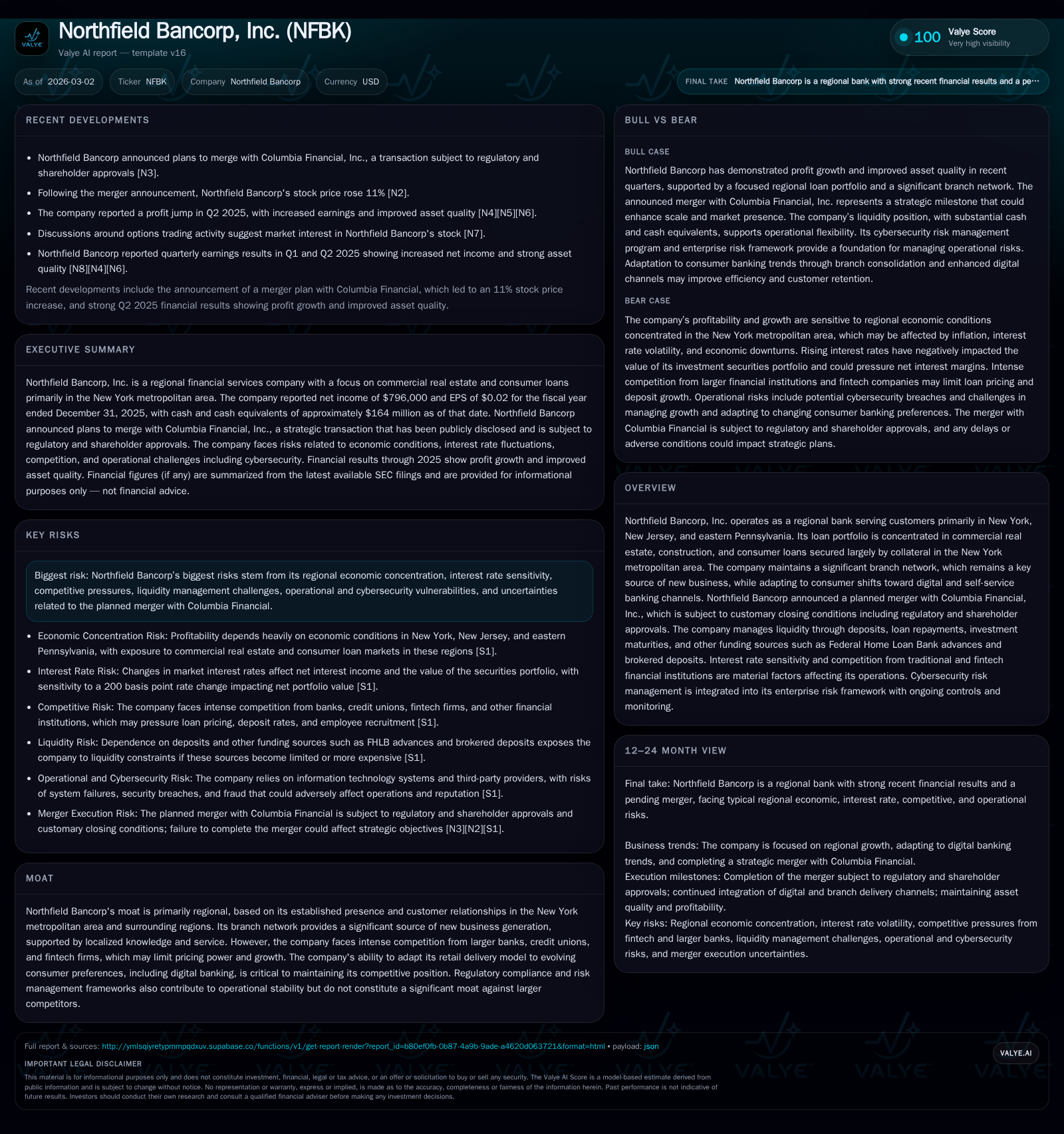
Northfield Bancorp, Inc. operates primarily in the New York metropolitan area with a focus on commercial real estate and construction lending. Recent financials reveal a sharp net income decline in 2025 despite increased operating cash flows, highlighting margin pressures amid rising funding costs and competitive challenges. The upcoming merger with Columbia Financial signals a strategic effort to bolster scale but carries integration and regulatory risks. Liquidity management, interest rate sensitivity, and adapting to digital banking remain key operational priorities going forward.
Historical Financial Performance
Northfield Bancorp’s recent financial trajectory shows considerable stress on earnings despite sustained operational cash generation. In fiscal year 2025, net income collapsed nearly 97% year-over-year from $29.9 million in 2024 to just $0.8 million [F1]. Meanwhile, operating cash flow expanded robustly by over 70%, reaching $53.7 million in 2025. This divergence suggests that while the company's core cash generation from operations remains intact—primarily driven by loan collections, deposit stability, and investments—profitability is compressed possibly due to increased funding costs and narrower net interest margins.
Historical performance (annual)
| FY | Net ($mm) | CFO ($mm) | Net YoY |
|---|---|---|---|
| 2025 | 1 | 54 | -97.3% |
| 2024 | 30 | 31 | -20.5% |
| 2023 | 38 | 47 | -38.4% |
| 2022 | 61 | 83 |
Source: SEC companyfacts cache [F1].
Capital returns and efficiency (annual)
| FY | Div ($mm) | Buybacks ($mm) | ROE% |
|---|---|---|---|
| 2025 | 21 | 15 | 0.1 |
| 2024 | 22 | 19 | 4.2 |
| 2023 | 23 | 37 | 5.4 |
| 2022 | 24 | 31 | 8.7 |
Source: SEC companyfacts cache [F1].
Operating expenses have likely increased alongside pressures from competitive loan pricing and elevated deposit betas in a rising rate environment [S24][S7]. Capital expenditure levels have remained modest relative to operating cash flows but recovered somewhat in recent years.
Business Model and Regional Concentration
Northfield Bancorp operates predominantly across New York State (especially metropolitan areas), New Jersey and eastern Pennsylvania [S4][S6][S12]. Its loan book is concentrated substantially in commercial real estate (CRE) and construction lending portfolios that notably rely on collateral values within these regional markets. This geographic concentration makes Northfield’s credit quality highly sensitive to local economic cycles including real estate valuations and supply chain effects influencing construction activity [S6].
Branch networks remain crucial for client acquisition—an advantage for customer trust and localized relationship management—but require careful balancing with growing demands for digital banking channels preferred by modern consumers [S4][S23]. The company regularly reviews branch footprints for consolidation opportunities while investing in alternative delivery methods.
Interest Rate Sensitivity & Liquidity Considerations
Northfield's financial results are particularly susceptible to shifts in interest rates; assets tend to have longer durations than liabilities exposing margins to compression when funding costs rise faster than asset yields [S24][S7]. The simulation model indicates that a parallel upward shift of two percentage points could reduce net portfolio value significantly (-7.32%) whereas downward shocks have much less positive impact (+0.98%), underscoring exposure asymmetry [S7].
Deposits remain the bank’s primary funding source but significant reliance on supplemental sources like Federal Home Loan Bank advances and brokered deposits highlights potential liquidity vulnerabilities if market conditions tighten or underwriting guidelines change abruptly [S5][S7]. As of December 2025 municipal deposits accounted for nearly a quarter of total deposits secured by securities or letters of credit; volatility here poses short-term funding risks [S19].
Competitive Landscape & Regulatory Dynamics
The competitive environment Northfield faces includes large national banks with broader service suites alongside nimble fintech players increasingly encroaching on payments processing and lending fronts [S23]. Legislative changes such as the GENIUS Act enabling federally chartered stablecoins could divert customer funds away from traditional deposit accounts towards new payment alternatives.
Regulatory compliance is rigorous with particular scrutiny on mortgage practices and consumer compliance governed at both federal/state levels [S16]. Enforcement risks persist even for inadvertent breaches requiring strong internal controls.
AI adoption introduces additional layers of operational risk including model biases or failures impacting fraud detection or customer service functions. Northfield acknowledges the need for robust governance frameworks to mitigate algorithmic risks associated with newer technologies [S29]. Cybersecurity safeguards include continuous monitoring overseen by a dedicated board committee supported by external consultants ensuring evolving threat preparedness [S1][S21].
Strategic Outlook & Merger Impact
Early February saw Northfield formally announce plans to merge with Columbia Financial Inc., signaling an intent to enhance scale in their overlapping regional footprints while gaining broader operational capabilities [N1][N3]. The transaction remains contingent on standard closing conditions like regulatory approvals; execution risks during integration are material given differing organizational cultures and systems alignment requirements.
Growth going forward depends heavily on success in acquiring customers from competitors locally while continually adapting products for evolving consumer habits including digital enhancements [S4][N3]. Post-merger synergy realization will hinge upon retaining key personnel amidst industry-wide talent competition [S8]. Northfield’s capacity to maintain liquidity while funding loan growth also remains key given competitive pressure on deposit pricing combined with potential constraints accessing wholesale liquidity markets.
Returns & Capital Allocation
Return on equity contracted precipitously reflecting net earnings erosion despite a relatively steady equity base hovering near $690–705 million range over four years [F1]. Based on latest figures approximate ROE falls below one percent (near ~0.1%), a stark decline from prior periods driven by income collapse rather than equity dilution.
Dividends continue but were trimmed slightly alongside buybacks which declined materially from prior years’ levels consistent with earnings trends [F1]. Free cash flow after capital spending remains strong at approximately $51 million suggesting disciplined capex but limited reinvestment opportunity or retained earnings strength for growth capital expansion currently.
Risks Summary
Key risks confronting Northfield encompass:
- Concentrated exposure to commercial real estate cycles within New York metro affecting loan performance;
- Interest rate mismatches pressuring net interest margins especially if deposit betas accelerate faster than asset yields;
- Potential funding disruptions from reduced access or increased cost of brokered deposits/FHLB advances;
- Intensifying competition squeezing pricing power amid fintech disruption;
- Cybersecurity breaches or AI model failure impacting operations or causing reputational damage;
- Execution hazards stemming from merger integration uncertainty;
- Regulatory enforcement risk despite compliance programs;
- Macroeconomic uncertainties including inflation impacts raising operating costs along with subdued loan demand due to slower regional economy growth;
- Operational exposures related to fraud risk inherent in complex payment ecosystems.
Conclusion & Points To Watch (Analysis)
Northfield Bancorp stands at an inflection point marked by compressed profitability but solid operational cash generation underpinned by its regional franchise serving largely commercial real estate clients. The announced merger with Columbia Financial underscores a strategic choice towards building scale in a competitive market landscape where standalone growth may be marginally constrained by pricing pressure and economic cyclicality. Critical near-term milestones include regulatory clearance of the transaction alongside adept management of integration complexities.
Investors should monitor trends in:
- Net interest margins relative to ongoing interest rate developments,
- Deposit cost trajectories especially municipal and brokered deposit segments,
- Credit quality metrics reflecting CRE portfolio performance given macroeconomic headwinds,
- Digital banking adoption rates influencing branch network economics,
- Cybersecurity incident disclosures,
- Regulatory developments impacting capital requirements or deposit insurance assessments.
These factors collectively will shape Northfield's ability to leverage its entrenched local relationships into sustainable earnings growth while navigating systemic headwinds prevalent across mid-sized regional banks in highly competitive Northeastern U.S. markets.
Disclaimer: This report synthesizes publicly available information without providing investment advice or recommendations. All data cited is sourced explicitly from company filings or credible news outlets as referenced throughout.
Disclaimer: This is research-only, informational analysis and not investment advice. It may include AI-generated interpretation and general industry context. Always verify important details using primary sources.

Comments