
Intellia Therapeutics Advances CRISPR Therapies with Phase 3 Progress and Capital Discipline
Intellia targets rare diseases with in vivo CRISPR treatments while managing clinical and regulatory hurdles.
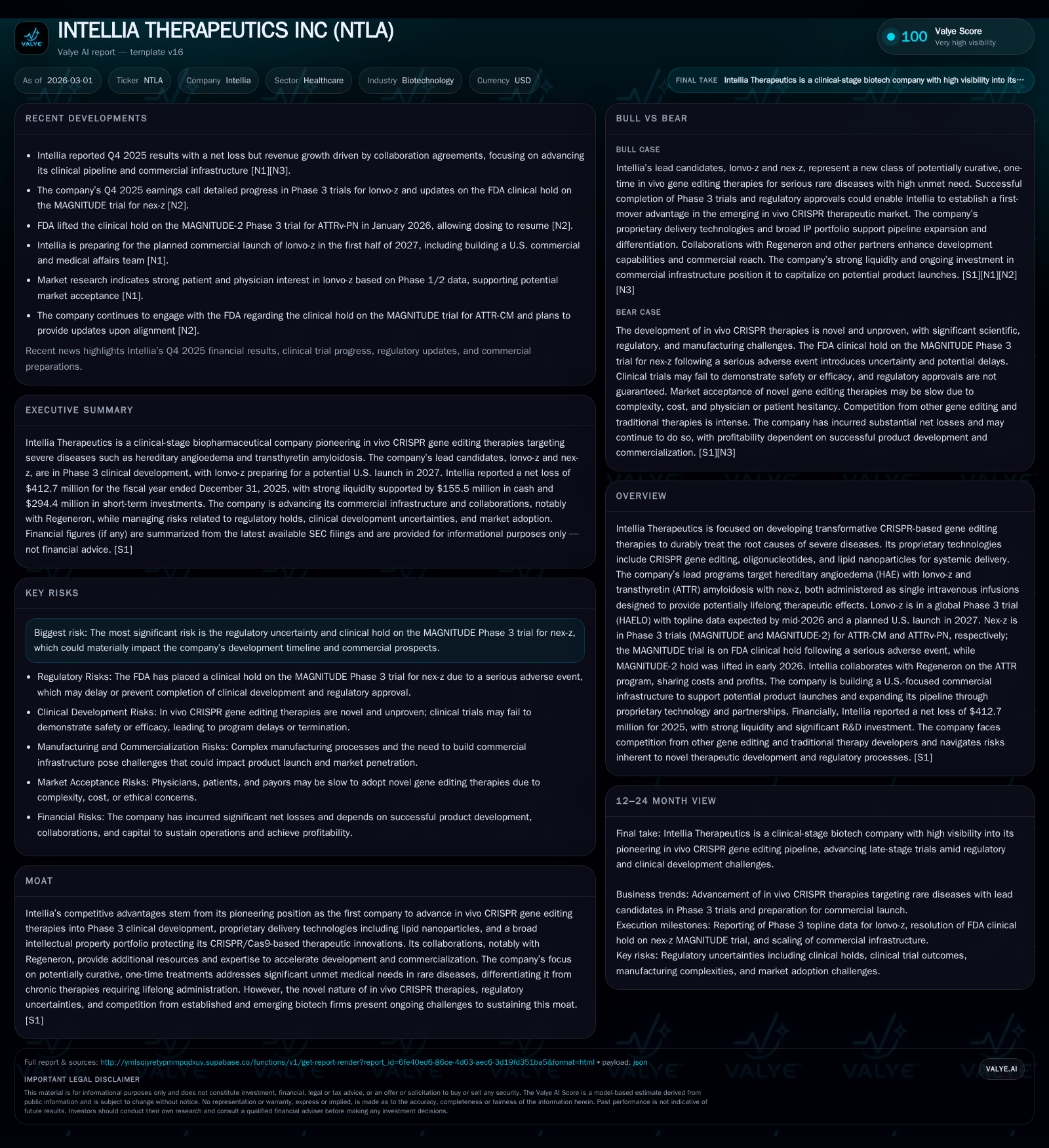
Intellia Therapeutics is pioneering in vivo CRISPR-based gene editing therapies, focusing on hereditary angioedema and ATTR amyloidosis. Its lead candidates, lonvo-z and nex-z, are in Phase 3 clinical development with a planned commercial launch of lonvo-z in early 2027. Financially, the company continues to incur operating losses but maintains a strong cash position supported by equity offerings. Clinical holds and regulatory scrutiny represent significant risks that could affect timelines and commercialization prospects.
Company Background and Business Model
Intellia Therapeutics stands at the forefront of biopharmaceutical innovation by developing potentially curative gene editing therapies using CRISPR technology. The company’s approach focuses on in vivo administration of systemically delivered CRISPR/Cas9-based therapeutics via proprietary lipid nanoparticles (LNPs), enabling treatment of genetic rare diseases through a single intravenous infusion. This strategy contrasts with chronic treatment paradigms by targeting the root cause of disease for durable effects [S1].
Their current pipeline centers on two lead candidates: lonvoguran ziclumeran (lonvo-z) for hereditary angioedema (HAE) and nexiguran ziclumeran (nex-z) for transthyretin (ATTR) amyloidosis — both poised to transform patient care pending regulatory approvals [S1].
Collaboration agreements, notably with Regeneron Pharmaceuticals, back Intellia’s financial resources and research development efforts [S1]. These collaborations provide milestone payments, research funding, and technology licensing revenue streams essential as product commercialization remains pending.
Historical Financial Performance
Operating losses have been significant but show signs of improvement. Between fiscal years 2022 through 2025, operating income remained negative with a notable decrease in loss magnitude from $534 million in 2024 to about $441 million in 2025 — an improvement reflecting lowered R&D spending as well as efficiency gains [F1][S8]. Net income followed a similar trend improving from -$519 million to -$413 million over the same period.
Research & Development expenses declined by approximately 17% year-over-year through prioritizing resource allocation to key late-stage programs such as lonvo-z and nex-z, along with scaling down discontinued or less prioritized candidates including NTLA-3001 [S8]. General and Administrative costs also fell moderately during this period despite incremental investments into building commercial infrastructure ahead of anticipated launches [S8].
Capital expenditures decreased sharply to $1.1 million in 2025 from $5.8 million the prior year, signaling stable asset base needs as the firm prepares for potential commercialization phases [F1].
Liquidity remains robust with approximately $155 million in cash and cash equivalents supplemented by marketable securities totaling over $450 million as of year-end 2025 — providing funding runway into the second half of 2027 under current expenditure projections [S6][F1][S19].
Historical performance (annual)
| FY | Net ($mm) | CFO ($mm) | OpInc ($mm) | Capex ($mm) | Net YoY |
|---|---|---|---|---|---|
| 2025 | -413 | -395 | -441 | 1 | +20.5% |
| 2024 | -519 | -349 | -534 | 6 | -7.9% |
| 2023 | -481 | -394 | -515 | 14 | -1.5% |
| 2022 | -474 | -333 | -458 | 14 |
Source: SEC companyfacts cache [F1].
Capital returns and efficiency (annual)
| FY | FCF ($mm) | ROE% |
|---|---|---|
| 2025 | -396 | -61.5 |
| 2024 | -355 | -59.5 |
| 2023 | -408 | -45.8 |
| 2022 | -347 | -38.4 |
Source: SEC companyfacts cache [F1].
Note: Revenue is primarily derived from collaboration agreements; no product sales revenue currently reported.
Future Growth Prospects
Lead Programs Pipeline Advancement
Lonvo-z is in a global Phase 3 trial named HAELO for hereditary angioedema, with topline results expected mid-2026. Success here would allow Intellia to seek regulatory approval imminently ahead of planned U.S. market launch slated for first half of 2027 [N12][N13][S1]. This program represents a high-value opportunity given its potential life-long therapeutic benefit administered as a one-time IV infusion.
The second major asset, nex-z targeting ATTR amyloidosis, has encountered regulatory setbacks; the MAGNITUDE Phase 3 trial was placed on clinical hold following a serious adverse event reported by FDA, while the related MAGNITUDE-2 trial was reactivated early in 2026 after resolving concerns [S2][N12]. The outcome of these trials will be critical indicators for overall clinical viability.
Expansion Beyond Lead Products
Intellia continues research into next-generation CRISPR therapeutics using its proprietary delivery platforms including oligonucleotides and advanced LNP formulations targeting systemic diseases beyond HAE and ATTR amyloidosis [S1]. Partnerships like those with Regeneron underpin ongoing preclinical programs that could broaden commercial opportunities if clinical translation proceeds favorably.
Risks Limiting Growth:
- Regulatory uncertainty remains pronounced due to the evolving nature of in vivo genome editing therapy oversight.
- Potential delays or adverse events could defer or diminish commercial timing for lead products.
- Patent litigations around core bi-directional insertion templates add legal risk [S16][S18].
- High cash burn rate persists until product revenues materialize.
Key Forecasts / Milestones to Track
- HAELO Phase 3 trial topline data release for lonvo-z expected mid-2026.
- NDA submissions anticipated following positive Phase 3 results to pursue U.S., EU, and global approvals.
- Resolution status updates on FDA clinical hold regarding MAGNITUDE trial for nex-z are critical near-term catalysts.
- Expansion or additional licensing deals could emerge as pipeline broadens.
- Commercial infrastructure buildout milestones coinciding with anticipated launch windows.
Numeric guidance has not been provided beyond these milestones [S1][N2][N3]. Monitoring progress against regulatory feedback cycles will be particularly consequential.
Capital Allocation and Returns Analysis
Intellia’s financial strategy prioritizes capital preservation alongside investment into high-potential clinical assets:
- No dividends or share repurchases have been declared or executed given continued developmental stage status [F1].
- Operating cash flow recorded negative $395 million in fiscal year 2025 reflecting intensive R&D outlays without commercial revenues yet [F1].
- Capital expenditures are minimal relative to operating expenses consistent with biotech norms emphasizing trial spend over fixed asset investment [F1].
- Equity financing via at-the-market offerings remains primary capital source supplemented by collaboration milestone payments; approximately $128 million net proceeds raised through ATM offerings during 2025 [S6].
- The approximate ROE based on net losses expressed against shareholders’ equity stood near negative 61.5%, reflective of early stage biotech investment profiles where profitability realization remains distant [F1].
Long-term capital discipline will be required especially given contingent patent litigation costs and clinical development uncertainties [S16][S18]. As commercial launch approaches preparation expenses are expected to rise impacting margins before eventual revenue ramp-up.
Intellectual Property and Legal Environment
Protecting their innovative CRISPR platform remains critical for Intellia’s moat:
- Extensive patent estate covers CRISPR/Cas9 therapeutic innovations including proprietary lipid nanoparticle delivery mechanisms enhancing systemic editing efficacy.
- Ongoing litigation from BlueAllele Corp alleging infringement of bi-directional insertion template patents poses uncertain financial exposure pending court rulings [S16][S18].
- Stockholder derivative lawsuits regarding corporate governance matters further complicate risk profile but have not yet yielded material liabilities [S16][S18].
These legal dynamics underscore challenges faced by cutting-edge biotech developers where IP defense becomes integral part of strategic positioning.
Disclaimer: This is research-only, informational analysis and not investment advice. It may include AI-generated interpretation and general industry context. Always verify important details using primary sources.

Comments