
Nuvation Bio’s Commercial Launch Performance and Pipeline Catalysts for 2026
A transition from a research-focused biotech to early commercial stage, Nuvation Bio advances IBTROZI sales and broadens its oncology pipeline under CEO David Hung’s leadership.
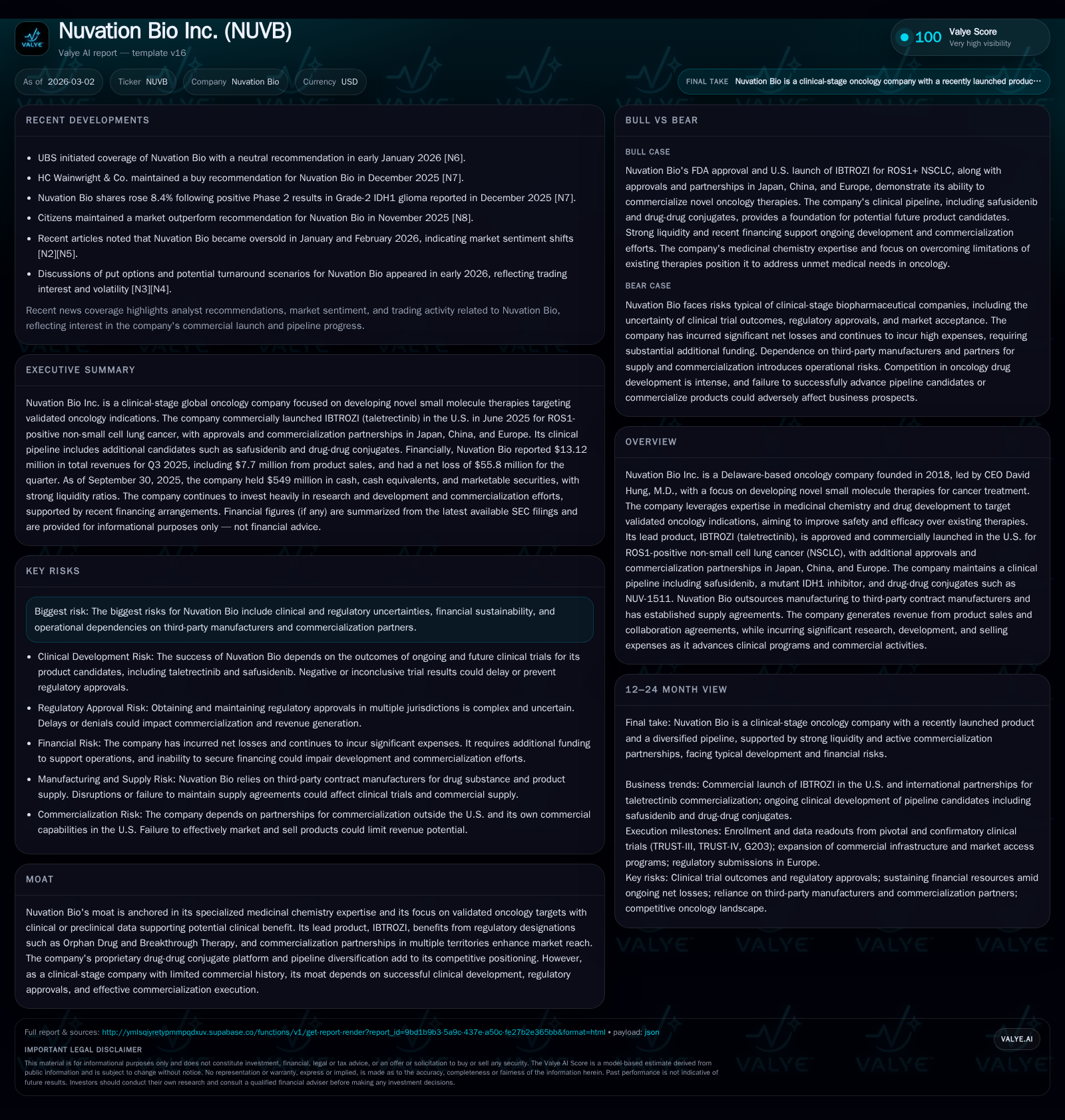
Nuvation Bio marked a pivotal juncture in 2025 with the FDA approval and commercialization launch of IBTROZI for ROS1-positive NSCLC, generating $62.9 million in U.S. revenues in its first approved year. Despite ongoing operating losses, the company has significantly narrowed its expenses year-over-year while maintaining strong liquidity supported by royalty interest financing and secured debt. Parallelly, Nuvation’s clinical pipeline expands with programs like the TRUST series for taletrectinib extensions and novel candidates including safusidenib and the drug-drug conjugate NUV-1511, underpinning longer-term growth potential amid regulatory and market execution risks.
Evolution from R&D Heavy to Commercial Stage: A Look Back at Nuvation Bio’s Growth Trajectory
Nuvation Bio’s trajectory reflects the typical profile of an oncology-focused biotech maturing from discovery through late-stage development into initial commercialization. Founded in 2018 by David Hung, M.D., a biotech veteran known for spearheading Medivation’s blockbuster oncology drugs, Nuvation operated as a clinical-stage company incurring steep losses as it built preclinical pipelines and advanced taletrectinib (marketed as IBTROZI) toward regulatory approval.
A financial summary reveals this shift vividly [F1]: revenues before 2025 were negligible, stemming primarily from milestone payments, licensing fees, and collaboration arrangements. The transformational event was FDA approval of IBTROZI in June 2025 for ROS1-positive NSCLC — triggering the company’s first product sales.
Historical performance (annual)
| FY | Net ($mm) | CFO ($mm) | OpInc ($mm) | Net YoY |
|---|---|---|---|---|
| 2025 | -205 | -173 | -213 | +64.0% |
| 2024 | -568 | -130 | -593 | -649.2% |
| 2023 | -76 | -68 | -100 | +27.3% |
| 2022 | -104 | -96 | -120 |
Source: SEC companyfacts cache [F1].
Capital returns and efficiency (annual)
| FY | ROE% |
|---|---|
| 2025 | -66.9 |
| 2024 | -122.5 |
| 2023 | -12.5 |
| 2022 | -15.9 |
Source: SEC companyfacts cache [F1].
The operating loss improvement of approximately 64% year-over-year between 2024 and 2025 reflects increasing revenue from IBTROZI coupled with efficiency gains as commercialization scaled up. Still, net losses remain sizable, indicating that profitability lies further out pending broader uptake and pipeline maturation.
Operating cash flow remained negative at $173.4 million by end of FY2025 despite revenue inception — typical for a biotech balancing early sales ramp against ongoing R&D investments.
Commercializing IBTROZI: United States Launch and Global Partnerships Driving Early Revenues
The FDA granted approval to taletrectinib (IBTROZI) on June 11, 2025 specifically for adult patients with locally advanced or metastatic ROS1-positive non-small cell lung cancer (NSCLC), marking a critical inflection point [S2][S1]. This approval came with orphan drug designation and previous breakthrough therapy designations that signaled expedited review pathways based on unmet medical need.
Nuvation initiated U.S. commercialization immediately post-approval leveraging internal capabilities augmented by outsourced manufacturing contracts essential for drug supply continuity [S2]. The impact on top-line is concrete with first full-year U.S revenues amounting to $62.9 million [F1]. However, this commercial launch faces headwinds common in oncology small molecule markets:
- Physician reluctance persists without long-term safety/efficacy data despite promising initial trial outcomes.
- Precise patient identification remains critical; ROS1+ NSCLC is rare, demanding sophisticated diagnostic testing often more accessible within academic rather than community healthcare settings.
- Reimbursement dynamics create variability; payer coverage determinations influence real-world access urgently needing navigation.
- Supply chain reliance on third-party contract manufacturers requires robust quality assurance practices to avoid shortages or delays impacting market penetration.
Internationally, distribution partnerships support regional reach: Nippon Kayaku handles Japan under brand IBTROZI while Innovent markets in China as DOVBLERON® [S2]. European approvals exist but broader commercialization progress awaits further regulatory milestones.
Despite a promising early revenue ramp, reliance remains heavily concentrated on IBTROZI's commercial success—failure to expand indications or new geographies would cap near-term sales growth unexpectedly.
Pipeline Ambitions: Advancing Taletrectinib and Novel Oncology Candidates Beyond ROS1+ NSCLC
Nuvation’s core strategic strength lies in its medicinal chemistry expertise focusing on validated oncology targets supported by clinical/preclinical evidence [S2]. Taletrectinib itself advances beyond initial NSCLC indication through multiple ongoing pivotal studies:
- TRUST-I/II: Single-arm Phase 2 pivotal studies focused on advanced ROS1+ NSCLC patients including broader geographies such as China.
- TRUST-III: A confirmatory randomized Phase 3 comparing taletrectinib versus crizotinib in China aiming at demonstrating superiority or non-inferiority.
- TRUST-IV: A global randomized placebo-controlled Phase 3 study evaluating adjuvant use post-surgical resection of early-stage disease—a critical extension potentially expanding patient population.
Pipeline diversification features complementary candidates:
Safusidenib is an oral potent mutant IDH1 inhibitor distinguished by brain penetration properties under evaluation in global Phase 2/3 studies targeting high-grade IDH1-mutant glioma [S2]. Its advancement signals Nuvation's push into precision oncology beyond lung cancer.
NUV-1511 represents the company’s inaugural drug-drug conjugate (DDC), integrating a targeting agent linked to a standard chemotherapy payload — a modality gaining traction across oncology for enhancing therapeutic index via targeted delivery.
This multi-product approach buffers reliance on IBTROZI sales alone while addressing broader oncology segments with high unmet needs.
Financial Overview: Narrowing Losses Amid Sustained Cash Burn and Strong Liquidity
Financial discipline parallels scientific advancement but capital consumption remains significant given the dual demands of late-stage trials plus commercialization build-out [F1][S6][S7]. Important metrics include:
- Operating income improved sharply from a negative $592.6 million in FY24 to negative $213.1 million in FY25 — still substantial losses but showing progress driven largely by revenue offsetting fixed costs.
- Operating cash flow was negative $173.4 million for FY25 compared with negative $130.4 million prior year — an increase reflecting ramping commercial spend alongside continual clinical development investment.
- Cash & equivalents stood robust at approximately $164 million end-FY25 providing runway coverage into at least mid-to-late 2026 when balanced against current spending levels.
- Current assets totaled about $571 million versus liabilities near $82 million yielding an enviable current ratio near seven times [F1], indicative of sound short-term solvency enabled by equity funding rounds plus non-dilutive debt financings.
Managing ongoing cash burn without dilution or debt distress while expanding revenues meaningfully through successful pipeline milestones and commercial uptake will be key challenges ahead.
Capital Structure and Allocation: Royalty Financing and Debt Support Commercialization Without Shareholder Returns
Nuvation structured capital infusion strategically around two key arrangements finalized March–June 2025 [S10][S12][F1]:
- The Royalty Interest Financing (RIF) Agreement provided $150 million upfront capital locked against future tiered royalties on U.S. net sales of IBTROZI capped cumulatively between 1.6x to 2x the invested amount depending on timing/treatment success; royalties range from ~5.5% up to $600 million annual sales then tapering to lower rates above that threshold [S12]. This synthetic royalty financing is non-dilutive yet encumbers revenue streams reducing net cash flow available but supports launch funding without stock issuance dilution.
- A senior secured term loan of up to $100 million split into tranches carries SOFR-based interest plus margin totaling at least ~10% cost annually; principal amortization is deferred until maturity enabling focus on commercialization cash flow generation before debt servicing burden escalates [S11][S7].
No dividends or share repurchases have been declared or planned given reinvestment priority for pipeline development plus commercial scale-up efforts [F1][S6]. Capital expenditures focus mainly on clinical trial infrastructure expansion along with commercial production capability enhancement rather than asset-heavy investments [S10].
Overall capital allocation balances near-term product launch needs with sustaining innovation capacity through pipeline progression—the twin engines driving valuation creation over next several years.
Regulatory Environment and Market Risks: Navigating Compliance and Competition Challenges
The regulatory environment offers expedited pathways such as Orphan Drug Designations and Breakthrough Therapy status but also imposes stringent compliance demands that could affect label scope or marketability if unforeseen adverse events emerge during ongoing studies or post-marketing surveillance [S4][S18].
Other risks include:
- Uncertainty around reimbursement policies impacting pricing negotiations especially under government programs like Medicare/Medicaid plus private insurers restricting access through formulary exclusions or prior authorization requirements [S5].
- Supply chain vulnerabilities due to reliance on third-party manufacturers whose performance directly influences product availability—any disruption could curtail revenue generation at critical growth phases.
- Intensifying competition from branded small molecules as well as biosimilars/generics facilitated by evolving European Union legislation truncating exclusivity periods potentially shortening commercial windows [S14].
- Legal exposure stemming from compliance with complex fraud-and-abuse statutes governing pharmaceutical marketing practices across jurisdictions—including transparency laws requiring reporting payments/incentives provided to prescribers or healthcare professionals raising reputational risks if mismanaged [S19][S20].
Effective management of these interrelated risks will determine how well Nuvation consolidates recent market entry advantages while preparing for broader competitive pressures ahead.
Outlook: Key Milestones To Watch Into 2026
While explicit management guidance remains limited publicly [N2], several near-to-medium term indicators warrant close observation:
- Enrollment progress and outcome readouts from key clinical programs—TRUST-II/III phase studies assessing taletrectinib’s comparative efficacy versus crizotinib particularly in China where sizable patient populations exist could broaden label claims materially if positive data emerge soonest.
- G203 study evolution as safusidenib transitions from Phase 2 randomized design into anticipated global Phase 3 setup after FDA alignment could validate next frontier indications outside lung cancer.
- Market uptake velocity domestically linked tightly to physician prescribing trends post-launch acceleration phases including payer reimbursement milestones will reveal real-world access dynamics vital for scaling sales beyond initial waves.
- Progression of regulatory filings/approvals internationally especially Japan & China partnerships’ execution alongside EU application developments may unlock incremental revenues diversifying geographic exposure beyond the U.S..
Complementarily monitoring operational metrics such as supply continuity reports, contract manufacturer performance benchmarks, and adverse event surveillance will provide timely flags concerning commercial sustainability prospects going forward.
This analysis integrates information sourced exclusively from verified SEC filings ([F1], [S#]) and reputable news outlets ([N#]), avoiding speculative projections or unauthorized forecasts.
Disclaimer: This is research-only, informational analysis and not investment advice. It may include AI-generated interpretation and general industry context. Always verify important details using primary sources.

Comments