
NWPX Infrastructure’s Earnings and Operational Shifts Reflect Sector Pressures
NWPX Infrastructure maneuvers through competitive pricing and public spending fluctuations with a diversified product base and disciplined capital allocation.
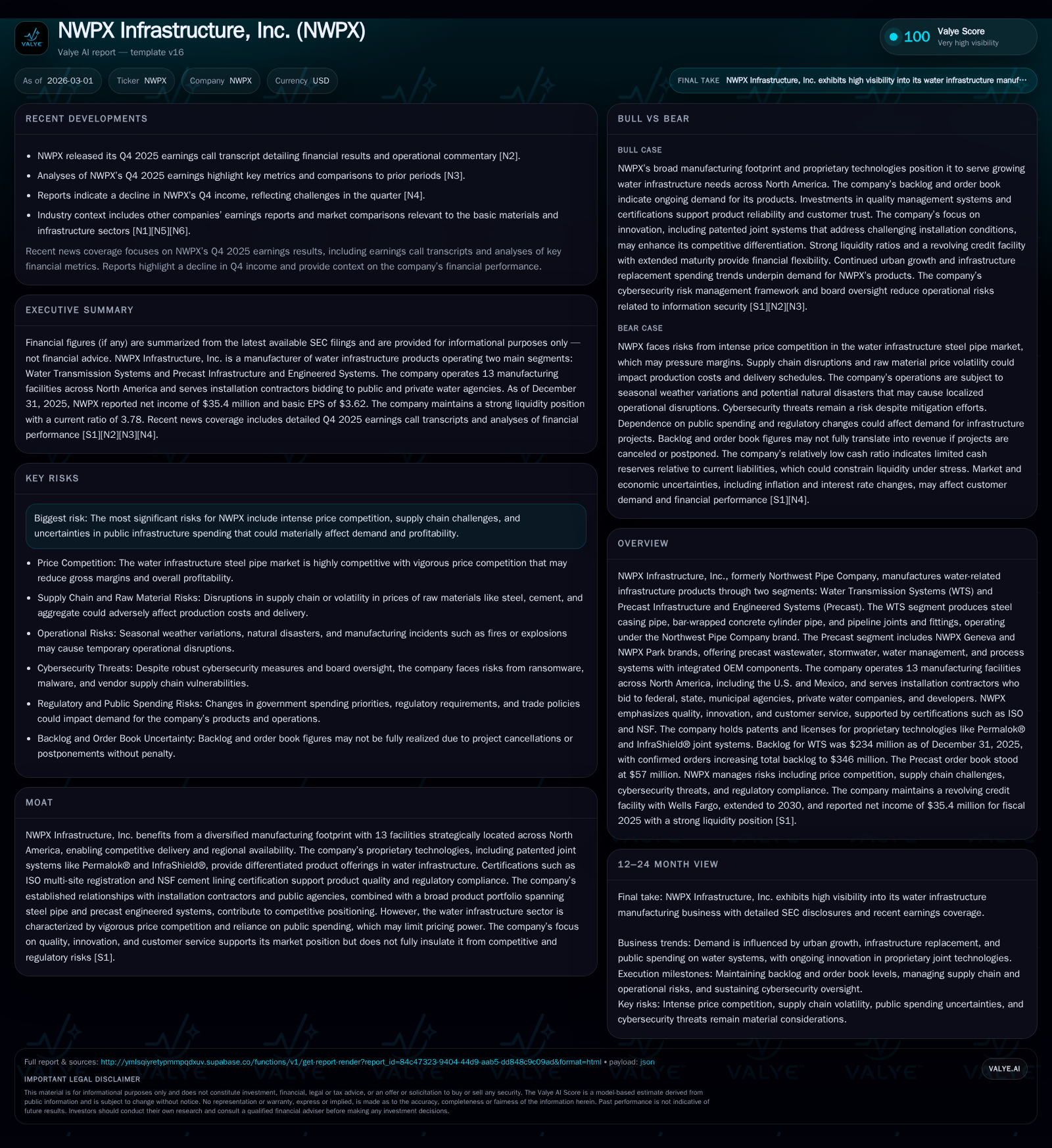
NWPX Infrastructure, Inc., a manufacturer of water infrastructure products through its Water Transmission Systems and Precast Infrastructure segments, reported a 9.1% revenue decline in FY2025 alongside moderate increases in operating income and net income. The company leverages patented joining technologies and a geographically dispersed manufacturing footprint to sustain competitive advantage amid vigorous price competition and variable public infrastructure spending. With strong operating cash flows enabling a sizable share repurchase program, NWPX navigates sector headwinds while focusing on backlog growth and maintaining liquidity. Investors should monitor order book developments, margin trends, and capital allocation shifts for insight into near-term performance.
Financial Overview: Mixed Performance Amid Sector Challenges
NWPX Infrastructure’s FY2025 results reflect the pressures common in infrastructure manufacturing sectors sensitive to public spending cycles and competitive dynamics. Reported revenue decreased by approximately 9.1% year-over-year to $356.3 million [F1], signaling softness consistent with tightening municipal capital budgets particularly affecting the steel pipe business segment.
Despite this top-line contraction, operating income rose by 5.4% to $50.9 million, suggesting effective cost management and margin resilience [F1]. Net income increased modestly by 3.5% to $35.4 million, reinforcing stable profitability amid challenging market conditions [F1].
Historical performance (annual)
| FY | Net ($mm) | CFO ($mm) | OpInc ($mm) | Capex ($mm) | Net YoY |
|---|---|---|---|---|---|
| 2025 | 35 | 67 | 51 | 20 | +3.5% |
| 2024 | 34 | 55 | 48 | 21 | +62.3% |
| 2023 | 21 | 53 | 34 | 18 | -32.4% |
| 2022 | 31 | 18 | 45 | 23 |
Source: SEC companyfacts cache [F1].
Capital returns and efficiency (annual)
| FY | Buybacks ($mm) | FCF ($mm) | ROE% |
|---|---|---|---|
| 2025 | 18 | 47 | 9.0 |
| 2024 | 4 | 34 | 9.1 |
| 2023 | 1 | 35 | 6.2 |
| 2022 | -5 | 9.8 |
Source: SEC companyfacts cache [F1].
This historical snapshot highlights the cyclical nature of demand tied to governmental infrastructure investment cycles that influence project volumes and pricing power.
Business Segments: Product Innovation and Market Reach
NWPX operates two primary segments: Water Transmission Systems (WTS) and Precast Infrastructure & Engineered Systems (Precast). The WTS segment focuses on manufacturing large-diameter, high-pressure steel pipeline systems primarily for drinking water infrastructure across North America under the Northwest Pipe Company brand [S4]. Steel raw materials are sourced domestically and internationally from suppliers such as Steel Dynamics Inc., Nucor Corporation, SSAB, and United States Steel Corporation [S10].
A distinctive feature of WTS is its proprietary Permalok® press-fit interlocking joint system enabling flexible trenchless construction around existing utilities—a significant technological advantage for urban infrastructure projects [S11]. In early 2025, NWPX introduced the InfraShield® Joint System designed for seismic resilience without requiring changes during field installation, enhancing its product appeal in geologically challenging areas [S11].
The Precast segment manufactures engineered precast concrete products including reinforced concrete pipe (RCP), manholes, box culverts, vaults, pump lift stations, and water management systems primarily from facilities in Texas and Utah [S4]. These products integrate OEM components to reduce field assembly time—a competitive edge against regional manufacturers like Oldcastle Infrastructure and Harper Precast Concrete Company [S10].
Together these segments enable NWPX to serve diverse market needs ranging from high-pressure drinking water pipelines to modular precast solutions for wastewater and stormwater management.
Competitive Environment: Pricing Pressures and Market Positioning
The water infrastructure materials sector is characterized by vigorous competitive bidding where pricing responsiveness significantly influences contract awards—particularly within the steel pipe market dominated by public bids [S4]. Key competitors include West Coast Pipe in western U.S./Canada markets and Thompson Pipe Group along with American SpiralWeld Pipe east of the Rocky Mountains [S10].
High freight costs emphasize the strategic importance of NWPX’s seven manufacturing plants across North America—from Oregon to Mexico—which provide logistical advantages mitigating some delivery cost pressures [S4].
Price competition constrains gross margins; however, product differentiation through patented joint technologies like Permalok® combined with ISO multi-site registration certifications and NSF cement lining accreditation help mitigate commoditization risks by emphasizing quality standards critical for government contracts [S11,S21].
In the Precast segment, competition is mainly localized with firms such as Oldcastle Infrastructure or AmeriTex Pipe & Products LLC competing on product variety, engineering integration capabilities, delivery reliability, and pricing within state-specific markets driven by localized bidding processes [S10,S16].
Raw material input costs remain volatile due to fluctuations in steel coil prices influenced by macroeconomic factors including tariffs and energy costs beyond company control [S10]. This volatility underscores the importance of adaptable cost structures.
Backlog and Demand Outlook: Sustained Visibility Amid Uncertainties
As of December 31, 2025, NWPX reported backlog for signed contracts within its WTS segment at approximately $234 million—up from $213 million at year-end 2024—indicating sustained near-term demand visibility though subject to typical cancellation provisions inherent in public projects contracts [S9]. Including confirmed orders without executed agreements expands this figure to about $346 million from $310 million previously.
Conversely, the precast order book showed a slight decrease from $61 million to $57 million over the same period—likely reflecting regional demand variability or timing shifts in procurement cycles [S9].
Public utility capital plans project nearly $200 billion investment over the next decade across wastewater and stormwater infrastructure—forming foundational demand drivers albeit subject to legislative appropriations uncertainties impacting project pipelines beyond short-term horizons [S9,N2].
Management commentary from Q4 earnings reflects cautious optimism about backlog health tempered by unpredictability surrounding federal/state budget approvals affecting project commencements ([N2]).
Capital Allocation: Share Repurchases Complement Stable Investment
Capital deployment balances shareholder returns with sustaining operational capabilities through targeted reinvestment.
In late 2025, NWPX authorized an incremental stock repurchase program up to $10 million complementing an existing plan totaling $30 million initiated in late 2023 ([S5]). Buybacks escalated notably from under $1 million executed in FY2023 to approximately $18.4 million deployed by end-2025 demonstrating a focus on returning capital opportunistically within liquidity constraints while maintaining compliance with credit facility covenants managed with Wells Fargo Bank ([F1,S17,S19]).
Capital expenditures remained steady near $20 million aimed at maintaining production capacity enhancements focused on dry utility platforms as well as quality control automation initiatives across both segments ([F1],[S11]). No regular dividends were disclosed; buybacks appear as the primary vehicle for direct capital returns currently.
Financial Health: Strong Cash Flow Generation Supports Flexibility
Operating cash flow grew over +22% year-over-year to approximately $67.3 million in FY2025 benefiting from working capital improvements alongside earnings growth ([F1]). Free cash flow after capex approximated $47.1 million underscoring robust internal liquidity supporting buybacks without reliance on additional debt financing ([F1,S6,S13]).
Balance sheet strength is evidenced by equity rising toward $395 million enhancing leverage capacity if needed ([F1,S15]). Working capital metrics remain solid with a current ratio near 3.8x derived from current assets around $251 million against current liabilities near $66 million despite relatively low nominal cash balances (~$2.3 million)—suggesting efficient treasury management rather than constrained liquidity ([F1,S6]).
Financial flexibility is further supported by an amended revolving credit agreement extended through August 2030 providing ample borrowing capacity ($125 million facility plus optional increases) with prudent covenant adherence ([S17]).
Operational Risks: Supply Chain Volatility and Cybersecurity Oversight
Key operational risks identified include supply chain disruptions impacting raw material availability—particularly hot rolled steel coil—and potential production delays or cost escalation risks given global sourcing dependencies ([S20]). Geographic diversification of manufacturing mitigates some localized disruption risk but broader inflationary pressures remain challenges.
Cybersecurity forms an integral part of enterprise risk management overseen directly by the Vice President of Information Technology reporting into the CFO—a governance arrangement highlighting priority placed on safeguarding operational technology assets against ransomware or malware threats common within industrial sectors ([S1]). External penetration testing complements internal intrusion detection/prevention strategies alongside continuous employee training aimed at reducing human factor vulnerabilities demonstrating mature cyber resilience practices ([S20]).
Additional risks arise from intense price competition noted earlier that may compress margins especially if new competitors expand capacity regionally affecting market share stability ([S10,S24]).
Investor Considerations: Monitoring Backlog Quality and Capital Deployment Trends
Investors should closely monitor backlog trends differentiating between confirmed contracts versus binding agreements offering insight into actual revenue realization versus tentative pipeline prospects ([N2],[S9]). Margin dynamics warrant attention given ongoing pressure from competitive bidding environments reported during earnings calls ([N3]).
Capital allocation patterns provide signals on management confidence regarding free cash flow sustainability amid sector headwinds—further buyback activity offsetting capex outlays would indicate positive outlooks ([S28],[F1]). Federal infrastructure appropriations developments also remain critical given their influence over public project funding cycles underpinning WTS volume stability.
Technological differentiation through expanded adoption of InfraShield® seismic joint technology could preserve competitive advantage though remains subject to overall project volume trends.
This report is prepared solely for informational purposes reflecting disclosures available as of early March 2026 without provision for investment advice or recommendations.
Disclaimer: This is research-only, informational analysis and not investment advice. It may include AI-generated interpretation and general industry context. Always verify important details using primary sources.

Comments