
Ouster's Digital Lidar Growth Fueled by Innovation Amid Persistent Losses and Supply Chain Risks
Ouster drives sensor adoption across industrial, automotive, robotics, and infrastructure markets while managing significant net losses and manufacturing challenges.
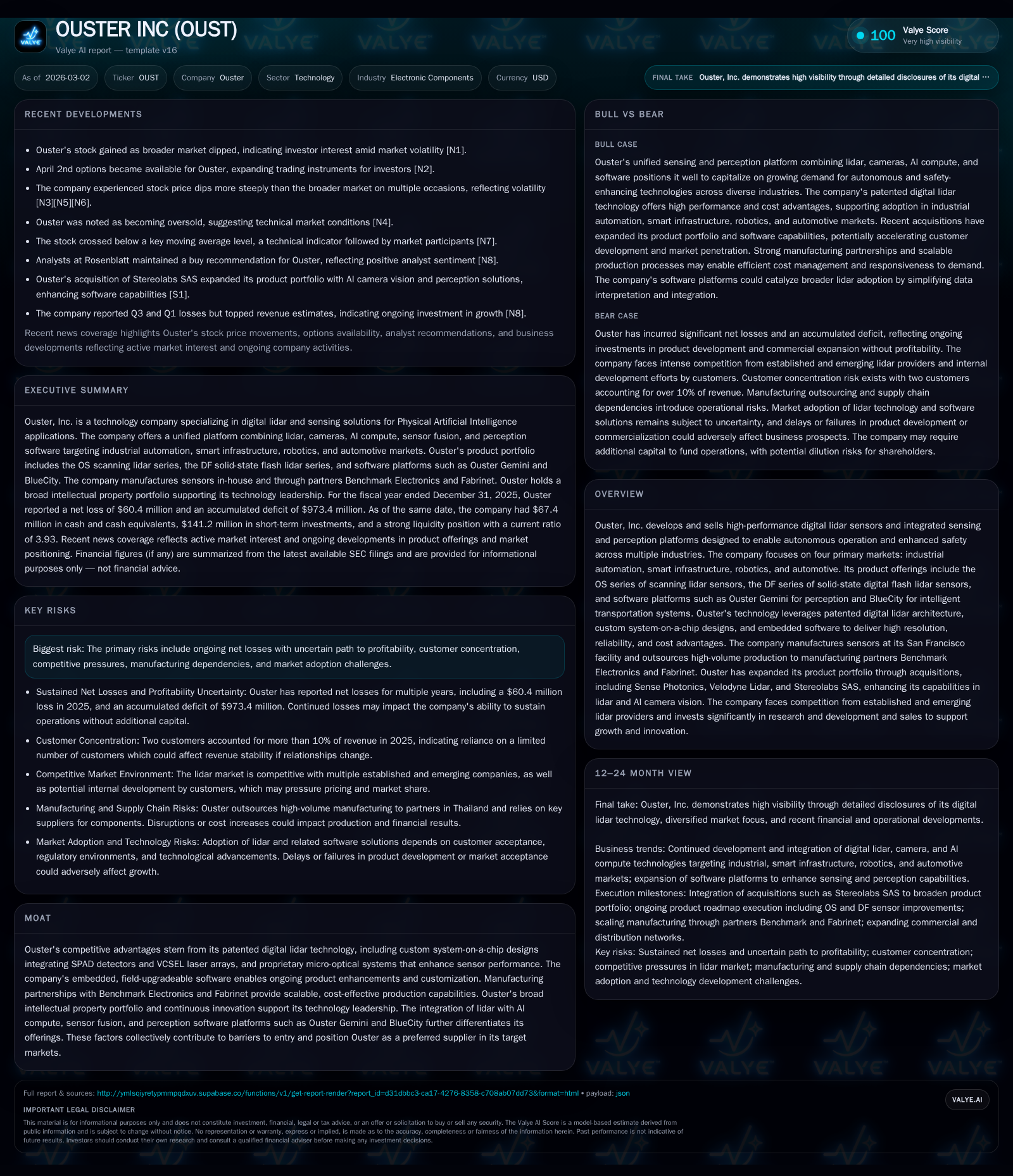
Ouster Inc., a pioneer in digital lidar technology, has steadily improved operational efficiency and broadened its product portfolio through acquisitions and innovation. Despite recurring net losses and negative cash flow, the company leverages patented architecture, scalable manufacturing partnerships, and growing software capabilities to penetrate four key markets. Ongoing risks include supply chain dependencies, geopolitical tariff impacts, and regulatory complexities surrounding AI-enabled products. Future growth hinges on ramping volumes with existing customers, solidifying OEM partnerships for solid-state sensors, and scaling distribution channels.
Company Overview
Ouster Inc. operates at the forefront of the physical artificial intelligence (Physical AI) movement, providing high-resolution digital lidar sensors alongside integrated sensing and perception platforms. Founded by lidar pioneers Angus Pacala and Mark Frichtl, the company's patented digital lidar technology replaces traditional analog systems with a unique combination of custom system-on-a-chip (SoC) designs integrating SPAD (single-photon avalanche diode) detectors with vertical-cavity surface-emitting laser (VCSEL) arrays. This technology enables Ouster to deliver sensors characterized by reliability, precision, cost-efficiency, and scalability.
The firm's product lineup includes its OS scanning lidar series tailored for broad applications, the DF solid-state flash lidar sensors aimed at high-volume automotive original equipment manufacturers (OEMs), and complementary software solutions like Ouster Gemini for general perception tasks and BlueCity targeting intelligent transportation systems [S4][S13].
Historical Financial Performance
Since inception in 2015, Ouster has pursued growth through technological leadership but has incurred consistent net losses annually. The years ending December 31 show a trajectory of improvement yet persistent unprofitability [F1]:
Historical performance (annual)
| FY | Net ($mm) | CFO ($mm) | OpInc ($mm) | Capex ($mm) | Net YoY |
|---|---|---|---|---|---|
| 2025 | -60 | -40 | -74 | 25 | +37.8% |
| 2024 | -97 | -34 | -104 | 4 | +74.1% |
| 2023 | -374 | -138 | -373 | 3 | -170.0% |
| 2022 | -139 | -111 | -145 | 5 |
Source: SEC companyfacts cache [F1].
Capital returns and efficiency (annual)
| FY | Buybacks ($) | FCF ($mm) | ROE% |
|---|---|---|---|
| 2025 | -65 | -23.1 | |
| 2024 | -37 | -53.6 | |
| 2023 | 0 | -141 | -208.2 |
| 2022 | 45000 | -116 | -80.7 |
Source: SEC companyfacts cache [F1].
Note: OpInc = Operating Income; CFO = Operating Cash Flow; Capex = Capital Expenditures; YoY = Year-over-Year change.
Despite improvements in reducing losses by roughly one-third year-over-year from 2024 to 2025, operating income remains significantly negative at nearly $74 million in losses for FY2025 [F1]. Net loss margins have shrunk but still represent substantial cash burn.
Operating cash flow also remains deep in negative territory, declining further to approximately negative $40 million with capital expenditures surging more than sixfold compared to prior year due largely to investments in production scale-up [F1]. This suggests aggressive reinvestment toward capacity expansion even as core operations do not generate positive cash flow.
Equity grew by about $80 million from FY2024 to FY2025 reflecting capital raises or retained earnings influences supporting the company’s balance sheet strengthening during its growth phase [F1]. Importantly though, return on equity remains negative (~-23%) underscoring ongoing losses relative to invested capital.
Business Model & Products
Ouster’s strategic vision anchors on Physical AI — machines that sense, think, act and learn autonomously — positioning its products as critical enablers of autonomy across diverse sectors [S4][S13].
Primary Markets:
- Industrial Automation: Automated guided vehicles (AGVs), autonomous mobile robots (AMRs), off-highway mining/farming vehicles leveraging lidar for safety and operational efficiency.
- Smart Infrastructure: Public safety applications including smart city deployments augmenting video surveillance with spatial tracking capabilities.
- Robotics: Advanced sensing facilitating robots performing complex or hazardous tasks beyond human capabilities.
- Automotive: ADAS features driven partially by lidar integration aimed at both consumer vehicles and autonomous freight applications.
Technology & Manufacturing:
The company’s digital lidar sensors embody several competitive advantages: patented micro-optical systems offering an equivalent performance leap akin to orders-of-magnitude higher detector efficiency; embedded field-upgradeable software enabling feature enhancements post-sale; a shared hardware architecture simplifying scaling costs; plus proprietary SoCs that consolidate components dramatically [S6][S13][S23].
Sensors are manufactured partly at Ouster’s San Francisco facility—focused especially on new product introductions compliant with Buy America standards—and partly outsourced to partners Benchmark Electronics and Fabrinet whose major assembly operations reside primarily in Thailand [S6][S12]. This hybrid manufacturing approach provides flexibility but introduces geopolitical tariff risks especially given recent U.S.-imposed tariffs affecting imports from Thailand alongside retaliatory global trade tensions [S2][S7].
Product Roadmap:
- Continued improvement of OS series scanning lidar via semiconductor upgrades projected to increase range/resolution without major form factor changes [S24].
- Scaling production of DF solid-state flash lidar targeting high-volume OEM automotive use cases anticipated to unlock substantial order volume growth [S24].
- Expansion into camera vision solutions and AI compute through recent Stereolabs acquisition enhancing integrated perception platform capabilities [S4][N1].
- Software offerings like Ouster Gemini advancing data processing efficiencies intended to accelerate market adoption by lowering engineering barriers for customers historically dependent on alternative sensing modalities [S6][S24].
Market Position & Competitive Moat
Ouster’s moat lies primarily in its intellectual property portfolio encompassing core digital lidar patents dating back to the invention phase in 2015 combined with accumulated IP from acquisitions such as Sense and Velodyne merger-related assets [S23]. The integration of multiple technology layers—hardware SoCs integrating SPAD arrays coupled with laser VCSEL dies plus embedded software supporting sensor customization—creates formidable entry barriers.
Additionally, cost advantages arise from the simplified digital architecture which allows utilizing single manufacturing processes across sensor families reducing component complexity relative to analog competitors [S23]. This results not only in lower selling prices but also supports gross margins resilient enough despite aggressive pricing strategies.
However competitive pressures remain intense with established lidar players like Luminar Technologies, Innoviz Technologies, Aeva Inc., Hesai Technology among others vying aggressively for market share across overlapping segments [S8]. Moreover, some large potential customers maintain internal development programs increasing buyer power risks.
Software-wise Ouster competes partially against standalone perception platform vendors necessitating continued investment in AI algorithm robustness particularly given safety-critical use cases inherent in automotive/autonomy deployments [S19][S18].
Customer Base & Sales Channels
Ouster reports a large but somewhat concentrated client base: two customers accounted for over 10% of revenue during calendar year 2025 indicating moderate concentration risk minimizing single-customer dependency albeit highlighting need for ongoing diversification [S24][F1].
Sales operate via a hybrid approach emphasizing direct engagements augmented by an expanding international distributor network inherited from Velodyne merger activities enabling broader regional reach without proportionally adding fixed commercial overhead [S8][S11]. This model facilitates faster penetration into multiple geographies while adapting commercially to varied market dynamics.
Marketing efforts include participation at targeted industry events along with university sponsorships fostering early-stage technology awareness fundamental for opening new pipeline opportunities within the highly technical automation ecosystems [S8].
Capital Allocation & Returns
Despite growing revenues enabled by increased volumes from maturing customer programs (from bench evaluation toward mass deployment phases), Ouster remains loss-making with significant negative operating income each year since its founding [F1][S1].
Dividend payouts have been nonexistent reflecting typical profile of early-stage technology firms prioritizing reinvestment over shareholder distributions [F1]. Share repurchases similarly negligible or zero as focus remains on funding product development cycles and scaling manufacturing capacities.
Capex rose notably in FY2025 reaching just under $25 million compared to prior years’ range near $3–4 million illustrating intensified investment activity chiefly related to process improvements automation at partner facilities as well as expansion aligned with DF sensor commercialization goals [F1].[footnote: This jump aligns temporally with broader expansion initiatives discussed in SEC filings regarding scale readiness.]
Liquidity appears reasonable given current assets outnumber current liabilities nearly fourfold resulting in a strong working capital position (current ratio about 3.93x), which should sustain ongoing operations near-term barring unforeseen disruptions [F1][S14].
Free cash flow remains negative near $65 million reflecting ongoing operating cash burn surpassing capex outlays limiting financial flexibility without additional financing rounds or strategic partnerships.[F1]
Risks & Challenges
Profitability Uncertainty:
The company forecasts continued losses as it executes growth plans highlighting the inherent challenge transitioning from technology pioneer status toward sustainable commercial scaling without immediate profitability visibility [S1].
Supply Chain & Geopolitical Risks:
Heavy reliance on manufacturing partners based primarily in Thailand exposes Ouster to tariff escalations introduced by U.S./global trade policies which could impose cost inflation or operational delays if mitigation strategies prove insufficient [S2][S7]. Global economic volatility including inflationary pressures also adds complexity.
Competitive Pressure & Customer Concentration:
While possessing differentiated digital lidar IP assets is vital, competitors possess larger resources capable of rapid innovation or aggressive pricing potentially eroding shares especially where customers have internal capabilities.[S8] Dependence on few large customers likewise raises revenue volatility concerns if contracts lapse or shift away.
Regulatory & Legal:
Evolving regulatory frameworks governing AI usage as embedded in Ouster’s software platforms could require continuous compliance adjustments increasing operational expense burdens [S18]. Intellectual property infringement litigation common within this field could entail costly defense expenses or reputational harm impacting business continuity.[S15][S25]
Technology Deployment Risks:
AI-enabled perception software must reliably perform under variable environmental conditions; failure could lead to product liability claims seriously impacting brand trust especially given safety-critical application contexts.[S19]
Outlook & What To Watch For (Analysis)
Future growth will depend heavily on successfully moving customers through sequential phases—from bench testing of sensors toward pilot production increasing order volumes exponentially—particularly critical within automotive OEM segments targeting lucrative ADAS upgrade cycles supported by the DF solid-state sensor line expansion [S4][S6][S24]. Monitoring announcements regarding design wins or series production contracts at Tier-1 suppliers or OEMs will be key milestones.
Expansion of software adoption leveraging Ouster Gemini's ability to reduce integration complexity will be important alongside geographic distribution network growth accelerating adoption outside core direct sales territories.[S8] Further technology advances in chip-level innovations anticipated over next product generations could unlock enhanced sensing performance maintaining cost leadership which would provide competitive differentiation.[S24]
Conversely investors should remain alert to potential delays stemming from supply chain constraints linked to tariff developments or pandemic-like disruptions as well as adverse outcomes stemming from regulatory changes impacting global sales strategies.
Conclusion
Ouster represents an intriguing case study balancing cutting-edge innovation with the difficult transition toward commercial viability characteristic of deep-technology companies operating within rapidly evolving autonomy sectors. Its strong IP foundation coupled with scalable manufacturing partnerships positions it well strategically but persistent profitability challenges highlight execution risks requiring careful monitoring.
As the firm seeks broader market traction via ramped production volumes tied to solid-state sensor placements within automotive OEMs alongside diversified industrial applications bolstered by complementary software solutions, its ability to manage external risks including geopolitical trade tensions and regulatory compliance will critically influence long-term sustainability.
This analysis is based solely on publicly available information including SEC filings dated March 2, 2026 ([F1], [S#]) and recent news sources ([N#]). It is intended solely for informational purposes without providing any investment advice or recommendations.
Disclaimer: This is research-only, informational analysis and not investment advice. It may include AI-generated interpretation and general industry context. Always verify important details using primary sources.

Comments