
Payoneer Global Inc.’s Growth Trajectory and Capital Strategy in a Dynamic Payments Market
Payoneer’s robust revenue growth contrasts with narrowing profitability as it invests in product expansion and navigates regulatory and geographic concentration risks.
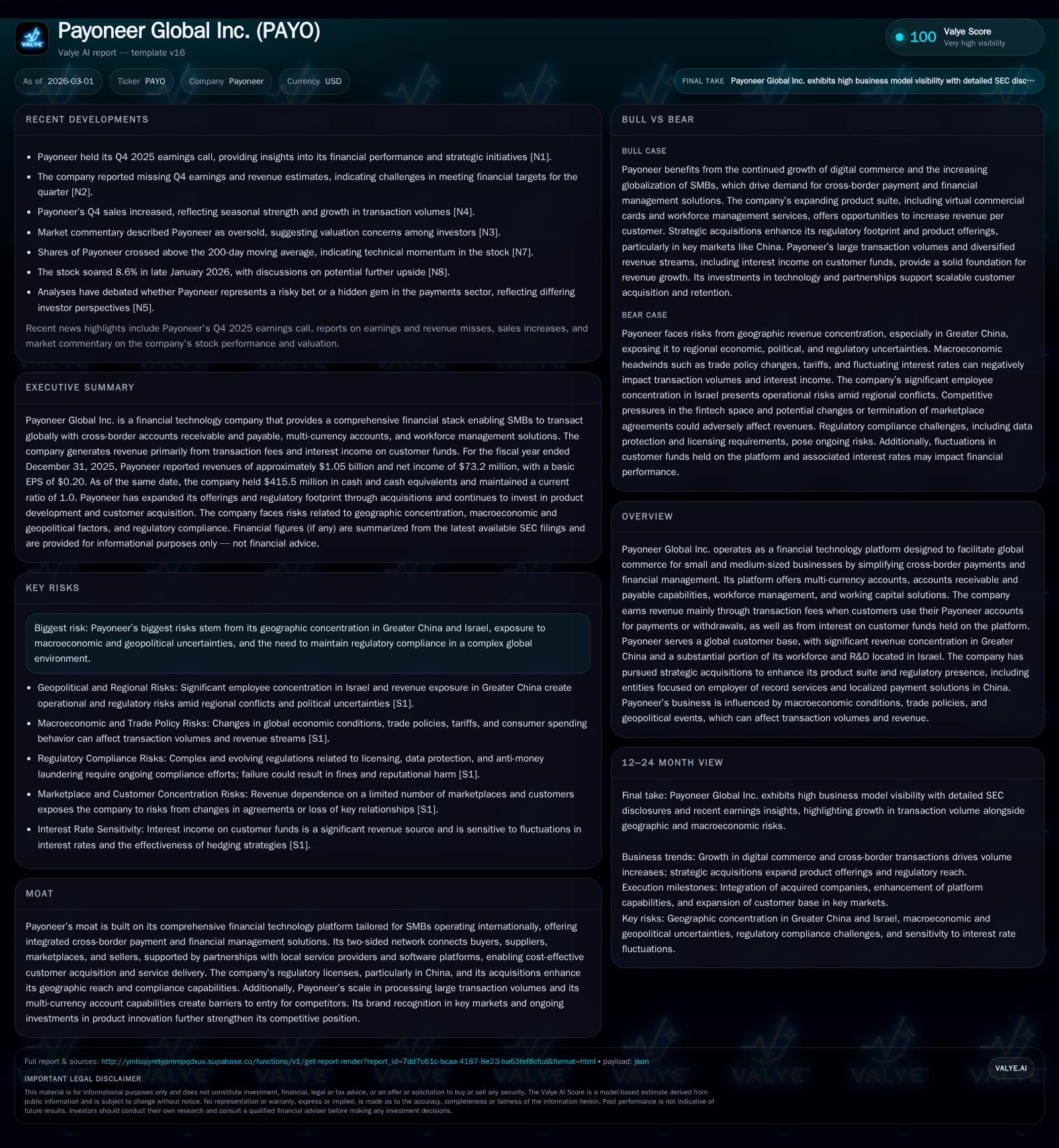
Payoneer Global Inc. has demonstrated consistent topline expansion driven by its fintech platform catering to SMB cross-border commerce, achieving approximately 7.7% revenue growth to $1.05 billion in 2025 [F1]. However, operating and net incomes declined due to significant R&D investments and integration costs, reflecting a strategic choice to prioritize platform innovation amid competitive pressures [F1][S8]. The company maintains a focused capital allocation approach, notably with sizable share repurchases supporting shareholder value, fueled by strong operating cash flows [F1][S4]. Its substantial business exposure in Greater China (~34% of revenue) and reliance on key marketplaces present ongoing concentration risks alongside regulatory compliance challenges across multiple jurisdictions [S5][S14]. Looking forward, Payoneer’s capacity to broaden its customer base, diversify geographically, and manage contract renewals will be critical indicators of sustainable growth amid evolving industry competition [N1][S6].
Unlocking Growth: Historical Financial Performance and Key Drivers
Payoneer Global Inc.'s financial trajectory through FY2025 underscores a narrative of solid topline momentum paired with rising strategic investment costs. Revenue reached approximately $1.05 billion in 2025, marking a 7.7% increase over the prior year fueled primarily by growing cross-border transaction volumes and interest income derived from escalating customer fund balances on the platform [F1][S6]. This dual revenue engine—transaction fees plus interest—exemplifies Payoneer’s hybrid fintech model that monetizes both payment flows and cash float.
However, beneath this topline growth lies pronounced pressure on profitability metrics. Operating income declined by roughly 16.3% to about $125 million despite expansion in sales volume, attributable chiefly to an aggressive ramp-up in capex and R&D expenses that soared by 228%, encompassing investments in new products as well as integration efforts following recent acquisitions such as PayEco [F1][S8]. Net income deteriorated more sharply by nearly 40%, highlighting additional margin compressions possibly linked to interest rate fluctuations and elevated compliance costs. Nevertheless, robust operational cash flow generation expanded by 32% to $233 million provides evidence of strong underlying business scalability in cash terms [F1].
Historical performance (annual)
| FY | Rev ($mm) | Net ($mm) | CFO ($mm) | OpInc ($mm) | Rev YoY | Net YoY |
|---|---|---|---|---|---|---|
| 2025 | 1053 | 73 | 233 | 125 | +7.7% | -39.6% |
| 2024 | 978 | 121 | 177 | 149 | +17.6% | +29.8% |
| 2023 | 831 | 93 | 159 | 104 | +32.4% | +879.7% |
| 2022 | 628 | -12 | 84 | -22 |
Source: SEC companyfacts cache [F1].
Capital returns and efficiency (annual)
| FY | Buybacks ($mm) | FCF ($mm) | ROE% |
|---|---|---|---|
| 2025 | 174 | 207 | 10.4 |
| 2024 | 138 | 169 | 16.7 |
| 2023 | 55 | 151 | 14.1 |
| 2022 | 73 | -2.2 |
Source: SEC companyfacts cache [F1].
Source: Payoneer Annual Reports and Company Facts Snapshot [F1]
Geographic and Customer Mix: Concentration Risks and Strategic Reach
The company's revenue concentration is notable both geographically and across key customers, introducing specific vulnerabilities into its profile. Approximately one-third (34%) of revenues are generated from customers based in Greater China, including mainland China, Hong Kong SAR, and Taiwan [S5][S12], creating exposure not only to regional economic cycles but also highly nuanced regulatory environments spearheaded by Chinese authorities such as the PBOC and SAFE following Payoneer's acquisition of PayEco's licensed entity in China during FY2025 [S14][S18]. This local license represents both a barrier to entry for competitors and a point of ongoing operational risk given shifting compliance requirements.
Additionally, about three-quarters (74%) of the company's cash balances are denominated in U.S. dollars held at major U.S.-based financial institutions layering currency risk amid fluctuating FX dynamics [S5][F1]. Customer concentration is illustrated through the fact that one individual marketplace accounted for roughly one-fifth (21%) of total revenues in FY2025; another marketplace held an approximate share of slightly above ten percent earlier years due to prior exclusivity arrangements [S5][S6]. Reliance on these marketplace partnerships supports efficient customer acquisition but also imposes risk of adverse contract renewals or termination forcing payoir-careful navigation of partnership diplomacy.
Banking partner dependencies exist as Payoneer issues Mastercard-branded cards through third-party issuing banks predominantly in the U.S., exposing operations to counterparty risk should licensing contracts be revoked or disrupted [S5]. This structure is common yet requires vigilant compliance given payment scheme rule adherence complexities inherent across global corridors.
Product Evolution and Market Position: From Payments to Comprehensive Financial Management
Payoneer's evolution beyond simple cross-border remittances into a broader fintech stack tailored for small- to medium-sized enterprises marks a definitional shift enhancing its competitive moat [S6][N5]. The platform delivers integrated multi-currency account functionality enabling clients to transact internationally as if locally domiciled; accounts receivable/payable solutions streamline invoicing logistics; workforce management addresses gig economy needs; working capital products inject liquidity into SMBs’ operations.
This comprehensive suite fosters stickiness through two-sided network effects connecting buyers with suppliers alongside marketplaces with sellers—a complexity not easily replicated without deep regulatory licenses coupled with proprietary technology infrastructure [N5].[ See further S27 for partnership integrations with accounting software vendors, banks ]. Strategic acquisitions have augmented localized regulatory coverage expanding the company's footprint particularly in challenging jurisdictions such as China where licensing is tightly controlled.
The complexity embedded within Payoneer’s integrated payment flows acts as both a customer value-add differentiator and a barrier against simplistic competitors focusing solely on payment transmission without deeper financial services layering.
Regulatory Landscape and Competitive Dynamics Affecting Expansion Paths
Operating across numerous markets exposes Payoneer to a web of evolving regulations mandating stringent compliance protocols around data privacy (GDPR/EU PIPL/CCPA), anti-money laundering (AML), anti-corruption laws including FCPA oversight, economic sanctions enforcement (OFAC), as well as payment scheme licensing adherence notably Mastercard rules governing card issuance activity [S14–15][S20–22]. Failure or lapses can trigger significant fines or operational restrictions materially impacting ongoing business continuity.
China stands out for its complex licensing model necessitating local entities licensed under PBOC auspices—a costly endeavor exacerbated by potential product alterations stemming from regulatory shifts [S14][S18]. Similarly, Israel-based R&D contributes intellectual capital but ties Payoneer into geopolitical risk spheres potentially impacting workforce distribution.
Competitive pressures are intense globally with incumbents ranging from multinational banks offering treasury services for larger clients through agile neobanks targeting SMBs to specialized B2B platforms like Bill.com[S21]. Price competition coupled with innovation races around AI-assisted compliance tools or blockchain-based settlement mechanisms intensify market entry barriers yet compress margins.
Marketplace exclusivity contracts embed some revenue stability but their finite terms require active negotiation management lest client churn dent topline predictability significantly.
Capital Allocation Framework: Cashflows, Buybacks, and Shareholder Returns
Reflecting a fintech firm focused on growth rather than steady dividend payouts typical of mature financial institutions, Payoneer emphasizes share repurchase programs—executing $174 million worth of buybacks during FY2025 representing a substantial increase over the prior year’s $138 million spend aimed at mitigating dilution from employee stock compensation programs while signaling confidence in intrinsic equity value appreciation potential [F1][S4].
The absence of declared dividends aligns with common industry practice prioritizing reinvestment into scaling technology platforms and market development initiatives.
Financial returns metrics reveal an approximate return on equity near 10.4% for FY2025—a moderate level acknowledging elevated investment spending restraining near-term earnings despite strong intrinsic cash generation capacity evidenced by about $207 million free cash flow after accounting for capital expenditure needs focused on office infrastructure upgrades and internal software development projects [F1][S13].
Liquidity position remains ample with more than $400 million in cash equivalents at fiscal year-end supporting operational flexibility while incremental debt exposure appears contained given no significant new borrowing reported alongside expiring facility arrangements [S7,S11,S16,S17].
Profitability Challenges Amid Revenue Growth: Causes and Implications
The decline in operating income (-16%) juxtaposed against increased revenues highlights margin compression largely attributed to mounting R&D outlays articulated as a strategic imperative supporting next-generation platform capabilities including AI-driven compliance modules alongside new product innovations designed for broader SMB financial management needs beyond mere payments processing [F1[S8]]. Augmented integration costs following acquisitions further reverberate on expense lines temporarily depressing earnings power.
Interest rate movements have affected yield on customer fund holdings negatively impacting non-transactional revenue streams this cycle while transaction cost increments correlate with heightened volume processing reflected proportionally upward alongside sales mix shifts toward higher-cost products such as virtual commercial cards which carry higher fee incidence but also greater transactional servicing overheads versus standard withdrawal transactions [N2][F1][S8].
This investment intensity forewarns future capacity enhancements positioning Payoneer competitively long term though it necessitates attentive monitoring of unit economics evolution especially under tightening market pricing dynamics triggered by aggressive competitor encroachment.
Future Outlook: Opportunities, Constraints, and Metrics to Monitor
Explicit forecast guidance remains limited though recent earnings commentary flags continued focus on expanding presence in emerging markets which harbor considerable unattended SMB populations ripe for digital financial inclusion via enhanced product offerings combined with geographic diversification reducing dependence on Greater China concentration risks.[N1,N4]
Key milestones include:
- Scaling new customer acquisition aligned with target economic profiles,
- Increasing product adoption rates per client via cross-selling card products or working capital solutions,
- Managing customer acquisition cost amidst marketplace partnership negotiations,
- Monitoring renewal terms for major marketplace contracts constituting material portions (>20%) of revenues potentially impacting near-term visibility[S6,N1,S12].
From an analytical standpoint, watching trends around average revenue per user (ARPU), net transaction volumes processed monthly or quarterly, geographic revenue mix shifts will offer real-time signals whether investment outlays are translating effectively into scalable growth dynamics consistent with management’s strategic roadmap.
Risks from Market Dependencies and Regulatory Compliance
Concentration risk tied to Greater China’s regulatory vagaries poses acute threat scenarios given political uncertainties intertwined with macroeconomic volatility leading possibly to service limitations or fines should compliance thresholds shift unfavorably.[S14,S20]
The global patchwork of privacy laws including GDPR fines reaching up to four percent global turnover plus U.S.-based CCPA legal exposures underline persistent operational scrutiny demands potentially multiplying compliance costs substantially.[S15,S20]
Cybersecurity remains an omnipresent issue where breaches could disrupt transactional integrity tarnishing brand reputation crucial in fintech trust economies.[S20]
Marketplace reliance creates dependency risks if contract renewals fail or terms worsen inflicting disproportionate impacts on revenue stability.[S6,S21]
Lastly compliance missteps vis-à-vis OFAC sanction enforcement or anti-bribery statutes expose Payoneer both financially through penalties and reputationally complicating partner relations.[S22]
Management appears cognizant deploying structured controls yet these risks mandate vigilant monitoring since they could abruptly impact operations beyond pure market-driven factors.
Disclaimer: This analysis is based solely on information extracted from company filings ([F1],[S#]) and related news reports ([N#]). It does not constitute investment advice or recommendations but rather aims to provide an informed perspective on operational performance drivers, strategic positioning, regulatory context, capital allocation decisions, risks inherent in current dependencies, and growth outlook frameworks for Payoneer Global Inc.
Disclaimer: This is research-only, informational analysis and not investment advice. It may include AI-generated interpretation and general industry context. Always verify important details using primary sources.

Comments